NewNMC’s advertising guidelines for doctors are in force from 6 Oct 2026. See what to change, and get a free compliance auditNew NMC advertising rules for doctors: what to change
Health Tech

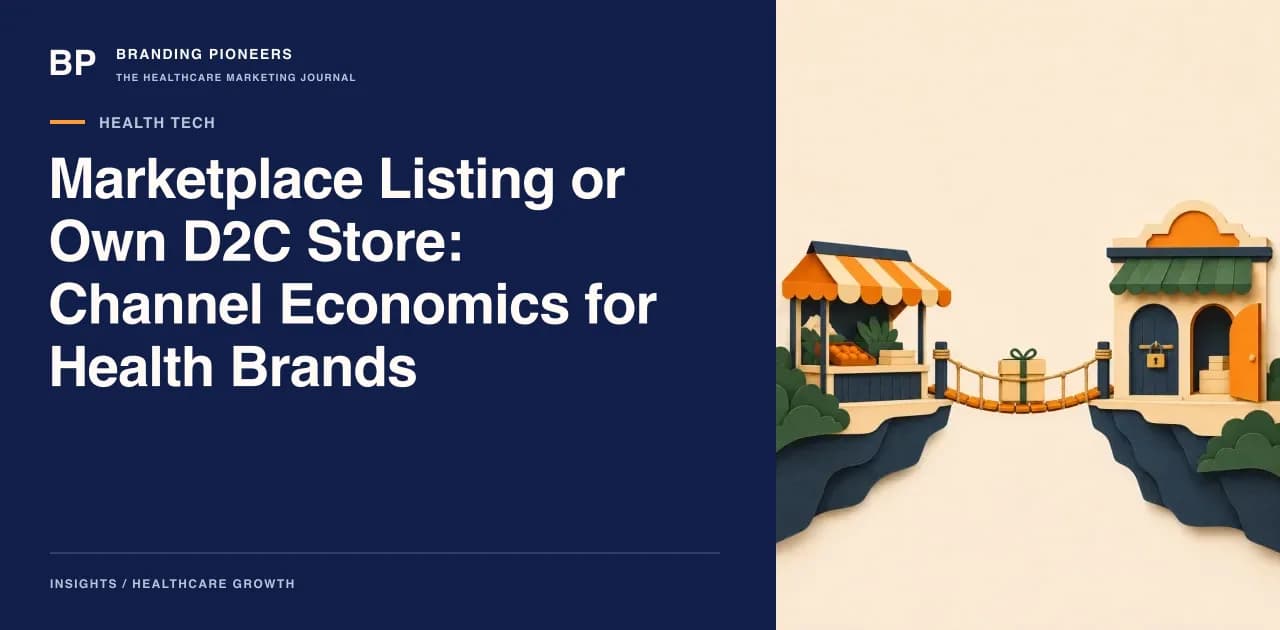
Marketplace Listing or Own D2C Store: Channel Economics for Health Brands

A comparison of marketplace and own-store selling for supplements, devices and wellness products in India, covering contribution margin, who owns the customer data and where compliance risk sits.

Marketplace Listing or Own D2C Store: Channel Economics for Health Brands

Founders of health brands usually face the channel question twice: once at launch, when a marketplace listing looks like the fastest route to sales, and again a year later, when the marketplace has become most of the revenue and none of the customer relationship. Both moments reward the same discipline: compare the channels on contribution per order, on what you learn about the customer, and on the compliance exposure each one creates.

This article is for founders and growth leads of supplement, wellness, device and home-care brands in India. It compares marketplace selling with an own-store (D2C) model on three axes and offers a worksheet you can fill in with your own numbers. All figures below are invented for illustration. Marketplace fee schedules and delivery charges change, so use the platform's current rate card, not our example.

The question is not which channel, but what each is for

A marketplace is a demand source with its own search engine and its own customers. An own store is a relationship owned by you. Treating them as substitutes leads to poor decisions, because they do different work.

  • A marketplace is good at discovery for people who already want a category of product. A customer searching for a vitamin D supplement is often comparing, and the listing competes on price, reviews and delivery speed.
  • An own store is good at conversion of intent you created, such as content, doctor recommendation or a diagnostics result that points to a product, and at repeat purchase, because you control the reminder and the offer.

The right mix depends on how the customer finds you. Brands that depend on paid ads to push people to a single product page are paying to create demand that a marketplace listing may then capture at checkout.

Axis one: margin per order

Compare channels on contribution margin per order, not on gross margin. Contribution margin is what remains after every cost that varies with the order. A worksheet in rupees, using a hypothetical product with a selling price of 1,000:

LineMarketplace orderOwn-store order
Selling price after discount900900
Product cost and packaging280280
Platform commission and fixed fees1900
Payment gateway feeincluded above25
Shipping and fulfilment7085
Returns and refunds provision4040
Marketplace advertising per order1100
Paid media per order (own store)0190
Support cost per order1020
Contribution per order200260

The figures are invented, and the interesting thing is the structure. On a marketplace, most of the spending sits in fees and on-platform advertising. On your own store, it moves into paid media, gateway fees, and your own fulfilment and support. The own store may win or lose depending on your acquisition cost, which is why the second row to scrutinise is blended acquisition cost per new customer, not the headline return on ad spend.

Three adjustments make the worksheet honest:

  1. Count repeat orders separately. An own-store customer who reorders at no acquisition cost lifts the lifetime contribution. A marketplace customer who reorders may do so on the marketplace again, or move to a competitor listing.
  2. Include working capital. Marketplaces settle on their own schedule, and return windows affect cash. Your own store usually collects at order or via cash on delivery that settles later.
  3. Include returns behaviour. Health products have category-specific return patterns: expiry issues, tampering concerns, and "wrong product" returns where the customer expected a different pack size.

If a product is sold below a threshold price, delivery and fee structures can swallow the margin. Work out the minimum order value at which each channel stays contribution-positive and design bundles to reach it.

Axis two: who owns the customer and the data

On a marketplace, the platform owns the checkout, the customer record and generally the right to contact the buyer. You see reviews and some aggregated reports, but not a customer file you can freely use for lifecycle marketing. That limits what you can do with first-party data: you cannot build refill reminders, segment by purchase history, or run a loyalty programme from the marketplace's customer base.

On your own store, you collect the customer's details directly and you are responsible for them. India's Digital Personal Data Protection Act, 2023 makes that responsibility concrete: you will need a clear notice, consent for the purposes you state and a way to honour requests and withdrawals. If your products relate to a health condition, purchase data can reveal health information, so design the data collected on the principle of necessity. The marketing implications are covered in DPDP Act for healthcare marketing.

The value of owning the customer shows up in four places:

  • Retention marketing: refill reminders, replenishment offers and cross-sell to adjacent products
  • Paid media efficiency: first-party event data for conversion measurement and audience modelling, subject to platform health-data restrictions
  • Product learning: direct questions and feedback, not only a star rating
  • Pricing control: you set the price and the offer, not a competing seller of your own brand

Beware one trap. Lower marketplace prices, set by the platform or by unauthorised resellers, can undercut your own store. Decide on a price policy and a distribution policy before you list, and monitor the listing regularly.

Want this applied to your practice? Get a free health tech audit.

Book my free audit

Axis three: compliance exposure

Where a product is sold does not change what the product is, and the regulator's rules still apply to it. What changes is who sees your claims, who can take them down and how much control you have.

Claims are public on both channels. A marketplace listing is advertising. Title, bullet points, A+ content and images are reviewed by the platform, and by regulators and competitors, in the same way as a landing page. A claims ledger, with each claim tied to its basis and approver, applies to listings as well as pages. Review the listing against your label every time you edit it.

Marketplaces enforce their own category rules. Many require licences or approvals to list food and supplements, devices or medicines, and they can suspend a listing quickly. Google's Healthcare and medicines policy shows the same pattern for ads: online pharmacies in India need third-party verification and Google certification, and prescription drugs cannot be promoted in ads or landing pages. A brand that sells a regulated item should expect a similar gate on any channel.

Consumer-law duties follow you. The Central Consumer Protection Authority's guidelines cover misleading advertisements and dark patterns. On your own store you control the checkout, so you carry the dark-pattern risk directly. On a marketplace, the platform controls the checkout, but your listing's claims are still yours.

Review manipulation. Incentivised or fake reviews are a risk on both. Keep your own review collection clean, and see how to respond to fake reviews for the reputation side.

Platform dependency risk. A single listing suspension can remove most of your revenue overnight. That is an operational risk rather than a legal one, but it belongs in the same table.

A scoring grid

Fill this in per product, not per company, because a commodity vitamin and a differentiated condition-specific programme need different answers.

QuestionPoints toward marketplacePoints toward own store
Do customers search the product category by name?YesNo, intent is created by content or a clinician
Is the product a repeat purchase with a known cycle?NoYes
Is price comparison the main buying driver?YesNo
Do you need data to personalise or follow up?NoYes
Is the product regulated or claim-sensitive?Needs careful listing controlNeeds careful page control
Do you have a content or doctor-referral engine?NoYes
Can you fulfil and support orders well?Not yetYes

Count the rows. A product that scores mostly on the left is a candidate for marketplace-first, with an own store as a brand home. A product that scores mostly on the right needs the own store as the primary channel, with marketplaces used to protect the brand name from resellers.

A sequence that works for many brands

  1. Launch with a controlled marketplace presence for the products where discovery matters, with listing content approved against your claims ledger.
  2. Build the own store for the products that need explanation or repeat purchase, and send every offline and content source there.
  3. Put a flyer or insert in marketplace parcels that invites customers to your own channel for refill reminders, if the platform's rules allow and with consent captured properly. Check the platform terms first; some restrict this practice.
  4. Track channel contribution quarterly using the worksheet above, and move spend toward the channel with the better marginal contribution, not the better headline revenue.
  5. Reassess when a channel exceeds a share of revenue you are not comfortable losing. The right share is a judgement about your cash and risk.

Where to start this week

  • Fill in the contribution worksheet for your top three products on both channels, using actual fees from your seller account.
  • List which marketplace listings carry claims that are not on your label.
  • Check what customer data you actually hold, and whether your own store has a compliant notice and consent flow.
  • Decide a minimum price policy for authorised sellers.

Our health tech startup marketing page and the guide for healthcare startups describe how we help with channel planning. For the wider tech stack that supports it, see the healthcare marketing tech stack article.

Filed underhealth brand marketplace vs d2cmarketplace vs own website health productsD2C health brand Indiasupplement marketplace listing economicsown store vs marketplace contribution margin

About the author

Founder & CEO · Gurugram, India

Nishu founded Branding Pioneers in 2016 with one rule that hasn't changed since: healthcare only. She'd run digital strategy at a top-10 Indian agency and watched generalist marketing underserve medical clients who needed something built for how patients actually search and decide. So she left to build the specialist instead. It's now an 80-person team working with healthcare brands worldwide.

Free guide · 15 pages

The Patient Acquisition Blueprint

A 90-day plan from first search to booked appointment.

The Pioneers Brief — one essay, three benchmarks, one teardown, every Thursday. Subscribe free →

Free health tech audit

Your next chapter starts with a conversation.

Three quick questions. We come prepared with a plan for your specialty and city.

  • A 30-minute call with a healthcare specialist
  • Your top three growth opportunities, in writing
  • Honest advice — even if that means not hiring us
  • No obligation and no hard sell
You’ll speak with a senior strategist
Consultations are hosted by Arush Thapar’s team.
Step 1 of 3Takes 30 seconds

What do you want to improve first?

Details stay privateNo obligationReply within 1 working day

Client portfolio · Healthcare websites

Work relevant to marketplace listing or own d2c store channel economics for.

Explore client work →