Most telehealth apps measure acquisition in installs, and most telehealth founders know the number misleads them. An install does not mean a registered user, a registered user is not a booked consult, and a booked consult is not a completed one. The expensive part of the funnel is the doctor's time, so the question that matters is how many patients you acquired who actually completed a consultation, and what each of them cost.
This article is for growth leads and founders of consultation, second-opinion and condition-management apps in India. It sets out a framework that matches channels to patient intent, explains how condition type changes the mix, and lists the measures to track after the install. The market context is favourable: the Government of India's eSanjeevani service has reported more than 50 crore teleconsultations, about 2.5 to 3 lakh a day, with women accounting for over 57 per cent of use. That is a public-sector service, and your numbers will differ, but it shows that remote consultation is no longer a novelty for Indian patients.
For the basics of promoting virtual care, see telemedicine marketing: how to promote virtual care services. This article assumes you have those in place and need to decide where the next rupee goes.
Start with intent, not channel
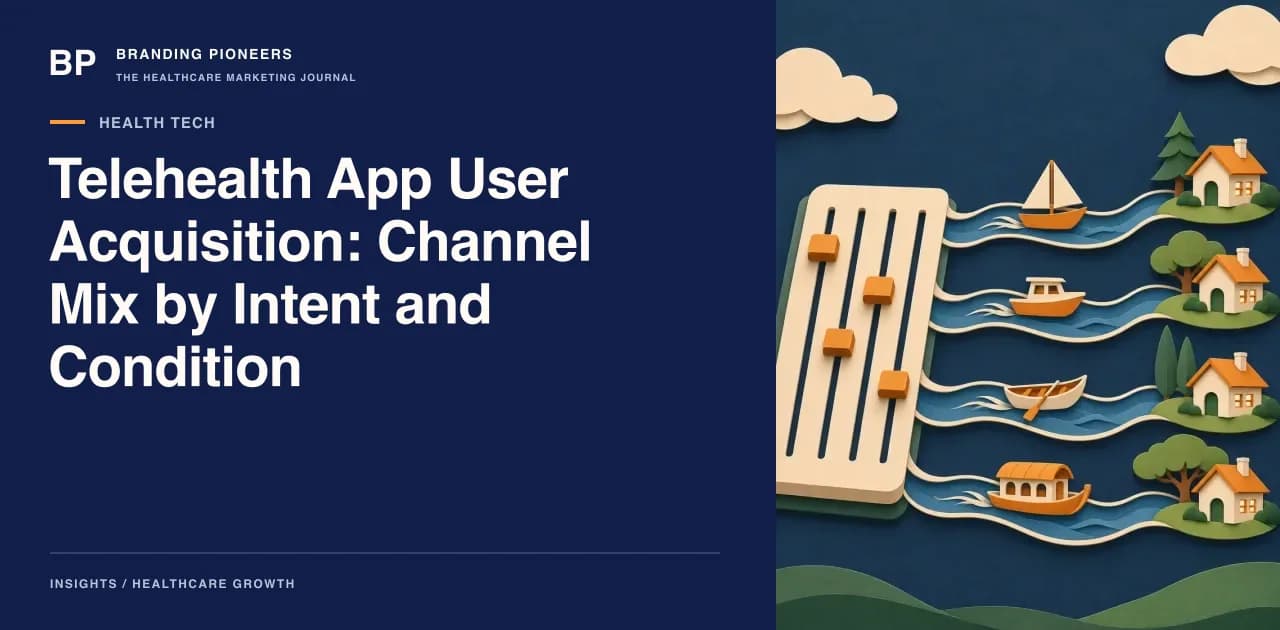
Patients arrive with different levels of readiness. A channel is only good or bad relative to the intent it reaches. Sort the demand into three levels.
Level one: the patient is ready to consult now. They have a symptom or a need and they are searching for a doctor or a service. Examples are "online doctor consultation for skin rash" or "talk to a gynaecologist online". These searches convert quickly, cost more per click and have limited volume.
Level two: the patient is researching. They want to understand a symptom, a test result or a treatment. They read, watch videos and compare options. The route to a consult is longer, but this level has the largest volume and the lowest cost per contact.
Level three: the patient does not know they need you. This is the audience for a screening camp, a chronic-condition programme or a corporate wellness offering. Reach is wide, but intent is created by the brand and the trust of the referrer.
Map each live channel to a level, and be honest about the mismatch. A level-three channel judged on same-day consult bookings will always look poor, and a level-one channel judged on awareness will look expensive.
Channels by level
Level one: capture
- Search ads. Intent searches for a doctor or consultation by specialty are the most direct route. Platform policy shapes the copy: Google's Healthcare and medicines policy restricts online pharmacy and prescription promotion, and its personalised advertising policy treats health as a sensitive interest category, which closes advertiser-curated audiences such as remarketing lists. Plan search around keywords and landing pages, not audience lists. The Google Ads for healthcare guide covers account structure.
- App store search. Patients who search inside the store are close to installing. Listing quality and policy disclosures matter here.
- Click-to-WhatsApp ads and WhatsApp entry points. Many Indian patients prefer starting a conversation to downloading an app. See click-to-WhatsApp ads for clinics for the mechanics, and keep consent rules in view.
- Branded search and direct. Protect your own name; competitors bid on it.
Level two: educate
- Search content. Condition and symptom pages that a doctor has reviewed, with a clear route to a consult. This compounds slowly and then becomes your cheapest source. The patient education content strategy article explains how to structure it.
- YouTube and short video. Doctor-led explainers reach people who prefer to watch. Show the consult flow in the video, not only the medical topic.
- Community and creator partnerships. Useful where the condition has an active community, but vet claims; the compliance work in healthcare influencer marketing applies.
Level three: create
- Corporate and insurer partnerships. A benefits programme delivers users who have a reason to consult and sometimes a reason to return.
- Pharmacy, diagnostics and clinic referral. A lab report that links to a follow-up consult is one of the strongest conversion paths in healthcare, since the patient already holds a result they want to discuss.
- Meta ads for awareness. Meta's personal attributes rule bars ads that assert or imply knowledge of a viewer's health, so copy must describe the service, not the person. See Meta's health and wellness ad restrictions for what you can still track.
Condition type changes the mix
Different conditions have different buying behaviour. A rough guide to test, not a rule:
| Condition type | Typical behaviour | Mix tilts toward |
|---|---|---|
| Acute, minor (cold, fever, skin rash) | Fast decision, price and speed matter | Search, app store, WhatsApp |
| Sensitive or stigmatised (sexual health, mental health, fertility) | Prefers privacy and anonymity | Search content, discreet landing pages, careful creative |
| Chronic (diabetes, hypertension, thyroid) | Long relationship, repeat consults | Referral, lab linkage, content, employer programmes |
| Second opinion or specialist | High trust threshold, high value | Doctor-led content, referral, YouTube |
| Women's health and paediatrics | Often family-influenced decisions | Search, community, WhatsApp |
| Post-discharge follow-up | Warm patients of a hospital | Hospital partnerships, WhatsApp |
Two things follow. A multi-specialty app should not run one blended campaign. And sensitive categories need copy that passes both platform review and the patient's own sense of dignity, with clinical content reviewed by the provider's team.
Measure beyond installs
Install-based reporting rewards cheap, low-quality traffic. Replace it with a funnel where every stage has a definition, a cost and an owner.
| Stage | Definition | What it tells you |
|---|---|---|
| Install | App opened first time | Channel reach |
| Registered | Account created with verified phone | Onboarding friction |
| Consult started | Doctor and slot chosen | Intent quality |
| Consult paid | Payment completed | Price fit |
| Consult completed | Patient and doctor both attended | The real unit of value |
| Second consult in 30 days | Returned for any reason | Retention |
| Follow-up completed | Patient completed a prescribed step, e.g. test booked | Care continuity |
Calculate cost per completed consult by channel. It is the total channel spend divided by completed consults attributed to that channel. A channel with cheap installs and a poor registration rate can rank last on this measure.
Add three supply-side measures, because acquisition is constrained by doctors:
- Doctor utilisation: booked slots divided by published slots, by specialty and time of day
- Time to first available slot: if it is too long, high-intent patients leave
- Cancellation by doctor: a hidden cause of poor conversion
If demand exceeds supply in a specialty, stop buying traffic for it. If supply exceeds demand, shift budget to that specialty at the right times.