The thing that broke on Meta for healthcare advertisers was not targeting. Targeting broke years earlier, quietly, and most clinics adapted without noticing.
What broke more recently is measurement — specifically, the ability to send Meta the event that says a patient booked something, and to have the platform use it. A clinic that was optimising towards a booking conversion woke up to an Events Manager showing that event as restricted, a delivery system falling back to whatever signal was still allowed, and a monthly report that no longer reconciled with the CRM.
Nobody was penalised. Nothing was appealed. It was a category assignment, and it is worth understanding exactly how it works before you spend another month arguing with the numbers.
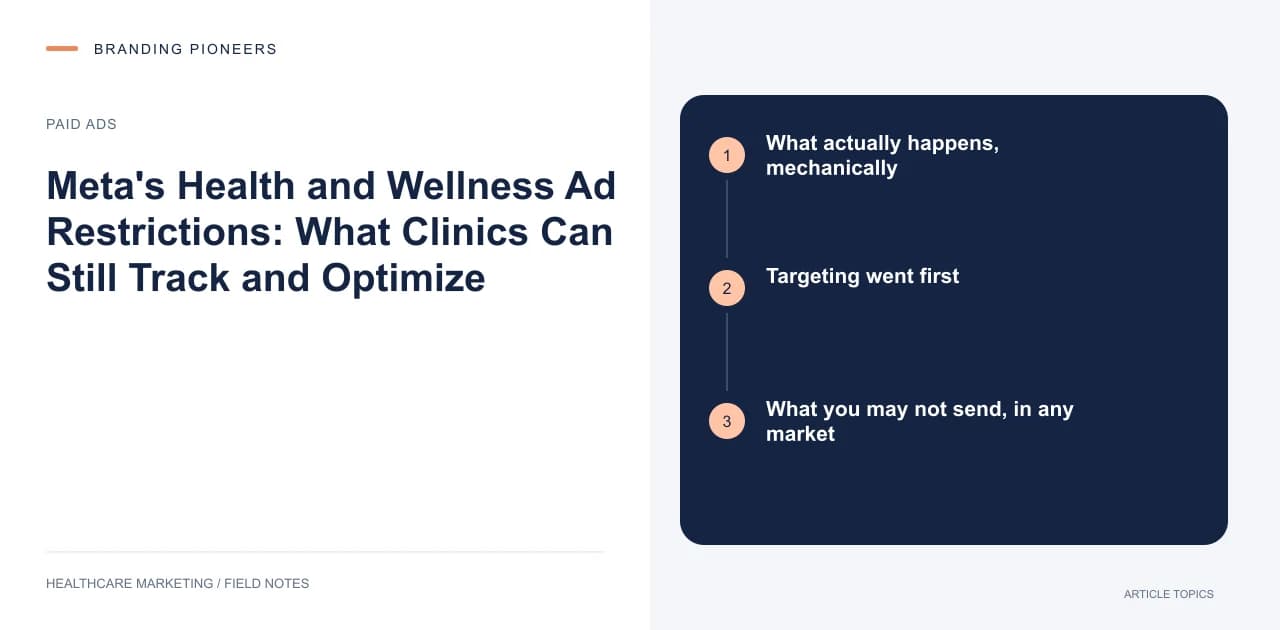
What actually happens, mechanically
Meta classifies data sources — your pixel, your Conversions API integration — into categories, and applies restrictions at the data source level rather than at the ad account level.
There are three tiers to know about. A core setup restriction limits what can be shared alongside an event: URL parameters and custom parameters get stripped, because a URL can carry a condition name in it. A restriction on certain standard events blocks the mid and lower funnel — events of the Lead or Purchase type — while leaving upper-funnel events working. A full restriction blocks all events from that data source, either in named regions or globally.
Two consequences follow. A restricted event cannot be used to optimise delivery, and it cannot be reported on. The campaign does not stop; it stops learning from the thing you cared about.
Meta's own documentation on health and wellness data sharing restrictions and on sensitive health information sets this out, and it is worth reading the current version rather than a summary, because the scope is described as capable of being country-specific or global and Meta does not publish a fixed country list.
One correction that saves a lot of confused conversation: health and wellness is not one of Meta's Special Ad Categories. Those are credit, employment, housing, and social issues, elections and politics, and they carry their own targeting limits. Health sits under this separate data source categorisation, which is why the symptoms are different — your audience options look normal and your events do not.
Targeting went first
Meta removed detailed targeting options tied to health causes and conditions starting in January 2022, with delivery on existing audiences ending that March. They have not come back.
So if a proposal in front of you promises to target "people interested in diabetes management" or "IVF intent audiences" on Meta, it is describing something that has not existed for years.
What remains: geography, age, gender, language, broad interest categories unrelated to health, engagement-based custom audiences from your own Meta assets, and value-based or lookalike modelling built on lists you are lawfully allowed to upload.
That last one needs care, and the rule is different depending on where you operate.
What you may not send, in any market
Neither Google nor Meta signs a business associate agreement. That is not a negotiating position, it is a published one, and it settles a whole category of question.
For a US covered entity, it means no protected health information may reach either platform — not in a customer list, not in an event parameter, not in a URL. The practical failures are almost never deliberate: a booking confirmation page with the procedure in the URL, a form field named after a condition, a third-party chat widget firing its own pixel, an appointment ID that maps to a patient in a system Meta can see.
For an Indian clinic, HIPAA is irrelevant and quoting it signals that nobody checked. What applies is the Digital Personal Data Protection Act, 2023 and the Digital Personal Data Protection Rules, 2025, with the Data Protection Board of India as regulator. Consent has to be specific to the purpose, and "we treated them, so we can market to them" is not a purpose they consented to.
And whatever your jurisdiction: "restricted category bidding" is not a Meta product. If a vendor offers it, they are selling you a phrase.
Audit your own pixel before you change anything
Most clinics have never opened this screen.
Go to Events Manager and look at each data source. Note which events show as restricted and at which tier. Then look at what your events are actually carrying: event parameters, custom parameters, and the page URLs they fire on.
Three checks find most problems. Does any URL on your site contain a condition, procedure or drug name in a way a pixel would transmit? Do any form field names or event parameters do the same? And is there a second pixel on the site — installed by a booking widget, a chat tool, a review platform or an old agency — that you do not control?
Fix the URLs first. A booking path that reads /appointment/confirmed instead of /appointment/ivf-consult-confirmed solves a surprising share of this at the source, and it is a two-hour job.
Move the conversion definition, then move the source of truth
Once you accept that the platform may not be able to use your booking event, the strategy becomes obvious: optimise on something the platform can still see, and judge on something you hold.
Optimise upstream. A view of a service page, a click to WhatsApp, a call initiation, a form start — an event that is allowed to carry signal and correlates with the outcome you want. Delivery needs volume and consistency more than it needs the perfect event.
Judge downstream, in your CRM. The number that goes to the board is cost per attended patient, calculated from your own records with the enquiry source attached, not a number copied from Ads Manager.
Then close the loop with what you are allowed to send back. Conversions API with hashed identifiers is the standard route, with the same limits as everything else — nothing patient-identifying for a US covered entity, purpose-specific consent under the DPDP framework in India. The measurement work behind this is the same problem set we cover in measuring healthcare marketing.
Expect under-reporting and say so in advance. Platform-attributed conversions in a restricted health account will undercount. A finance director who hears that in month one treats it as a known limitation; one who discovers it in month six treats it as a failure.
What this does to lead quality, and what to do about it
There is a second-order effect that catches people out. When the optimisation event moves upstream, the delivery system starts finding people who complete upstream actions — and upstream actions are cheaper to complete than booking an appointment.
So the leads get cheaper and softer at the same time. If nobody warns the front desk, they will conclude the campaign has gone wrong.
Two things keep it honest. Qualify harder at the form or in the first message, with one or two questions that a casual browser will not bother answering. And feed quality back into the account manually: if the CRM says a particular asset, audience or placement is producing enquiries that never book, cut it, because the platform can no longer work that out on its own. It is a return to judgement-based optimisation, which is uncomfortable for teams who got used to the machine doing it.
Where the volume moved
With lower-funnel events restricted, the channels that carry their own conversation have become more useful, not less.
Click-to-WhatsApp in India and the Gulf, and Messenger or Instagram DM elsewhere, keep the conversion inside a thread you can read, staff and measure. Lead forms keep it on-platform with fields you control, and you can keep condition names out of them.
Broad targeting with strong creative has also become the sane default. When the machine cannot be told who to find, the creative becomes the filter — a video that only speaks to people considering a knee replacement will be watched by people considering a knee replacement, and it will not tell Meta anything about them.
Creative has its own policy layer. Meta's personal attributes rules prohibit implying that you know something about a person's health, which rules out the second-person "struggling with hair loss?" opening that most clinics default to. Say it in the first person or the third, describe the service rather than the reader, and you keep the same message without the rejection.
What to do first
- Open Events Manager and write down the restriction tier on every data source.
- Strip condition and procedure names out of URLs, form fields and event parameters.
- Find and remove the pixels you did not install.
- Move the optimisation event upstream to something allowed and high-volume.
- Rebuild the report so cost per attended patient comes from the CRM, and tell the board why.
- Shift budget towards conversation-based formats where the thread is the conversion.
The account-side execution is the part that takes longest, and it is most of what our performance advertising work involves in the first six weeks of a healthcare account. If you are US-based, do the data review against HIPAA marketing compliance before you touch the campaigns.
---
If you want someone to open your Events Manager, read your pixel payloads and tell you what is being restricted and why, get a free audit and we will send the findings whether or not you work with us. Or book a strategy call to talk through the measurement rebuild.
Filed undermeta health and wellness restrictionsmeta's new restrictions on health and wellness adsmeta ads healthcare policymeta ads for healthcarefacebook ads for clinics

About the author
Nishu Sharma
Founder & CEO · Gurugram, India
Nishu founded Branding Pioneers in 2016 with one rule that hasn't changed since: healthcare only. She'd run digital strategy at a top-10 Indian agency and watched generalist marketing underserve medical clients who needed something built for how patients actually search and decide. So she left to build the specialist instead. It's now an 80-person team working with healthcare brands worldwide.
Free guide · 17 pages
The Patient Acquisition Blueprint
A 90-day plan from first search to booked appointment.