NewNMC’s advertising guidelines for doctors are in force from 6 Oct 2026. See what to change, and get a free compliance auditNew NMC advertising rules for doctors: what to change
Compliance

HIPAA Marketing Compliance

What HIPAA requires of healthcare marketers. BAAs, tracking restrictions, ad targeting limits.

5–8 min read4 sectionsHealthcare-only since 2016

Branding Pioneers mascot and name applied to stationery in a photorealistic brand application concept
Branding Pioneers · Identity studyBrand application concept · AI-generated mockup
Hospital walkathon event branding
Event — Walkathon — event branding

What HIPAA covers in marketing

HIPAA's Privacy Rule and Security Rule apply to any vendor (Business Associate) that creates, receives, maintains, or transmits PHI on behalf of a covered entity. For marketing teams, this hits:

  • Email service providers
  • CRMs
  • Analytics platforms
  • Ad platforms (limited)
  • Form vendors
  • Telehealth platforms

What we maintain

  • A BAA with every vendor in the stack that touches PHI. Google and Meta do not sign BAAs, so no PHI reaches them — which is a constraint on what can be tracked, not a box we tick
  • HIPAA-aware tracking — PHI segregated from analytics
  • Annual HIPAA training for all senior staff
  • Audit trails for every PHI access event

What you should ask any healthcare marketing partner

  1. Do you sign a BAA?
  2. How do you segregate PHI from analytics?
  3. What's your training programme for staff handling PHI?
  4. Do you have an audit log? Can I access it?
  5. What's your incident response plan?

Common HIPAA marketing mistakes

  • Retargeting based on health-condition signals
  • Sending appointment reminders via vendors without BAA
  • Using analytics platforms without proper PHI exclusion
  • Webhook integrations passing PHI to non-BAA tools
From the studio

This, applied to real practices.

Hospital event invitation design
Print
Event invitation suite
Google Ads campaign management console
Google Ads
Google Ads — campaign management
Clinic clients across specialties
Clients
Clinics across specialties
Hospital walkathon event branding
Event
Walkathon — event branding
Healthcare marketing performance analytics dashboards
Analytics
Reporting built for clinical teams
Branding Pioneers co-founders Arush Thapar and Nishu Sharma
Founders
Arush Thapar and Nishu Sharma
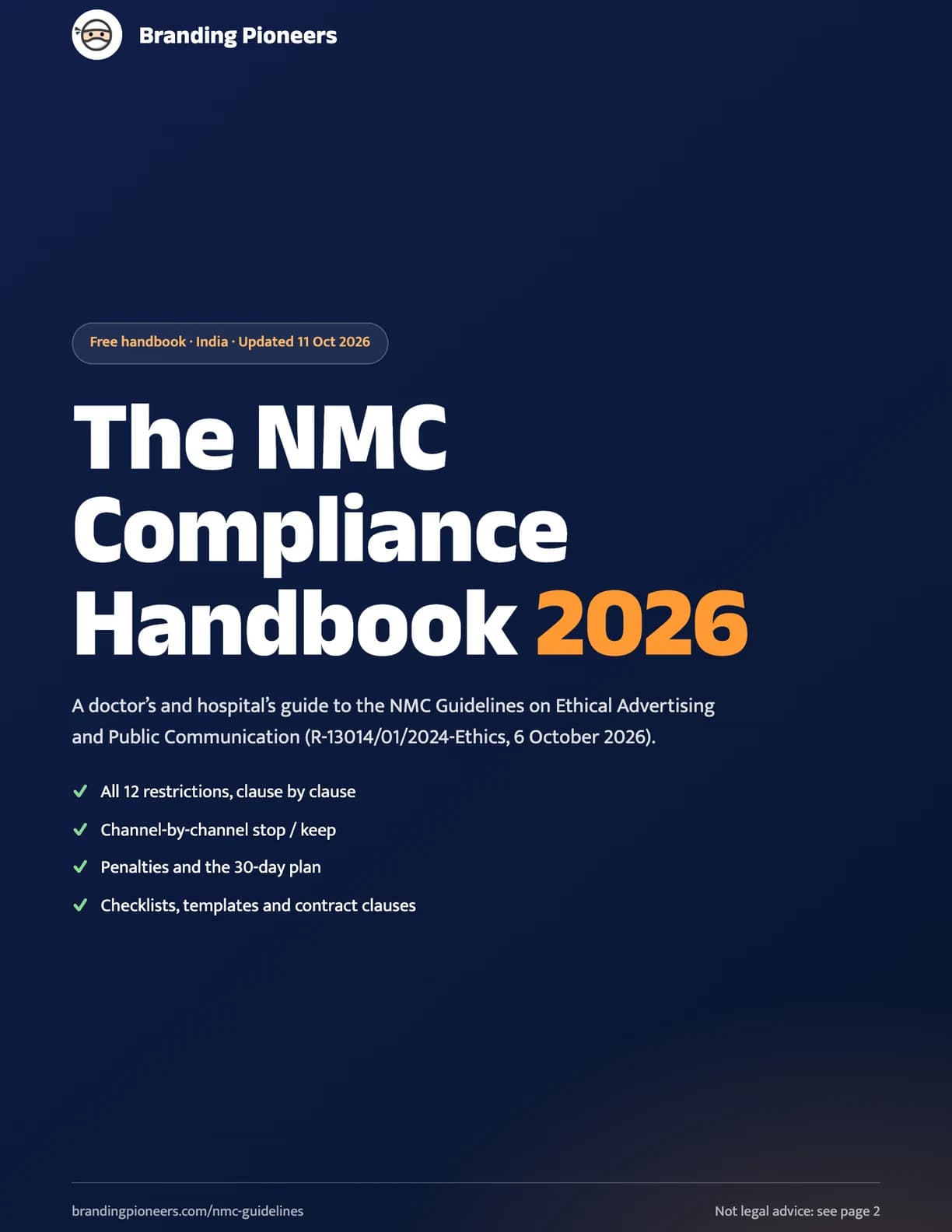
The NMC Compliance Handbook 2026 — guide cover

Free executive download

The NMC Compliance Handbook 2026

Every clause of NMC's 6 Oct 2026 advertising guidelines, with checklists and templates.

  • All 12 restrictions in para 8.1, clause by clause
  • The disclosure line every post needs, with templates
  • Channel-by-channel stop / keep guide
  • Penalty ladder and what happens after a complaint

20 pages · In force since 6 Oct 2026: penalties go up to removal from the register

We never share your details

Free · 30 min · no commitment

Want it for your practice?

Free 30-min audit. We map your situation against this guide and ship a 90-day plan.

✓ 30-minute call✓ Written plan✓ No obligation

Why choose us

Why healthcare brands choose us.

Six reasons hospitals, clinics, and doctors pick a healthcare-only firm over a generalist agency.

  • Healthcare-only

    It's all we do. No retail, no fintech — the whole team thinks in patient journeys, clinical trust, and the way people actually choose a doctor.

  • AI-first systems

    Receptionists, WhatsApp triage, and attribution built in-house — we answer patients in seconds and tie every click to a booked appointment.

  • Compliance built-in

    HIPAA-aware handling, ASCI-reviewed creative, and GDPR/DPDP sign-off on every campaign — our standard, not an upcharge or an afterthought.

  • Senior on every account

    The senior who pitched you stays on the engagement. No bait-and-switch to juniors learning on your budget.

  • Measured to the appointment

    Patient-level attribution across calls, forms, and walk-ins. Monthly reports show booked patients — not just clicks and impressions.

  • Receipts, not promises

    We name our clients and show the work. Quarterly reviews with the numbers attached, every cycle.

The Branding Pioneers healthcare-marketing team at work

Healthcare-only · since 2016

A team that does one thing well.

Keep going

Adjacent services, problems we’re asked about most often, and the case files that show how we work.

Practical notes & supporting evidence

More detail for your next decision.

A practical reference for this page
  1. Start hereHIPAA Marketing Compliance

  2. Establish contextUse the published scope and relevant source material

  3. Choose the next stepFollow the linked resource and assign an owner

Putting HIPAA Marketing Compliance into practice

Use the HIPAA resource to map the information involved in a marketing workflow and the organisations that receive it. A marketing contact form, a scheduling process and a clinical system are not interchangeable. Record the data path and ask the appropriate privacy and legal owners to review the actual configuration rather than relying on a generic badge.

Choose the resource that matches your next decision

Begin with the question you need to answer, then choose the most appropriate destination in this collection. A guide explains a method, a checklist supports a repeatable review, a calculator explores assumptions and a case file documents a particular engagement. Reading them as interchangeable resources can create confusion. If you need to brief a supplier, start with the relevant service or framework. If you need to assess evidence, start with the source reports and the limits stated alongside the example.

Use the collection to narrow the investigation rather than adding every possible task to a marketing plan. Identify the stage where progress is blocked: discovery, understanding the service, making contact, arranging an appointment or following up. Choose a resource that addresses that stage and keep a short note of the evidence you need. A focused review is easier to act on than a long list of unrelated recommendations, particularly when clinical approvals and operational changes involve different people.