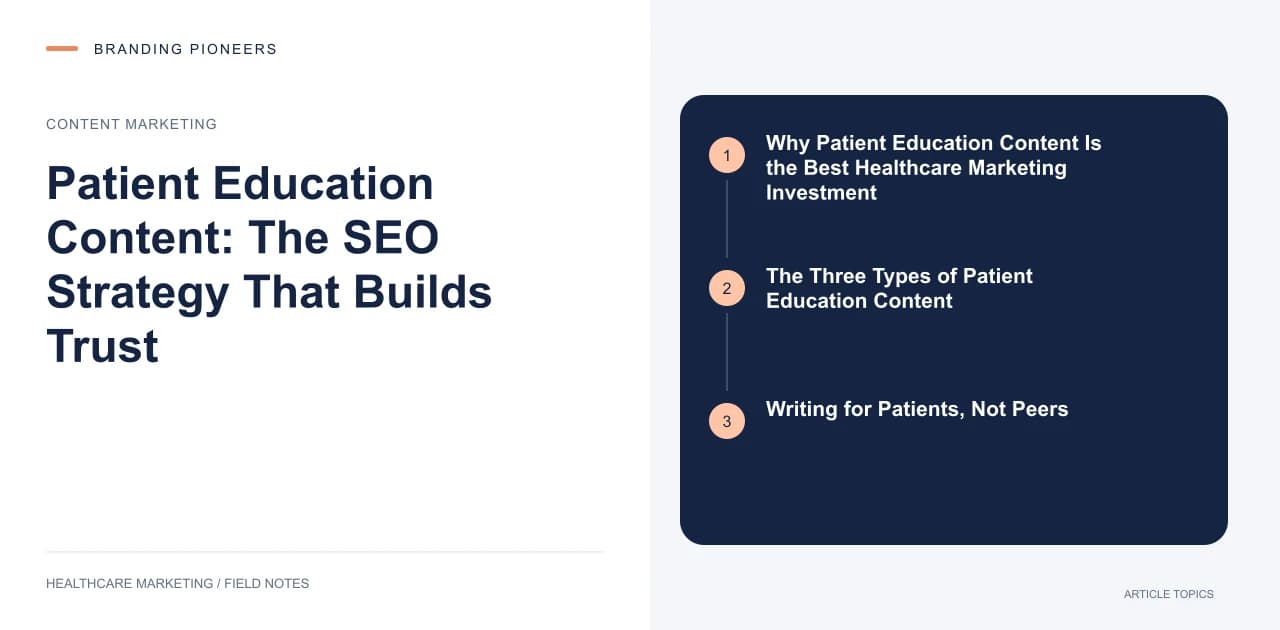
Why Patient Education Content Is the Best Healthcare Marketing Investment
Every month, millions of patients search Google for information about their symptoms, conditions, and treatment options. These searches represent patients in the early stages of their healthcare decision journey — they are not yet looking for a specific doctor, but they are forming opinions about which providers are trustworthy and knowledgeable.
Patient education content captures these patients at the moment of highest receptivity. When someone reads a comprehensive, well-written article about knee replacement on your hospital's website, two things happen: they get the information they need, and they begin associating your hospital with expertise in knee replacement. When they are ready to book a consultation, you are already their first choice.
The numbers support this approach. Healthcare organizations that publish regular patient education content see 3 to 4 times more organic traffic than those that do not. More importantly, visitors who engage with educational content before booking convert at 2 times the rate of direct visitors — because they arrive with pre-built trust.
The Three Types of Patient Education Content
Not all patient education content serves the same purpose. Organize your content strategy around three categories:
Condition content: Explains what a condition is, its symptoms, causes, risk factors, and when to see a doctor. Targets searches like "what causes atrial fibrillation," "symptoms of rotator cuff tear," and "when to see a dermatologist for a mole." This content casts the widest net and captures patients at the earliest stage.
Treatment content: Explains what a specific treatment involves, what to expect, recovery timeline, risks, and alternatives. Targets searches like "knee replacement surgery procedure," "laser skin resurfacing recovery," and "IVF success rates by age." This content captures patients who have been diagnosed and are evaluating treatment options.
Decision-support content: Helps patients choose between options. "Hip replacement vs. hip resurfacing: which is right for you," "Invisalign vs. traditional braces: cost, timeline, and results compared," and "Questions to ask your surgeon before knee replacement." This content captures patients closest to making a decision — and closest to booking.
Build content in all three categories for each major service line. A complete content ecosystem for orthopedics might include 5 condition pages, 3 treatment pages, and 2 decision-support articles — 10 pieces of content that cover the full patient journey.
Writing for Patients, Not Peers
The most common mistake in patient education content is writing at a clinical level. Your audience has no medical training. They are anxious, confused, and looking for clarity — not terminology.
Write at a sixth-to-eighth grade reading level. Use short sentences. Define medical terms when you must use them. Replace "the patient may experience post-operative edema" with "swelling after surgery is normal and usually goes down within 2 to 3 weeks."
Use the inverted pyramid structure: put the most important information first. If a patient wants to know "how long does knee replacement recovery take," the answer should be in the first paragraph — not buried after 500 words of anatomy explanation.
Include visual aids: diagrams, illustrations, and infographics improve comprehension by 65 percent compared to text alone. A simple illustration of what happens during a procedure can do more to reduce patient anxiety than a thousand words of description.
SEO Optimization for Patient Education Content
Patient education content is among the most competitive content categories in healthcare SEO. To rank, you need to go beyond basic on-page optimization:
Depth over breadth. A 2,000-word comprehensive guide on a specific condition will outrank a 500-word overview every time. Cover the topic completely — symptoms, causes, diagnosis, treatment options, recovery, prevention, and FAQs.
Author attribution. Every patient education article must have a named physician author with credentials. Link to the author's profile page, which should have Physician schema markup. This is a non-negotiable E-E-A-T requirement for medical content.
Medical review date. Display the date the content was medically reviewed and update it at least annually. Google prioritizes fresh medical content, and patients trust dated content more than undated content.
Internal linking. Link between related condition and treatment pages. A page about ACL tears should link to your ACL reconstruction page, your orthopedic surgeon profiles, and your sports medicine department page. This creates topical clusters that signal depth of expertise.
FAQ schema. Add an FAQ section at the bottom of every patient education page with 5 to 8 questions that mirror common patient searches. Mark up with FAQPage schema to earn rich snippet placement.
Measuring Content Marketing ROI
Track three categories of metrics for patient education content:
Traffic metrics: Organic sessions, keyword rankings, and search impressions for target queries. These show whether your content is reaching patients.
Engagement metrics: Time on page, scroll depth, and pages per session. These show whether patients find your content useful. Average time on page above 3 minutes indicates genuine engagement.
Conversion metrics: The most important measure. Track how many readers click through to appointment booking, how many call your practice after reading, and how many cite your content when they arrive for their appointment. Use GA4's conversion paths to see whether content touches appear in the patient journey before appointment booking.
Patient education content has a longer ROI curve than paid advertising — 3 to 6 months before pages gain significant ranking traction. But the returns compound: a page that ranks well will generate traffic and appointments for years at zero marginal cost. After 12 months of consistent publishing, organic content typically becomes the most cost-efficient patient acquisition channel in the marketing mix.
Filed underpatient education contenthealthcare content marketingmedical content strategyhealth content SEO

About the author
Nishu Sharma
Founder & CEO · Gurugram, India
Nishu founded Branding Pioneers in 2016 with one rule that hasn't changed since: healthcare only. She'd run digital strategy at a top-10 Indian agency and watched generalist marketing underserve medical clients who needed something built for how patients actually search and decide. So she left to build the specialist instead. It's now an 80-person team working with healthcare brands worldwide.
Free guide · 17 pages
The Patient Acquisition Blueprint
A 90-day plan from first search to booked appointment.