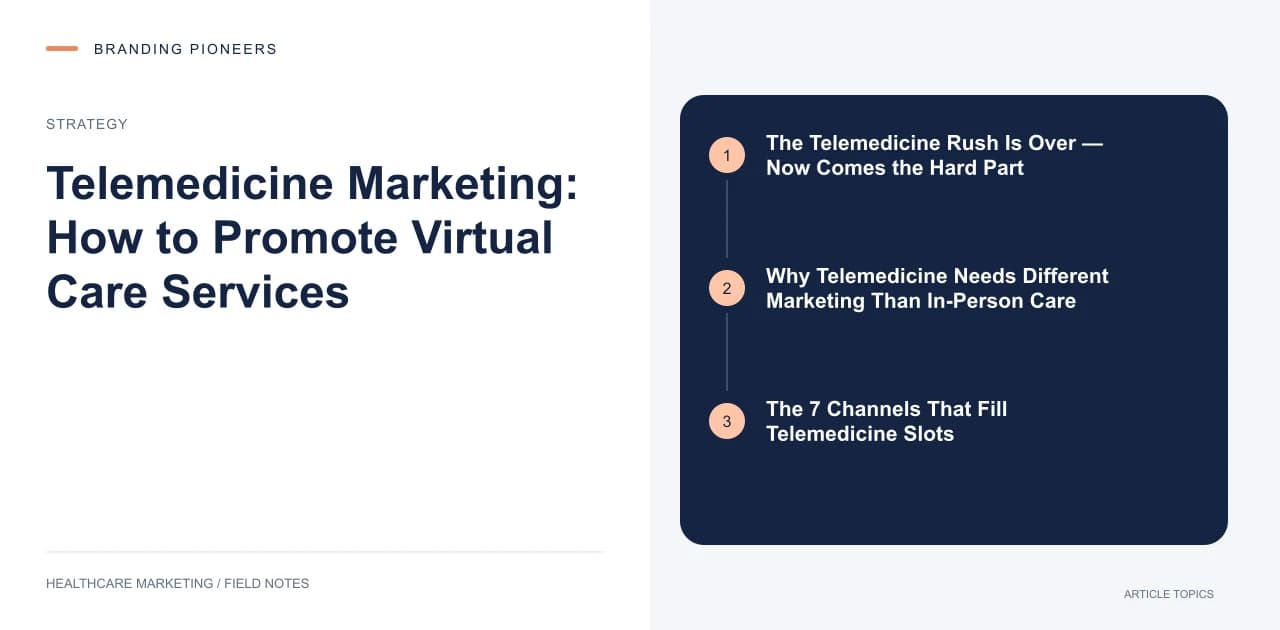
The Telemedicine Rush Is Over — Now Comes the Hard Part
In 2020, every hospital scrambled to launch telemedicine. Patients had no choice. Doctors had no choice. The technology, despite all its roughness, became the only option. Visit numbers were staggering.
By 2023, volumes dropped sharply at most facilities. Not because patients stopped wanting virtual care — a large share of Indian urban patients still prefer teleconsultation for follow-ups and minor ailments. The drop happened because most hospitals marketed telemedicine exactly once: at launch.
The hospitals that maintained strong virtual consultation volumes — Apollo 24/7, Practo's clinic partners, Narayana Health's tele-OPD — share one thing: they treat telemedicine as a permanent product line with its own marketing engine, not a pandemic workaround that never got turned off.
If your virtual consultation slots are half-empty, the problem is almost certainly not your platform. It is your marketing.
Why Telemedicine Needs Different Marketing Than In-Person Care
Physical hospital marketing sells a location. You want patients in that building, using those machines, seeing those doctors.
Telemedicine marketing sells access. The patient does not need to know where your building is. They need to know they can see your doctor from their couch, right now or tomorrow, without taking half a day off work.
That fundamental shift changes the creative, the targeting, and the messaging. Most hospitals ignore this and run the same poster-on-a-wall advertising they use for their emergency department.
The promise is different. For in-person care, the promise is quality, expertise, facilities. For telemedicine, the promise is convenience: no waiting room, no travel, no missed half-day of work, consulting fee from ₹300 to ₹800 instead of ₹1,500 in-person.
The audience is different. Your best telemedicine patients are people who would not otherwise visit you. Working professionals in Gurugram who cannot leave the office at 11am. Parents in Tier-2 cities who want a specialist opinion without driving 80 km. NRI families who want their elderly parents in India to consult a familiar name doctor. These people need different messages than the ones you send to your local walk-in patients.
The search behavior is different. Nobody searches "telemedicine hospital near me" — the phrase defeats the purpose. They search "online doctor consultation," "consult cardiologist online," "video consultation diabetes specialist," or even "can I get prescription online?" Your keyword strategy needs to match this intent exactly.
The 7 Channels That Fill Telemedicine Slots
1. Google Search — The Highest-Intent Traffic
Patients actively searching for online consultation are ready to book. They just need to find you first.
The specific keywords to build content and ads around:
- "Online [specialty] consultation India"
- "Video consultation [doctor name]"
- "Consult [specialist] from home"
- "[Condition] doctor online appointment"
Hospitals that launch a dedicated search campaign targeting these intent phrases — specifically separating telemedicine keywords from their main hospital campaigns — typically see a significant increase in teleconsultation bookings within a few months. The lesson: do not let your telemedicine offering compete with your own in-person OPD for the same keyword budget.
Build dedicated landing pages for each specialty you offer via telehealth. One page for online cardiology consultation, one for online dermatology, one for online pediatrics. Each page should answer the three questions patients always have: Who is the doctor, what does it cost (₹500 for 15 minutes, ₹900 for 30 minutes, whatever your actual pricing is), and how quickly can I book?
2. Google My Business — Local Meets Virtual
Here is a quirk most hospitals miss: even though telemedicine is location-independent, your GBP listing still drives bookings. Patients in your city search for doctors on Google Maps, see your listing, and if they notice "also available for online consultation," many prefer that option.
Add "Telehealth available" to your GBP attributes. Create a GBP post every two weeks highlighting your online consultation service. Include your booking link in the appointment URL field.
3. WhatsApp Marketing — The Re-Engagement Channel
Your existing patient database is your warmest telemedicine audience. These people already trust you. They have been to your facility. They know your doctors. They just do not know they can consult those same doctors from home.
A simple WhatsApp broadcast to past patients can be astonishingly effective:
"Hi [Name], Dr. [Doctor] is now available for online consultations from Monday to Saturday, 6pm to 8pm. Fee: ₹600 for 30 minutes. Book at [link] or reply to this message."
We have run this exact campaign for multi-specialty clinics — reaching thousands of past patients, with a strong share booking within days, at zero advertising spend. Return on that kind of campaign is about as good as marketing gets.
The key is personalization by specialty. Patients who visited cardiology get a message about online cardiology consultations, not a generic "we have telehealth" blast.
4. Social Media — Education Over Promotion
The biggest mistake in telemedicine social media: posting "Book online consultation at ₹500!" repeatedly. This performs terribly.
What performs: educating patients on when telemedicine is right for them.
"5 conditions you can manage via video consultation (and when to come in person)" — this piece of content builds trust AND educates patients that they have a telemedicine option. Hospitals running pediatric teleconsultation services see strong results from this kind of regular Instagram content, with a booking link in bio. Educational posts consistently drive far more click-through to booking pages than promotional posts do.
Post formats that work for telemedicine on Instagram and Facebook:
- "How a video consultation works: step by step" (removes fear of technology)
- "Is your condition right for a teleconsult? Here's a quick guide" (decision helper)
- Doctor introduction videos: 60 seconds, the doctor explains their teleconsult service in their own words (humanizes the virtual experience)
5. Paid Ads — When to Spend and How Much
Google Ads on telemedicine keywords convert well but face one challenge: major aggregators like Practo, Apollo 24/7, and 1mg are also bidding on these terms. Cost-per-click for "online doctor consultation" can run ₹40 to ₹120 in metros.
The winning approach: bid on your specific doctors' names and your specific specialties rather than generic terms. "Dr. Sharma cardiologist online" costs ₹8 to ₹20 per click and converts far better than generic terms.
Facebook and Instagram ads work well for telemedicine when targeted to:
- Working professionals (job title targeting: software engineer, marketing manager, corporate employee)
- Parents with children under 12 (pediatric teleconsult)
- People who have shown interest in health, fitness, or medical topics but who are NOT local to your facility (expand your radius — telemedicine has no geographic constraint)
6. Platform Partnerships — Practo, mfine, Tata 1mg
Should you list on aggregator platforms? Yes, if you approach it correctly.
Platforms give you reach. Patients who have never heard of your hospital will book a telemedicine consultation through Practo. Some become loyal in-person patients.
The trap: becoming entirely dependent on platform traffic. Platforms take 20 to 40 percent commission and can de-prioritize your listing tomorrow. Build platform traffic while simultaneously building your own direct booking channel.
Use platforms for volume. Use your own website and app for margin.
7. Email and SMS Drip Campaigns — Nurturing Intent
Patients who visit your telemedicine landing page but do not book are not lost — they are thinking about it. A retargeting sequence via email (if you have their email) or Google Display ads can bring them back.
A five-message sequence over 10 days:
- Day 1: "Here is how our online consultation works"
- Day 3: "Meet Dr. [Specialty Doctor]"
- Day 5: "Patient story: How Priya managed her thyroid from home"
- Day 7: "Your questions answered: Is teleconsult right for me?"
- Day 10: "Book this week at ₹100 off your first consultation"
A meaningful share of people who abandoned the booking page come back and book through this sequence.