The first searches after a cancer diagnosis are almost never made by the patient.
They are made by a son on a train, a daughter at her desk with the report open in another tab, a spouse who has read the same histopathology line eleven times. The patient is usually still absorbing it. Somebody else has quietly appointed themselves the researcher, and they are working fast, in a state that makes them trust whichever page sounds like it was written by a human being rather than a marketing department.
That is the audience an oncology marketing strategy is actually writing for. Get the reader wrong and everything downstream is wrong — the tone, the page structure, the channel mix, the way the enquiry is answered.
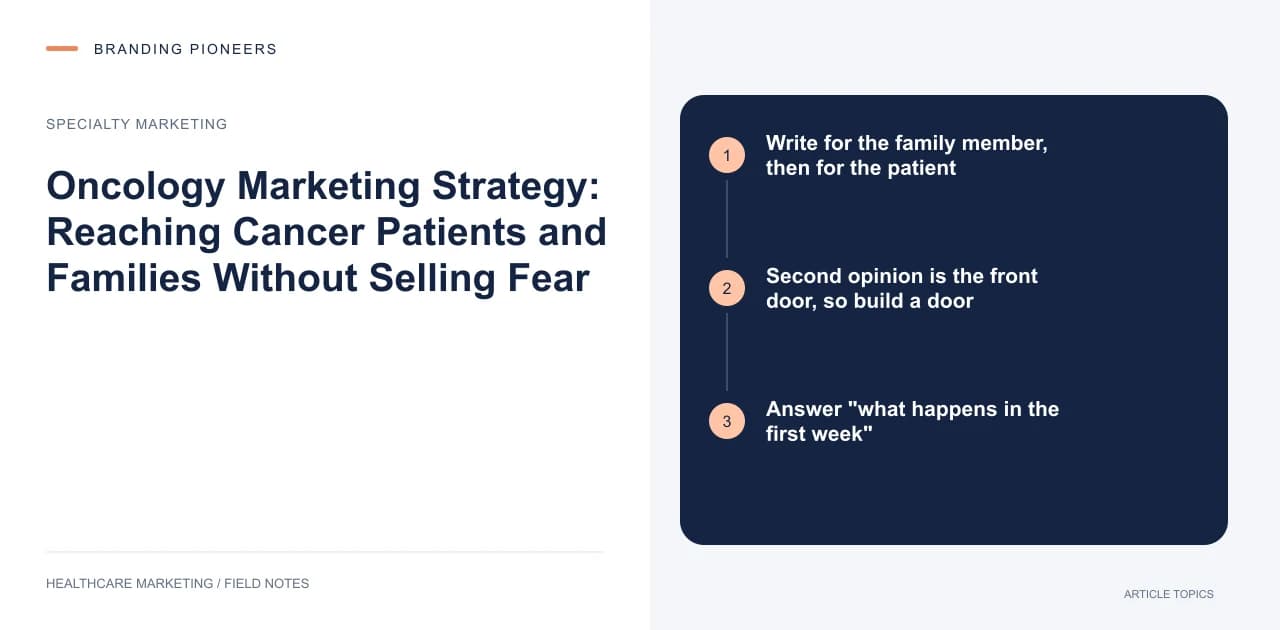
Write for the family member, then for the patient
The family researcher has a different question set. They want to know whether the diagnosis is the final word, whether this hospital treats this cancer often, who the person in charge would be, how quickly treatment could start, and what it will cost to get from where they are to where treatment happens.
The patient, when they arrive on the site a week later, wants something narrower and more personal: what the treatment will do to their body, whether they will lose their hair, whether they can keep working, who will be with them.
Both readers need serving, and they need serving separately. A single department page written in institutional language serves neither. The structure that works is a cancer-type page — breast, head and neck, colorectal, blood — that opens with the practical questions the family is asking and then goes deeper into treatment for the patient who reads it later. Our oncology marketing pages follow that split, because the two readers arrive at different moments and never in the same frame of mind.
Second opinion is the front door, so build a door
A very large share of oncology enquiries are second opinions, and most cancer centres treat that channel as an inconvenience rather than as the main entrance.
It is the main entrance. A family holding a report from another hospital is the most qualified enquiry you will ever receive. They have a diagnosis, a set of images, a timeline, and an unresolved question. What they do not have is an easy way to ask you.
So make one. A second-opinion page that says exactly which documents to send, gives a named route to send them to, states honestly how long a response takes, and does not pretend the answer will always be different from the first one. That last part matters more than it looks: a centre that says "often our opinion confirms the original plan, and that is useful too" reads as a medical service. A centre that implies the first hospital probably got it wrong reads as a sales pitch, and families can tell.
Answer "what happens in the first week"
The single piece of content that moves an oncology enquiry forward is the one almost nobody writes: a plain description of the first week.
Which tests get repeated and why. How long staging takes. When the tumour board meets and what it does. Who explains the plan, and whether the family can be in the room. What happens between the consultation and the first cycle. Where a patient from out of town stays.
None of this is promotional and all of it is decisive, because the thing families are most afraid of after diagnosis is not the treatment. It is the unexplained wait.
The line between honest and frightening
Oncology marketing fails in two directions. The first is fear — countdown language, "every day counts", imagery that treats a diagnosis as an emergency sale. The second is false comfort — cure language, survival claims with no denominator, before-and-after framing borrowed from aesthetics.
The regulations here are worth knowing precisely rather than vaguely.
In India, the Drugs and Magic Remedies (Objectionable Advertisements) Act, 1954 prohibits advertising a drug or remedy as a treatment or cure for the conditions named in its Schedule, and cancer is one of them. The National Medical Commission's ethical advertising guidelines of 6 October 2026 bar a registered practitioner from soliciting patients, advertising success rates or cure guarantees, and publishing patient success stories (paras 8.1(ii), (iii) and (v)), and hold hospitals to the same ban on unverifiable superlatives (para 8.1(ix)). The ASCI code covers misleading health claims on the advertising side. In the United States, the Federal Trade Commission has acted repeatedly against unsupported cancer treatment claims, and its authority extends to what a hospital's marketing says, not only to what a product label says.
Practically: do not publish your own survival figures unless they come from an audited registry and you are willing to explain the denominator on the same page. A number without a case mix is not evidence, and an informed family will read it as an evasion.
Referral is where most of the volume actually comes from
Cancer patients arrive through general physicians, surgeons, pathologists and radiologists far more often than through advertising. Most cancer centres spend nothing on that channel because it does not look like marketing.
It is marketing, and it is the highest-yield kind. A referring doctor needs the same things a family needs, with less time: who to send what to, a number that reaches a human, a realistic sense of waiting time, and a report that comes back fast enough that they refer again. A referral page with named sub-specialty interests and a direct line does more for oncology volume than most campaigns. If you are building this properly, start with a patient referral system rather than a quarterly lunch.