Local SEO

Pathology Lab Marketing: Home Sample Collection, Doctor Referrals and Google Maps

A lab's catchment used to be measured in kilometres. It is now measured in whether a phlebotomist can reach a flat before the patient leaves for work — and in whether the lab appears on a map at that moment.

NS
Founder & CEO · October 9, 2026 · 7 min read
FILE · PATHOLOG
Pathology Lab Marketing: Home Sample Collection, Doctor Referrals and Google Maps

A neighbourhood pathology lab used to compete with the other labs in the neighbourhood. It now competes with an app that will send someone to the patient's door at six in the morning and deliver the report to their phone by lunchtime.

The aggregators did not take the patients. They took the search. A person who wants a blood test no longer walks past your collection centre and remembers it; they open a phone, search, and choose from what appears. If you are not in that moment, the distance between your lab and their house is irrelevant.

That is the whole shift, and most of lab marketing follows from it.

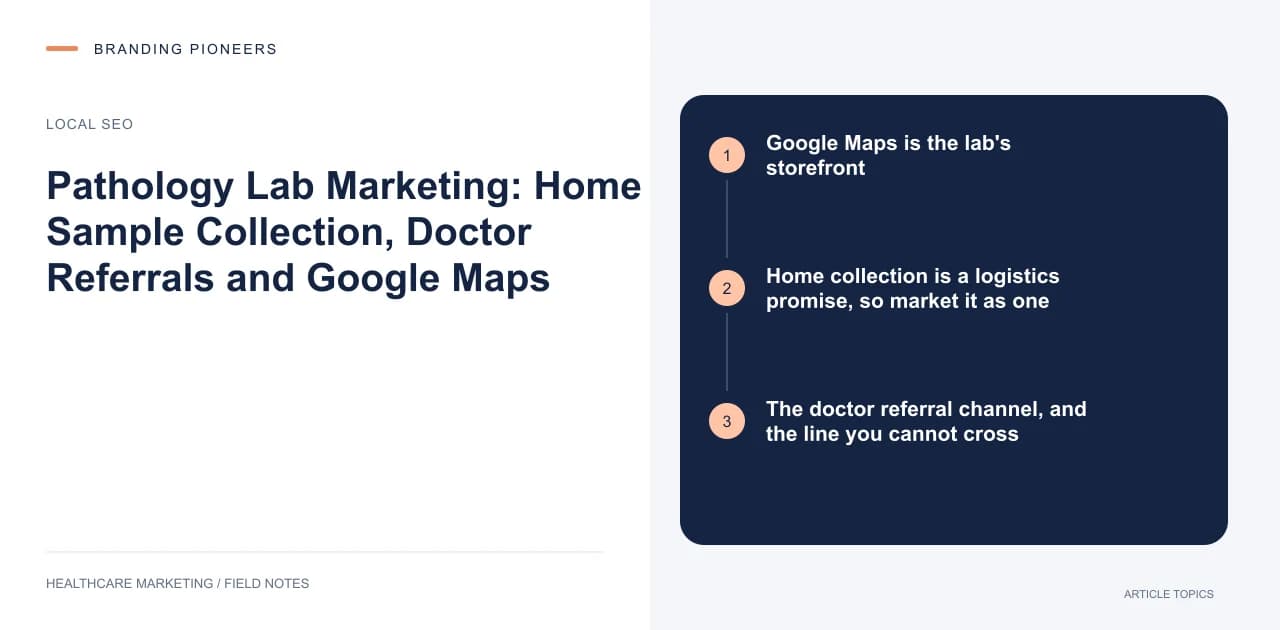
Google Maps is the lab's storefront

For an independent lab the Google Business Profile is not a listing. It is the shopfront, and in most cases it is doing more work than the website.

Get the basics exactly right, because they are frequently wrong. The primary category should be the one that matches what you are — medical laboratory, diagnostic centre, blood testing service — rather than a general clinic category. Every service should be named the way patients say it: blood test, thyroid test, sugar test, full body checkup, home sample collection. Hours must be true, and for a lab that means the collection window, not the office hours. Photographs should show the actual collection room and reception, because patients are checking whether the place looks clean.

Then there are the parts nobody maintains: the Q and A section, which anyone can answer and which usually sits empty; the posts, which are the obvious place for a seasonal package or a new test; and the messaging feature, which for a lab is often the fastest booking route a patient will ever use. The mechanics are covered properly in our Google Business Profile guide, and for a multi-branch lab the same discipline has to be applied to every collection centre individually, not just the main one.

Reviews decide the ranking and the click. Labs are unusually good at earning them and unusually bad at asking, because the interaction is short and transactional. Ask by message when the report is delivered — that is the moment the service is complete and the patient is satisfied.

Home collection is a logistics promise, so market it as one

Home sample collection is the single biggest change in Indian diagnostics and most independent labs advertise it as a feature. It is not a feature; it is a promise about time, and time is what the patient is choosing on.

What converts: the actual collection window you can honour, the areas you genuinely cover, how quickly somebody arrives after booking, whether the phlebotomist is your own staff, what happens if the patient needs to fast, and when the report will be ready. State these specifically. A lab that says "home collection available" and a lab that says "collection between 6am and 9am across these sectors, report by evening for routine tests" are selling different products.

The booking route matters as much as the promise. Most home collection bookings in India start on a phone call or a WhatsApp message, not on a form. Make the number prominent, answer it, and keep the WhatsApp conversation structured — the test required, the address, the slot, the fasting instruction, the confirmation.

The doctor referral channel, and the line you cannot cross

Referrals from clinicians remain the backbone of lab volume, and this is the part of lab marketing where the rules are genuinely strict and genuinely ignored.

In India, the NMC's professional conduct rules prohibit a registered medical practitioner from receiving or giving any commission, rebate or fee-splitting arrangement in return for referring patients — including to diagnostic laboratories. Any "cut per test" arrangement puts the referring doctor's registration at risk, and a lab that builds its growth plan on that arrangement is building on something that can be taken away. The Clinical Establishments (Registration and Regulation) Act, 2010 applies to the lab's own registration where the state has adopted it.

What is legitimate, and what actually works better over time, is making the lab easier to refer to. Turnaround that is predictable. Reports delivered to the doctor as well as the patient, in a format they can read quickly. A pathologist who picks up the phone when a result needs discussing. Prescription pads and requisition forms that are convenient. Home collection extended to the doctor's own patients. Clear communication when a critical value comes up.

Those are services, not inducements, and they compound.

Packages, without the spiral

Health checkup packages are how labs raise average order value and how they destroy their own pricing at the same time.

The way out is composition rather than discount. Build packages around a reason — a post-viral panel, a pre-diabetes screen, a package for someone with a family history of thyroid disease, an annual check appropriate to an age band — and explain what each test in it is for. A patient who understands why a panel contains what it contains is not comparing you on price with an aggregator's generic bundle.

Publish what the package includes in full. Labs routinely list a package name and a number of parameters without naming them, which invites exactly the comparison they are trying to avoid.

The report is the product

Everything before the report is logistics. The report is the thing the patient keeps, shows their doctor, and remembers you by.

Deliver it fast and deliver it where they are — on WhatsApp, as a PDF that opens properly on a phone, with the previous values alongside if you have them. A lab that shows a patient their thyroid trend over three years has made itself difficult to replace. Add a plain-language note about what the flagged values mean, carefully framed as information rather than advice, and the report becomes a reason to come back rather than a transaction that ended.
Content: write what people actually type

Test-related search is enormous, specific, and mostly unanswered by labs. What a CBC measures. Whether you need to fast for a lipid profile. What a high TSH means. Why a vitamin D test is being asked for. What an HbA1c is actually telling you.

In India a large share of this is typed in Hindi or in transliterated Hindi, and the phrasing is different — people search how to grow a lab and how to get tests done in their own words, and a lab writing only formal English content is absent from half its own market. Write in the language your catchment searches in.

The full structure for this — local search, packages, corporate tie-ups and home collection funnels — is set out in our diagnostic centre marketing guide, and the operational version sits under diagnostic center marketing. Our pathology lab marketing pages cover how the pieces connect for an independent lab competing with a chain.

Corporate and society camps

Camps are the most reliable volume a neighbourhood lab can create, and most labs run them badly — one table, one day, no follow-up.

What makes them work: booking the camp through somebody with authority (an HR head, a resident welfare association secretary), collecting consent properly, delivering reports quickly and individually rather than in a bundle, and having a clear, non-pushy route for the people whose results need repeating. The camp is not the revenue. The abnormal results that need follow-up testing are, and they only convert if the communication afterwards is good.

Data, and the rules that now apply

Patient data in India is governed by the Digital Personal Data Protection Act, 2023 and the DPDP Rules, 2025, with the Data Protection Board of India as the regulator. For a lab this is not abstract: you hold names, phone numbers, addresses, and results. Notice and consent have to be real, retention has to be considered, and sharing data with a marketing platform or a third-party caller is exactly the sort of processing the Act exists to govern. HIPAA is a US law and does not apply to an Indian lab.

If your centre also does ultrasound, the Pre-Conception and Pre-Natal Diagnostic Techniques Act, 1994 applies: advertising relating to pre-natal sex determination is an offence under Section 22, and the prescribed notice must be displayed.

Where to start

  1. The Google Business Profile completed properly, for every collection centre.
  2. Home collection stated as a specific promise about areas and timing.
  3. A review request sent with every report.
  4. Packages built around a reason, with every parameter named.
  5. Referral support built as service rather than inducement.
  6. Content written in the language your catchment actually searches in.

What to measure

Test volume alone will not tell you what is working. Track bookings by source, home collections as a share of total, repeat patients within a year, package versus single-test mix, and referral volume by referring clinician.

The last one is the number most labs never assemble, and it is the one that shows you which relationships are real.

---

If you want to see how your lab appears in local search across your catchment — profile gaps, competitor visibility, and where bookings are being lost — get a free audit and we will send the findings regardless. Or book a strategy call.

FILED UNDERpathology lab marketingdiagnostic lab marketingdiagnostic centre marketingpathology lab ki marketing kaise kare
Stop reading. Start ranking.
Get a free local seo audit — we'll show you exactly what's missing.
Book audit →
Author
Founder & CEO · Gurugram, India

Nishu founded Branding Pioneers in 2016 with one rule that hasn't changed since: healthcare only. She'd run digital strategy at a top-10 Indian agency and watched generalist marketing underserve medical clients who needed something built for how patients actually search and decide. So she left to build the specialist instead. It's now an 80-person team working with healthcare brands worldwide.

The Patient Acquisition Blueprint (2026 Edition) — guide cover
Free · 15 pages

The Patient Acquisition Blueprint (2026 Edition)

The exact 90-day patient-acquisition system, step by step.

We never share your details

FREE · 30 MIN
See your local seo opportunity gap.

Senior strategist, no boilerplate. Reply within 4 hours.

Book audit → Or call us directly
The Pioneers Brief · weekly
One essay. Three benchmarks. One teardown.
Subscribe — free
The Patient Acquisition Blueprint (2026 Edition) — guide cover
Free for local seo readers

The Patient Acquisition Blueprint (2026 Edition)

The exact 90-day patient-acquisition system, step by step.

  • The 90-day patient acquisition operating system
  • Channel-by-channel budget allocation (₹50L–₹5Cr/yr)
  • 12 real, named client engagements walked through
  • ROI tracking spreadsheet (CAC, LTV, payback)
15 pages · Used by 350+ healthcare clients · Updated for AI search

We never share your details

Continue reading

More on local seo.

BROWSE ALL →
From the studio

This thinking, applied.

Apollo Hospitals — doctor-led video library
Video · Library
Apollo — the doctor-led video library
Meta Ads reach and delivery reporting
Meta Ads
Meta Ads — delivery and reach reporting
Doctor clients across specialties
Clients
Doctors we work with
A selection of the doctors and specialists we have produced work with
Doctors
A few of them — full interviews on request
Multi-clinic social media design system
Social · System
Social design system across clinics
Why choose us

Why healthcare brands choose us.

Six reasons hospitals, clinics, and doctors pick a healthcare-only firm over a generalist agency.

  • Healthcare-only

    It's all we do. No retail, no fintech — the whole team thinks in patient journeys, clinical trust, and the way people actually choose a doctor.

  • AI-first systems

    Receptionists, WhatsApp triage, and attribution built in-house — we answer patients in seconds and tie every click to a booked appointment.

  • Compliance built-in

    HIPAA-aware handling, ASCI-reviewed creative, and GDPR/DPDP sign-off on every campaign — our standard, not an upcharge or an afterthought.

  • Senior on every account

    The senior who pitched you stays on the engagement. No bait-and-switch to juniors learning on your budget.

  • Measured to the appointment

    Patient-level attribution across calls, forms, and walk-ins. Monthly reports show booked patients — not just clicks and impressions.

  • Receipts, not promises

    We name our clients and show the work. Quarterly reviews with the numbers attached, every cycle.

The Branding Pioneers healthcare-marketing team at work
Healthcare-only · since 2016
A team that does one thing well.
More from the brief

If this resonated, here’s what else lands.

Adjacent practices, the relevant tools, and the case files where we shipped this thinking against real patient-acquisition targets.

THE PIONEERS BRIEF · WEEKLY

One essay,
three benchmarks,
one teardown.

Healthcare growth, every Thursday morning. No hype, no fluff.