Strategy

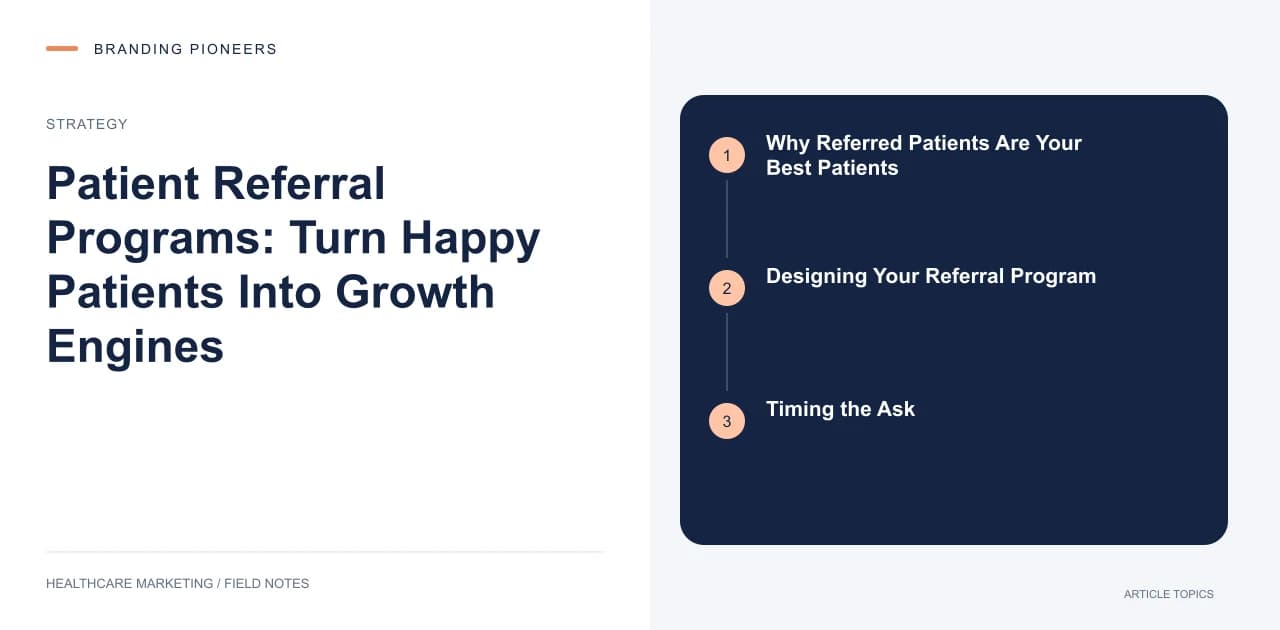
Patient Referral Programs: Turn Happy Patients Into Growth Engines

Referred patients convert 4x faster and have 25% higher lifetime value. Here is how to build a referral program that turns your existing patient base into your most productive marketing channel.

NS
Founder & CEO · November 5, 2025 · 4 min read
FILE · PATIENT-
Patient Referral Programs: Turn Happy Patients Into Growth Engines

Why Referred Patients Are Your Best Patients

Referred patients arrive with pre-built trust. They have heard about your care from someone they personally know and trust, which means the most difficult marketing task — establishing credibility — has already been accomplished. The data reflects this advantage: referred patients convert from inquiry to appointment 4 times faster than patients from cold marketing channels, have 25 percent higher lifetime value, generate 37 percent higher retention rates, and are 5 times more likely to refer others in turn.

Despite these advantages, only about 18 percent of healthcare practices have a structured referral program. The rest rely on organic word of mouth — patients referring friends spontaneously. While organic referrals are valuable, they are unpredictable and unscalable. A structured program amplifies what is already happening naturally.

Designing Your Referral Program

An effective healthcare referral program has four components: a clear incentive structure, a frictionless referral mechanism, tracking and attribution, and consistent promotion.

Incentive structure: Healthcare referral incentives must be carefully designed to comply with anti-kickback regulations and maintain ethical standards. You cannot pay patients to refer other patients for clinical services in many jurisdictions. What you can do: offer non-clinical benefits like priority appointment scheduling, free add-on services (complimentary dental cleaning, free skin analysis), wellness product credits, or charitable donations in the referrer's name.

For cosmetic, dental, and elective procedure practices, the rules around incentives are less restrictive. A 10 percent discount on the next cosmetic treatment for both the referrer and the referred patient is common and effective.

The most effective incentive we have tested is a two-sided reward: both the referrer and the referred patient receive a benefit. This removes the social awkwardness of referring someone purely for personal gain and frames the referral as a favor to the friend.

Frictionless mechanism: The referral process must be dead simple. Give patients a unique referral code or a shareable link. When their friend books using that code or link, both parties automatically receive their benefit. If the process requires forms, phone calls to explain, or in-person verification, participation drops by 70 to 80 percent.

Digital referral tools like ReferralCandy, InviteReferrals, or a simple custom solution in your CRM can automate the entire workflow: unique link generation, tracking, reward fulfillment, and thank-you communication.

Timing the Ask

When you ask for referrals matters as much as how you ask. The optimal moments:

Immediately after a positive outcome. When a patient completes successful treatment and expresses satisfaction, that is the peak moment for referral willingness. Train your team to recognize these moments and make the ask naturally: "I am glad you are happy with your results. If you know anyone who could benefit from similar treatment, here is a card with your personal referral link."

At follow-up appointments. Patients returning for follow-up visits are re-engaging with your practice and are often reflecting on their positive experience. Include referral program information in your follow-up communication.

In your post-visit communication. Include referral program details in your appointment follow-up emails and WhatsApp messages. A simple "Know someone who needs expert [specialty] care? Share your personal link: [link]" included in post-visit communication generates a steady stream of referrals.

After a positive review. When a patient leaves a 5-star Google review, they are at peak advocacy. Send them a thank-you message with their referral link: "Thank you for the wonderful review. If any friends or family need similar care, you can share this link for a special welcome benefit."
Physician-to-Physician Referral Programs

For specialists and hospitals, physician referrals are often more valuable than patient referrals. Building a systematic physician referral program requires different tactics:

Make referral frictionless for physicians. Create a dedicated referral phone line or online form that bypasses standard scheduling. The referring physician should be able to send a patient to you with a single action — not a multi-step process that they do not have time for.

Close the communication loop. After seeing a referred patient, send the referring physician a timely update (with patient consent) about the diagnosis and treatment plan. Physicians who receive follow-up communication refer 3 times more patients than those who refer into a communication void.

Provide value to referring physicians. Host CME events, share relevant clinical research, and offer collaborative case discussions. These touchpoints maintain the relationship and keep your practice top-of-mind when referral opportunities arise.

Tracking and Measuring Referral Program Performance

Track these metrics monthly: number of referral links shared, number of referred patients who booked, conversion rate (bookings / shares), average lifetime value of referred patients versus non-referred, total revenue attributable to the referral program, and cost per acquisition through referrals versus other channels.

Compare referral channel cost per acquisition against your paid channels. In most healthcare practices, the referral channel delivers patients at 70 to 90 percent lower cost per acquisition than paid search or social media — making it the most cost-efficient growth channel available.

Scaling the Program

Once your referral program is generating consistent results, scale it:

Identify your super-referrers. In every patient base, a small percentage (typically 5 to 10 percent) generate a disproportionate share of referrals. Identify these patients and give them VIP treatment — exclusive benefits, personal thank-you from the doctor, and early access to new services.

Integrate referrals into every patient touchpoint. Mention the program in appointment reminders, post-visit surveys, email newsletters, social media, and even in-office signage. Consistent, low-pressure promotion keeps the program visible without being pushy.

Measure and celebrate milestones. Send patients a thank-you when their first referral books. Celebrate when they reach 5 or 10 referrals. Public recognition (with permission) on social media amplifies the behavior and inspires other patients to participate.

A well-executed referral program does not just acquire patients — it builds a community of advocates who actively promote your practice. That community is the most durable competitive advantage in healthcare marketing.

FILED UNDERpatient referral programhealthcare referral marketingdoctor referral systempatient word of mouth
Stop reading. Start ranking.
Get a free strategy audit — we'll show you exactly what's missing.
Book audit →
Author
Founder & CEO · Gurugram, India

Nishu founded Branding Pioneers in 2016 with one rule that hasn't changed since: healthcare only. She'd run digital strategy at a top-10 Indian agency and watched generalist marketing underserve medical clients who needed something built for how patients actually search and decide. So she left to build the specialist instead. It's now an 80-person team working with healthcare brands worldwide.

The Patient Acquisition Blueprint (2026 Edition) — guide cover
Free · 15 pages

The Patient Acquisition Blueprint (2026 Edition)

The exact 90-day patient-acquisition system, step by step.

We never share your details

FREE · 30 MIN
See your strategy opportunity gap.

Senior strategist, no boilerplate. Reply within 4 hours.

Book audit → Or call us directly
The Pioneers Brief · weekly
One essay. Three benchmarks. One teardown.
Subscribe — free
The Patient Acquisition Blueprint (2026 Edition) — guide cover
Free for strategy readers

The Patient Acquisition Blueprint (2026 Edition)

The exact 90-day patient-acquisition system, step by step.

  • The 90-day patient acquisition operating system
  • Channel-by-channel budget allocation (₹50L–₹5Cr/yr)
  • 12 real, named client engagements walked through
  • ROI tracking spreadsheet (CAC, LTV, payback)
15 pages · Used by 350+ healthcare clients · Updated for AI search

We never share your details

Continue reading

More on strategy.

BROWSE ALL →
From the studio

This thinking, applied.

Healthcare video thumbnail design set
Video
Video thumbnail systems
Meta Ads reach and delivery reporting
Meta Ads
Meta Ads — delivery and reach reporting
Medical tourism — healthcare marketing by Branding Pioneers
Vertical
Medical tourism
In-house training session at Branding Pioneers
Craft
In-house training session
Vizer — investor and go-to-market deck design system
Deck · Diagnostics
Vizer — investor and go-to-market deck
Why choose us

Why healthcare brands choose us.

Six reasons hospitals, clinics, and doctors pick a healthcare-only firm over a generalist agency.

  • Healthcare-only

    It's all we do. No retail, no fintech — the whole team thinks in patient journeys, clinical trust, and the way people actually choose a doctor.

  • AI-first systems

    Receptionists, WhatsApp triage, and attribution built in-house — we answer patients in seconds and tie every click to a booked appointment.

  • Compliance built-in

    HIPAA-aware handling, ASCI-reviewed creative, and GDPR/DPDP sign-off on every campaign — our standard, not an upcharge or an afterthought.

  • Senior on every account

    The senior who pitched you stays on the engagement. No bait-and-switch to juniors learning on your budget.

  • Measured to the appointment

    Patient-level attribution across calls, forms, and walk-ins. Monthly reports show booked patients — not just clicks and impressions.

  • Receipts, not promises

    We name our clients and show the work. Quarterly reviews with the numbers attached, every cycle.

The Branding Pioneers healthcare-marketing team at work
Healthcare-only · since 2016
A team that does one thing well.
More from the brief

If this resonated, here’s what else lands.

Adjacent practices, the relevant tools, and the case files where we shipped this thinking against real patient-acquisition targets.

THE PIONEERS BRIEF · WEEKLY

One essay,
three benchmarks,
one teardown.

Healthcare growth, every Thursday morning. No hype, no fluff.

patient referral programs healthcare growth · Portfolio

Healthcare websites: selected work

Explore the collection →