Specialty Marketing

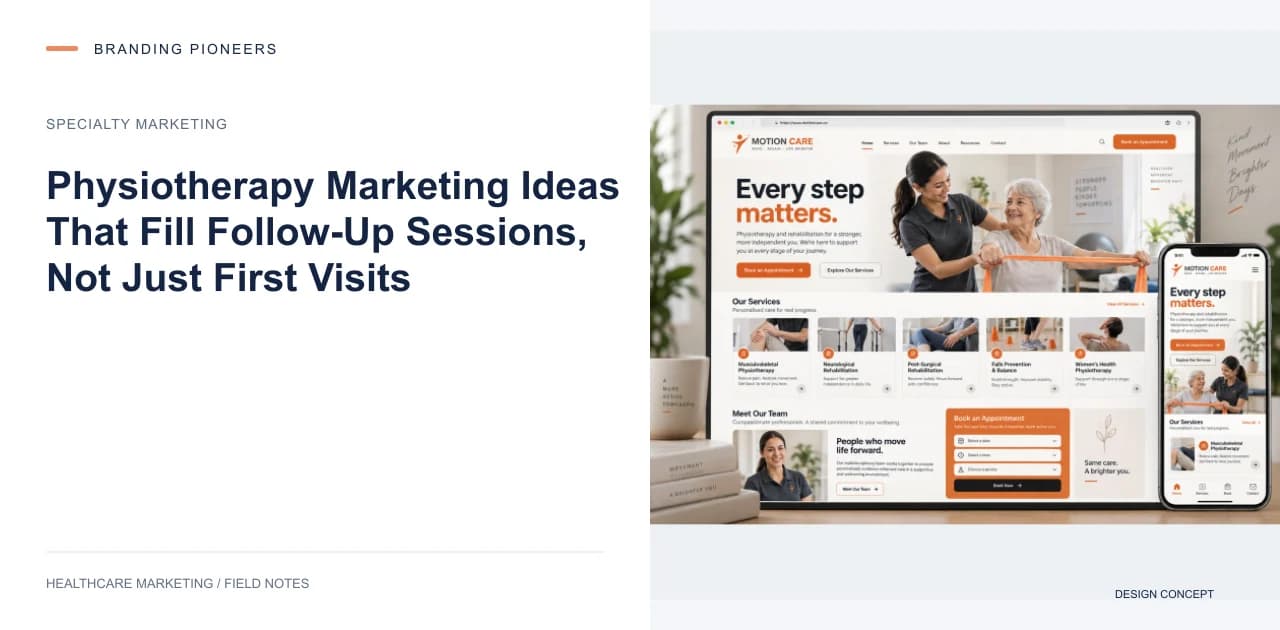
Physiotherapy Marketing Ideas That Fill Follow-Up Sessions, Not Just First Visits

Physiotherapy clinics market the first appointment and lose the rest of the course. The money is in the sessions nobody advertises, and so is the clinical outcome.

NS
Founder & CEO · October 5, 2026 · 7 min read
FILE · PHYSIOTH
Physiotherapy Marketing Ideas That Fill Follow-Up Sessions, Not Just First Visits

Every physiotherapy clinic I have looked at measures new patients. Almost none of them measure whether those patients finish.

That is the wrong end of the business. A physiotherapy episode is a course of care, not an appointment, and the economics — along with the outcome — sit in the sessions after the first one. Patients feel better partway through, decide they are fixed, stop coming, and re-present six months later with the same problem and a slightly worse opinion of physiotherapy.

Clinics respond by spending more on acquisition. It is the most expensive possible answer to a retention problem.

The leak is in the middle of the course, not at the front door

Attrition in physiotherapy is predictable. It happens when pain drops and the reason for attending becomes abstract. The patient came for pain relief; they are now being asked to attend for strength, control and load tolerance, which are not things they feel.

Marketing has a real job here, and it starts before the first session ends. The patient has to understand the shape of the episode: what the first phase is for, what the second phase is for, what happens if they stop early, and what "better" will mean at the end.

Say it on the website, say it in the first appointment, and put it in writing they take home. A patient who knows the plan is a patient who finishes it, and a patient who finishes is a patient who refers.

Market the plan of care, not the appointment

Almost every physio clinic advertises "book an appointment". Very few explain what they are actually selling.

Pages that work describe an episode: assessment, what the first two weeks look like, what changes after that, roughly how long an episode of this kind of problem runs, what the patient does between sessions, and how you decide they are finished.

This reframes the price comparison too. A patient comparing per-session fees across three clinics is comparing the wrong thing, and the clinic that explains the episode is the one that moves them off that comparison. Our physical therapy marketing pages are structured around the episode rather than around a service list, for the same reason.

Reactivation is the cheapest acquisition you have

The most under-used asset in any physio clinic is the list of patients who stopped coming.

Some of them recovered. Many did not, and have simply absorbed the problem into their life. A message that asks how the shoulder is now, sent months later, with a specific route back in and no sales pressure, is the highest-return outreach available to this specialty — cheaper than any ad, and welcomed rather than resented because it reads as clinical follow-up.

Build it as a standing programme rather than a campaign: a defined interval after the last attended session, a message that references the actual problem, and consent recorded properly. Increasing repeat patients is the systematic version of this, and it belongs in the plan before any new spending does.

Attack the no-show before it becomes a drop-out

Missed appointments in physiotherapy are not an administrative annoyance. They are the first visible step of a patient leaving the course.

Which means a no-show should trigger a conversation, not just a rescheduling link. Why did they not come, is the pain worse, is the time inconvenient, is the cost the problem. Clinics that treat the missed session as a clinical signal recover patients that clinics with an automated reminder system alone will lose. The mechanics of reducing the no-show rate matter, but the follow-up conversation matters more.

Local search decides who gets found, and convenience decides who gets chosen

Physiotherapy is chosen on proximity and availability more than on reputation, which is unfair but true. Somebody with acute back pain wants to be seen this week, near where they live or work.

So the Google Business Profile is the primary acquisition asset. Right primary category. Every service named the way patients say it — back pain, sports injury, post-surgery rehabilitation, sciatica, frozen shoulder — rather than in clinical taxonomy. Current photographs of the actual treatment space, which matters because patients want to know whether it is a gym or a cubicle. Accurate hours, including whether you run early mornings or evenings, because that is often the deciding factor. And a booking link that works on a phone.

Reviews in physiotherapy are easy to earn and rarely asked for. Ask at discharge, when the patient has just finished a course that worked, and ask by message.

Referral sources are broader here than clinics realise

General practitioners and orthopaedic surgeons are the obvious ones, and they respond to the same things every referrer responds to: a direct route to a human, clarity about what you treat, honest waiting times, and a discharge summary that comes back.

The less obvious ones are more available. Gyms and personal trainers refer constantly if you make it easy and do not try to poach their clients. Running clubs and sports teams. Corporate occupational health, where desk-related musculoskeletal complaints are a standing problem nobody owns. Podiatrists, dentists for jaw problems, obstetric units for post-partum floor rehabilitation.

None of these need a budget. They need one person with the relationship as part of their job.

Content that ranks and also does the clinical work

Physiotherapy is one of the few specialties where the content people search for is the content you would give a patient anyway.

Exercise videos for specific problems, filmed by your own therapists in your own clinic, indexed properly, each answering one thing — what to do in the first week after an ankle sprain, how to sit if your back is bad, three things not to do with a frozen shoulder. These rank, they get shared, they demonstrate competence, and they double as the home programme.

Write the condition pages around what the patient calls it, not what you call it. "Neck pain from working at a laptop" is a search. "Cervical spondylosis management" is a heading in a textbook.

Home visits and the search terms nobody owns

Home physiotherapy demand is real, growing, and contested by almost nobody at the level of search.

The patients are specific: post-operative knee and hip replacements in the first weeks, stroke rehabilitation, elderly patients who cannot travel, post-fracture recovery. The searches are made by a family member, usually in a hurry, and usually with a location attached.

If you offer home visits, treat it as a distinct service with its own page rather than a line on the pricing list. Say which areas you cover, what a home session involves when there is no equipment, how many sessions a typical episode of that kind runs, what equipment you bring, and what you would ask the family to arrange. Most clinics bury this and lose an entire demand stream to whoever wrote a page about it.

Corporate and insurance channels pay differently

Two channels change the economics of a physiotherapy clinic and both take relationship work rather than advertising.

Corporate contracts — onsite sessions, ergonomic assessments, a referral route for employees with musculoskeletal complaints — give predictable volume, are negotiated once, and rarely churn. The people who buy them are HR and facilities heads, not patients, and they are reached through direct approach and LinkedIn rather than search.

Insurance and third-party administrators matter where physiotherapy is covered. Being listed correctly in a payer's provider directory is a search problem in disguise; patients find clinics through those directories and the listings are routinely wrong. Auditing your own entries across every payer and directory you appear in is unglamorous work that produces bookings immediately.

Claims, regulation and what you may say

Physiotherapy sits under different authorities in different markets, and the claims rules follow them.

In India, the National Commission for Allied and Healthcare Professions Act, 2021 establishes the statutory framework for physiotherapists and other allied professions, and the ASCI code governs advertising claims. In the United Kingdom, physiotherapists are registered with the Health and Care Professions Council, and the Advertising Standards Authority enforces the CAP Code on claims. In the United States, practice and advertising are regulated state by state, and the FTC governs claim substantiation. In Australia, physiotherapy is a registered profession under AHPRA, whose advertising guidelines are unusually explicit and worth reading even if you practise elsewhere — they prohibit testimonials about clinical care outright.

Common to all of them: do not promise a cure, do not claim to be the best, and do not use a patient's story without documented consent and an accurate framing.

Measure the episode, not the enquiry

Four numbers tell you whether a physiotherapy clinic is healthy: sessions per episode, the share of episodes that reach planned discharge, the share of patients who return within a year, and the source of each.

Most clinics can produce none of them from their practice management system without effort, and every one of them is more informative than a cost-per-lead figure.

Where to start

  1. Explain the episode on the website and in the first appointment.
  2. Build reactivation as a standing programme.
  3. Treat every no-show as a clinical signal.
  4. Complete the Google Business Profile properly.
  5. Film exercise content with your own therapists.
  6. Give one person ownership of referral relationships.

---

If you want to see where your clinic sits in local search and where the course of care is leaking, get a free audit and we will send the findings either way. Or book a strategy call to talk through the retention side first.

FILED UNDERphysiotherapy marketing ideasphysiotherapy clinic marketing strategyphysical therapy marketing ideasphysio clinic marketing
Stop reading. Start ranking.
Get a free specialty marketing audit — we'll show you exactly what's missing.
Book audit →
Author
Founder & CEO · Gurugram, India

Nishu founded Branding Pioneers in 2016 with one rule that hasn't changed since: healthcare only. She'd run digital strategy at a top-10 Indian agency and watched generalist marketing underserve medical clients who needed something built for how patients actually search and decide. So she left to build the specialist instead. It's now an 80-person team working with healthcare brands worldwide.

The Patient Acquisition Blueprint (2026 Edition) — guide cover
Free · 15 pages

The Patient Acquisition Blueprint (2026 Edition)

The exact 90-day patient-acquisition system, step by step.

We never share your details

FREE · 30 MIN
See your specialty marketing opportunity gap.

Senior strategist, no boilerplate. Reply within 4 hours.

Book audit → Or call us directly
The Pioneers Brief · weekly
One essay. Three benchmarks. One teardown.
Subscribe — free
The Patient Acquisition Blueprint (2026 Edition) — guide cover
Free for specialty marketing readers

The Patient Acquisition Blueprint (2026 Edition)

The exact 90-day patient-acquisition system, step by step.

  • The 90-day patient acquisition operating system
  • Channel-by-channel budget allocation (₹50L–₹5Cr/yr)
  • 12 real, named client engagements walked through
  • ROI tracking spreadsheet (CAC, LTV, payback)
15 pages · Used by 350+ healthcare clients · Updated for AI search

We never share your details

Continue reading

More on specialty marketing.

BROWSE ALL →
From the studio

This thinking, applied.

Vizer — investor and go-to-market deck design system
Deck · Diagnostics
Vizer — investor and go-to-market deck
YouTube channel optimisation for doctors
YouTube
Channel optimisation for clinicians
Doctor clients across Apollo, Max, AIIMS and more
Clients
Doctors we work with
Services for hospitals and hospital systems
Services
Built for hospital systems
Always-on social management for healthcare brands
Social
Always-on social management
Why choose us

Why healthcare brands choose us.

Six reasons hospitals, clinics, and doctors pick a healthcare-only firm over a generalist agency.

  • Healthcare-only

    It's all we do. No retail, no fintech — the whole team thinks in patient journeys, clinical trust, and the way people actually choose a doctor.

  • AI-first systems

    Receptionists, WhatsApp triage, and attribution built in-house — we answer patients in seconds and tie every click to a booked appointment.

  • Compliance built-in

    HIPAA-aware handling, ASCI-reviewed creative, and GDPR/DPDP sign-off on every campaign — our standard, not an upcharge or an afterthought.

  • Senior on every account

    The senior who pitched you stays on the engagement. No bait-and-switch to juniors learning on your budget.

  • Measured to the appointment

    Patient-level attribution across calls, forms, and walk-ins. Monthly reports show booked patients — not just clicks and impressions.

  • Receipts, not promises

    We name our clients and show the work. Quarterly reviews with the numbers attached, every cycle.

The Branding Pioneers healthcare-marketing team at work
Healthcare-only · since 2016
A team that does one thing well.
More from the brief

If this resonated, here’s what else lands.

Adjacent practices, the relevant tools, and the case files where we shipped this thinking against real patient-acquisition targets.

THE PIONEERS BRIEF · WEEKLY

One essay,
three benchmarks,
one teardown.

Healthcare growth, every Thursday morning. No hype, no fluff.