NewNMC’s advertising guidelines for doctors are in force from 6 Oct 2026. See what to change, and get a free compliance auditNew NMC advertising rules for doctors: what to change
Compliance

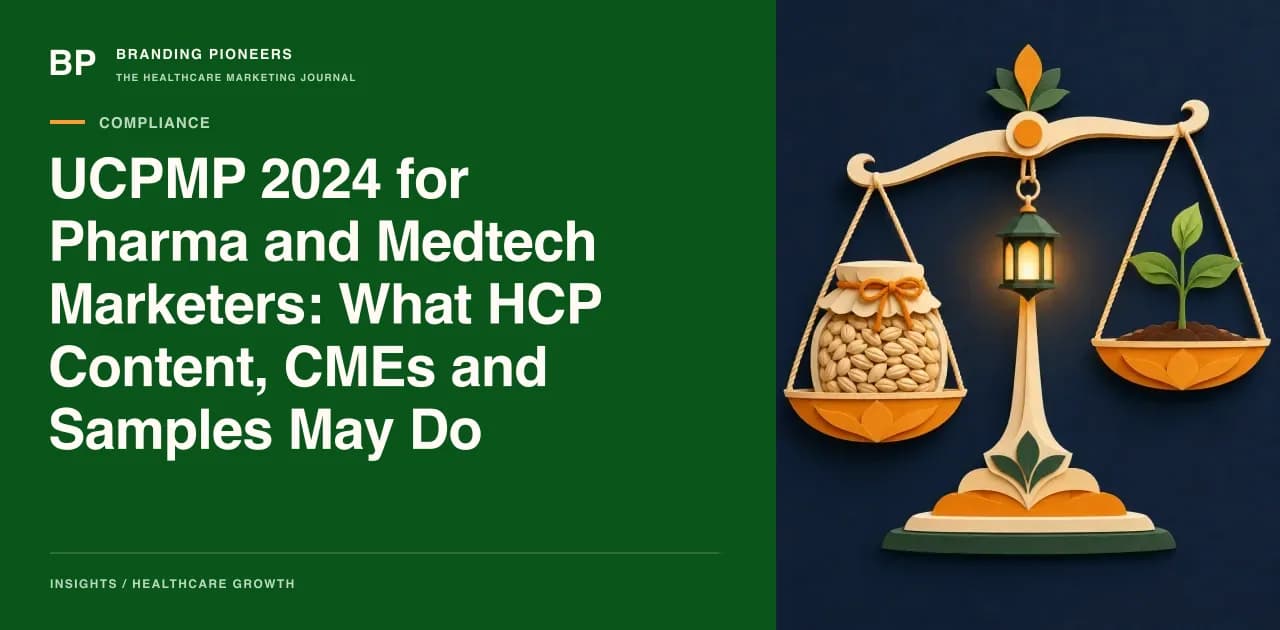
UCPMP 2024 for Pharma and Medtech Marketers: What HCP Content, CMEs and Samples May Do

What UCPMP 2024 allows for digital HCP engagement: gifts, samples, CME and events, the NMC endorsement limits that cut across it, a sample ledger design and a launch checklist.

UCPMP 2024 for Pharma and Medtech Marketers: What HCP Content, CMEs and Samples May Do

This article is for marketing, medical affairs and compliance leads at pharmaceutical and medtech companies in India who run, or sign off, content aimed at healthcare professionals. It answers a narrow question: what does the Uniform Code for Pharmaceutical Marketing Practices 2024 allow when the engagement is digital, such as an HCP webinar, a CME invitation on LinkedIn, a sample request by WhatsApp or a speaker video?

A caveat about sources. The Code was notified by the Department of Pharmaceuticals, and we read it through two detailed law-firm summaries because the Department's own PDF would not load for us. Those summaries do not reproduce clause numbers or any digital-specific provision, so where we apply the Code to digital formats below, that is our interpretation, labelled as such. Read the Code itself on the Department of Pharmaceuticals website before you sign off a process, and take legal advice. We are a marketing team, not a law firm.

This article is separate from the rules on influencers. Those sit with the advertising self-regulator ASCI and cover public-facing content. The UCPMP is about a company's dealings with healthcare professionals.

What the Code is, and who it binds

The Department of Pharmaceuticals notified UCPMP 2024 on 12 March 2024. According to Trilegal's analysis, it applies to pharmaceutical companies and medical device manufacturers, and requires industry associations to make sure their members comply, to set up an Ethics Committee for Pharmaceutical Marketing Practices, and to run a UCPMP portal. The same analysis notes that the Code was not issued under a specific parliamentary law, so its legal force is debated, but that the Department expects strict compliance and has signalled a "name and shame" approach. Treat it as binding in practice. Your association membership, your reputation with hospitals and your next audit all depend on it.

What the Code says about promotion

Promotion follows the World Health Assembly's 1988 definition. Promotional material must be consistent with the product's marketing approval, balanced, up to date, verifiable and capable of substantiation, and it must not mislead directly or by implication. For a digital team that translates into four concrete controls: every claim in an e-detail, banner or video carries a reference; the content matches the approved prescribing information; risk information is not buried; and old assets are withdrawn when the approval changes.

Gifts, hospitality, samples and educational items

The detail that matters most to operations teams, again from Trilegal's summary:

  • Gifts. Gifts, monetary grants, pecuniary advantages and benefits in kind to healthcare professionals or their family members are prohibited, including through agents, distributors and suppliers.
  • Travel and hospitality. These may be extended to event speakers only, not to delegates or attendees.
  • Educational items. Items such as books, calendars, diaries, journals and clinical guidelines must be for professional use in healthcare settings, cost no more than INR 1,000 per item and have no independent commercial value.
  • Free samples. No more than 12 packs per drug per year, enough for three patients at the prescribed dose, no larger than the smallest commercial pack, and an aggregate value capped at 2% of the company's domestic sales for the year. Companies must keep a system of accountability and control over sample distribution.

The cap on sample value is a company-level control. A team that runs sample requests through a WhatsApp number or an HCP portal needs a ledger that reconciles to it: product, HCP name, quantity, date.

CME, CPD and events

The Code allows companies to run continuing medical education events alone or with professional bodies, with conditions. According to the same analysis, a company must publish on its website how participants and speakers are selected, with a statement of funding and expenditure, and events may not be held at foreign locations. Expenditure follows industry guidelines and the Income Tax Act, and the arrangements are open to audit.

For digital events this has three consequences, which are our reading rather than the text:

  1. The registration page is a compliance artefact. If the CME is sponsored, the page should show the sponsor, the funding statement and the selection criteria, not just the agenda.
  2. A virtual event is not a loophole for hospitality. If the invitation offers anything beyond access to the educational content, such as a hamper to delegates, check it against the gifts rule.
  3. Speaker arrangements stay documented. Fees, travel and the written agreement for a speaker are still subject to the same disclosure and tax rules when the speaker joins from a studio.

Where the NMC notice cuts across the Code

A pharma or medtech marketer can satisfy the UCPMP and still put a doctor in breach of medical ethics. Paragraph 8.1(iv) of the NMC's 6 October 2026 notice says a registered medical practitioner shall not give any approval, recommendation, endorsement, certificate, report or statement about a drug, medicine, device or health product for use in advertising or publicity in connection with their name, signature, photograph, voice or professional status, whether or not money is received. Paragraph 8.1(ii) bars a doctor from permitting the use of their name, image, voice, testimonial or endorsement for the promotion of services or products. Both concern advertising and publicity to the public, not scientific exchange between professionals, but they narrow what a doctor can safely appear in.

For brand teams, the practical effect is that "doctor says" content must be designed as education, not endorsement. A speaker presenting clinical evidence at a CME is different from the same doctor appearing in a product-branded video that the company then boosts. Have your legal team review that boundary for every doctor-fronted asset, and keep the doctors' own advice in the loop. Our overview of the 2026 NMC rules lists the other restrictions that touch doctors.
Want this applied to your practice? Get a free compliance audit.

Book my free audit

Communicating with HCPs: what stays open

The Drugs and Magic Remedies Act, section 14, exempts drug advertisements sent confidentially only to registered medical practitioners in the prescribed manner. This is the legal basis for gated professional portals. The practical implication is that HCP content should sit behind a verification step. A product page with prescribing claims on an open website is not a professional-only communication, whatever the banner says. If you rely on a gate, document how it checks registration, and keep access logs.

A worked example: designing the sample ledger

The numbers below are hypothetical and only illustrate the arithmetic. Suppose a company with domestic sales of INR 500 crore in a year. The Code's cap on the value of samples, which Trilegal reports as 2% of domestic sales, would work out to INR 10 crore of sample value for that year. The company-level cap is not the only limit, because the per-HCP rules also apply: no more than 12 packs per drug per year, and a quantity sized for three patients.

A ledger that holds up to an audit needs one row per issue, with these fields:

  • sample_id and product name, strength and pack size
  • HCP name, registration number and the council that issued it
  • quantity issued and the pack value at the valuation basis the company has chosen
  • date of issue and the representative or channel that issued it
  • the request source (written request, portal, message) and a link to the stored request
  • running totals per HCP per drug for the financial year, and a running company total against the cap

Build two checks into the workflow. A hard stop when an HCP's running total for a drug would pass 12 packs. And a monthly reconciliation of the company total, reviewed by someone outside the sales team. If requests arrive by message, store the message, not a summary of it. The record is only useful if a reviewer can trace each issue to a request.

Medtech companies should ask counsel how sample and demonstration units are treated for devices. The summaries we read describe the sample rules in terms of drugs, and the Code's educational-item rule (for example, a dummy device model that cannot be functional) is the closest equivalent we could confirm.

How the Code is enforced

Complaints must be filed within six months of the alleged breach, extendable by six months with written reasons, and cannot be anonymous. The association's committee must decide within 90 days and can act on media reports by itself. Appeals go to the Apex Committee for Pharma Marketing Practices within 15 days of the decision, extendable by 15 days. Possible outcomes include a public reprimand, suspension or expulsion from the association, a corrective statement, recovery of money or items given, and referral to authorities. The chief executive or managing director files an annual self-declaration of compliance with each association the company belongs to. These details come from Trilegal's summary; confirm the current procedure with your association.

A digital HCP engagement checklist

Use this as a design review for any HCP-facing campaign. It is our interpretation of the Code's principles, to be confirmed by your legal team.

ItemQuestion to answer before launch
Audience gateIs the content visible only to verified healthcare professionals?
ClaimsIs every claim consistent with the marketing approval and referenced?
BenefitsDoes anything in the invitation, reminder or follow-up amount to a gift or hospitality for a delegate?
Sample requestsDoes the request flow write to a ledger that reconciles to the company-level cap?
CME pageDoes it show sponsor, selection criteria and funding statement?
SpeakerIs there a written agreement, a documented fee basis and a disclosure of the arrangement?
Doctor-fronted assetsIs each framed as education, and reviewed against the NMC's endorsement rules?
AI-generated contentHas a human checked every claim, citation and image? AI output has no special status under the Code
RecordsAre approvals, versions, distribution lists and takedown dates stored for audit?

On the last two rows, our note on generative AI for hospital marketers covers review workflows for AI-assisted drafting. The same discipline applies to pharma content.

Where to start

Start by mapping every HCP touchpoint your team runs: email, WhatsApp, LinkedIn, webinars, portals, sample requests. For each, write down who the audience is, who approves the content, and where the record lives. Then fix the three that carry the most exposure: sample accounting, CME disclosure and doctor-fronted video. If you are building HCP content from scratch, our pharma marketing guide and industry page for pharmaceutical companies show how we plan compliant programmes.

Filed underUCPMP 2024 marketing rulesUCPMP 2024 digital HCP engagementpharma marketing code IndiaUCPMP CME sponsorship rulesmedical device marketing code India

About the author

Founder & CEO · Gurugram, India

Nishu founded Branding Pioneers in 2016 with one rule that hasn't changed since: healthcare only. She'd run digital strategy at a top-10 Indian agency and watched generalist marketing underserve medical clients who needed something built for how patients actually search and decide. So she left to build the specialist instead. It's now an 80-person team working with healthcare brands worldwide.

Free guide · 15 pages

The Patient Acquisition Blueprint

A 90-day plan from first search to booked appointment.

The Pioneers Brief — one essay, three benchmarks, one teardown, every Thursday. Subscribe free →

Free compliance audit

Your next chapter starts with a conversation.

Three quick questions. We come prepared with a plan for your specialty and city.

  • A 30-minute call with a healthcare specialist
  • Your top three growth opportunities, in writing
  • Honest advice — even if that means not hiring us
  • No obligation and no hard sell
You’ll speak with a senior strategist
Consultations are hosted by Arush Thapar’s team.
Step 1 of 3Takes 30 seconds

What do you want to improve first?

Details stay privateNo obligationReply within 1 working day

Client portfolio · Healthcare websites

Work relevant to ucpmp 2024 for pharma and medtech marketers what hcp content.

Explore client work →