NewNMC’s advertising guidelines for doctors are in force from 6 Oct 2026. See what to change, and get a free compliance auditNew NMC advertising rules for doctors: what to change
Branding

Brand for Healthtech Startups Selling to Hospitals Versus Consumers

How tone, proof and visual identity should differ when a healthtech brand sells to hospital buyers versus patients, with an audience matrix and guidance for hybrid products.

Brand for Healthtech Startups Selling to Hospitals Versus Consumers

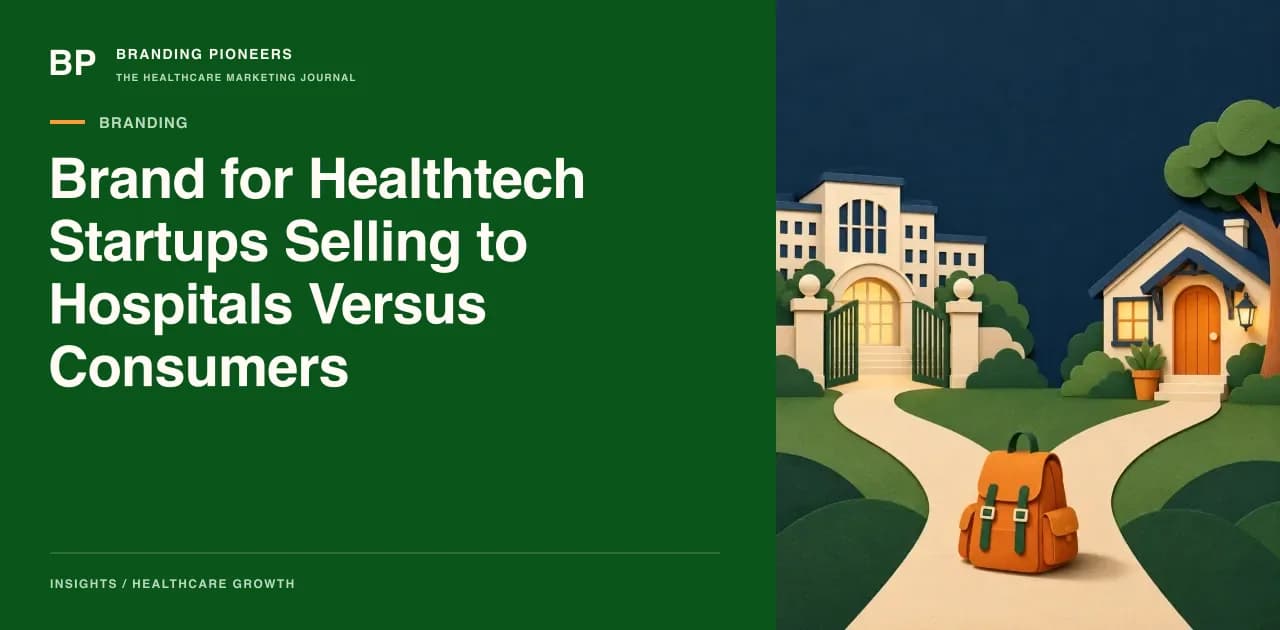
A healthtech startup that sells to hospitals and one that sells to patients are both in healthcare, yet their brands have almost nothing in common. A hospital chief information officer evaluating a clinical platform wants to see integration depth, security posture and references. A patient choosing a symptom checker or a medicine reminder wants to feel calm, understood and unembarrassed. A single brand voice cannot do both jobs well.

This article is for healthtech founders and marketing leads deciding how to position a product. It lays out how tone, proof, visual identity and channel choices should differ for B2B and B2C buyers, then covers hybrid models where a product reaches patients through hospitals. It builds on our general work on healthcare brand building for clinics and hospitals, and on the earlier digital health marketing guide for startups. Any claims about clinical performance need review by qualified people and, where relevant, regulatory advice.

Start with who decides, who uses, who pays

In healthcare, the user, buyer and payer are often different people. Map them before you design anything.

  • Hospital product: the user may be a nurse or doctor, the buyer a hospital IT or operations head with a purchasing committee, the payer the hospital, and the influencers include clinical leads, compliance, finance and sometimes promoters.
  • Consumer product: the user is a patient or carer, the buyer is the same person, and the payer is that person or, sometimes, an employer or insurer.
  • Hybrid: a hospital buys or distributes a product that patients use. The patient may never choose it.

Each role has different questions. Branding that speaks to the wrong role wastes its effort. A polished patient-friendly app site may impress a consumer and reassure no one in procurement.

The audience matrix

Use this as a working tool. The rows are brand decisions, and the columns are the audiences.

DecisionHospital buyer (CIO, ops, clinical lead)Patient or carer
Core questionWill this work with our systems, staff and risk profile?Will this help me, and can I trust it?
TonePrecise, calm, evidence-led, unhurriedWarm, plain, reassuring, respectful
VocabularyWorkflow, integration, audit trail, uptimeAppointment, reminder, report, family
ProofNamed deployments with permission, integration list, security documentation, clinical validationReviews, clear explanations, doctor involvement, privacy promises
Visual identityRestrained, structured, data-dense where neededOpen, friendly, generous space, human imagery
ImageryReal workflows, clinician settings, screensPeople, relationships, everyday life
Length of contentLong-form, documents, comparison tablesShort, scannable, mobile-first
Sales pathDemo, pilot, procurement, security reviewDownload or book in minutes
ChannelsLinkedIn, conferences, referrals, email, direct outreachSearch, app stores, social, WhatsApp, doctors' recommendations
Risk languageCompliance, liability, data handling, downtimePrivacy, cost, embarrassment, errors

The point of the matrix is not to create two companies. It is to make a deliberate choice about which audience a given asset serves.

Tone

For hospital buyers, write as a competent colleague. Say what the product does, what it needs and what it does not do. State limits openly: a buyer who finds an overclaim in the first paragraph assumes the rest is inflated. Avoid slogans. Replace them with a specific description of the workflow improved and the person whose time it saves.

For patients, write plainly and without alarm. Avoid medical jargon unless you explain it. Do not imply diagnosis unless the product is validated and cleared for that use. Patients are often anxious, so the register should be steady rather than cheerful.

In both cases, no outcome promises. For doctors who use or recommend your product, remember that advertising by doctors is regulated, and endorsement by a doctor must follow current rules. See the NMC advertising guidance before building doctor testimonials into your brand.

Proof

Proof is where the two audiences diverge most.

Hospital proof includes:

  • A clear explanation of integration approach with hospital information systems, lab and imaging systems, and billing, stated in terms an IT team can evaluate.
  • Security and data handling documentation: where data is stored, who can access it, how consent is handled. Hospitals will ask under India's data protection law, and the answer should be on a page, not only in a sales call.
  • Named references, with written permission, or described deployments such as "a 150-bed hospital in western India" if the customer declines to be named. Never invent a reference.
  • Evidence on outcomes only where you have it, with method and limitations. If you do not have clinical validation, do not imply it.
  • An implementation plan: who does what in the first ninety days.

Patient proof includes:

  • A transparent explanation of who built the product and who reviewed the content clinically.
  • Clear statements on privacy in plain language.
  • Reviews on app stores and Google, collected within platform rules.
  • Real screenshots and honest descriptions of what the product cannot do.
  • Evidence of a human behind the product: a support number that gets answered.

A common mistake is to use consumer-style testimonials in B2B materials, or enterprise jargon in consumer materials. Both erode trust.

Want this applied to your practice? Get a free branding audit.

Book my free audit

Visual identity

The two audiences do not need two logos, but they need different systems around the logo.

For a B2B brand, build a structured, flexible system: a restrained palette, a clear type hierarchy and layouts for tables, diagrams and screenshots. Plan for slide decks, one-pagers and security sheets, since these are the formats buyers pass between colleagues. Colour choices should look reliable on a projector and in print.

For a B2C brand, build a system for small screens and quick comprehension: large touch targets, generous spacing, simple illustration or photography, and accessible contrast. Test in the languages and scripts your users read. Avoid imagery that suggests illness in a way that frightens, and take care with images of patients and consent for any photography. Our guide to visual identity for healthcare practices covers the basics that apply to both.

For both, name and logo should survive trademark, domain and app store checks before you invest in either; the brand naming service covers them.

Channels

B2B healthtech sales are slow and relationship-heavy. Channels that work are those where buyers evaluate peers: professional networks, conferences, clinical advisory relationships, referrals from existing hospitals, and well-made case documents. Content that explains a problem in detail is more valuable than content that broadcasts a message. Our article on hospital executives on LinkedIn is relevant to how hospital leaders build visibility; the same networks are where you find them.

B2C healthtech runs on search, store listings and trust cues at the moment of need. Channels include search for symptoms and tasks, app store pages, short video, and doctor recommendations. Each of these is regulated by platform policy, so check the current rules for health-related advertising on any platform you use.

Hybrid models

Many healthtech products reach patients through hospitals: a patient app deployed by a hospital, a remote monitoring programme, a digital front door. These products need a deliberate brand architecture.

White-label. The hospital's brand is front-facing and yours is invisible. This serves the hospital, but you have no direct relationship with the patient and no consumer brand equity. Choose it when the hospital is your only customer and you want rapid adoption.

Co-branded. The patient sees both names: "[Hospital] Care, powered by [Your product]". This lends the hospital's trust to your product and your technical credibility to the hospital. Agree the terms for the use of each name and the exit position at the start.

Own-brand with hospital endorsement. Your product has its own consumer brand, and hospitals endorse it. You hold the patient relationship but must maintain consumer marketing. This is the most demanding model.

A decision rule: the more your growth depends on a few hospitals, the more reasonable white-label or co-branding is. The more you want an independent consumer base, the more you need your own brand from day one.

For hybrid products you also need two messages that do not contradict each other. If your hospital sales deck promises that the product reduces staff workload and your patient page promises that a person will respond to every message, check that both are true.

Common mistakes

  1. One site for everyone. The homepage tries to talk to patients, hospitals and investors at once. Fix by routing early: separate paths for each audience, with the homepage short.
  2. Consumer polish on enterprise products. Cartoon illustrations and casual language can signal a toy to a hospital buyer.
  3. Enterprise coldness on consumer products. A dense security-first message can overwhelm a patient.
  4. Claims ahead of evidence. Claims about diagnosis, accuracy or outcomes need validation and review. State the intended use carefully.
  5. Ignoring the influencers. The clinical lead and the compliance officer often decide the outcome. Create material for them specifically.
  6. No answer on data. In India, the DPDP Act and rules shape how health data should be handled. Our overview of healthcare marketing compliance is a starting point for marketing; your counsel must advise on the product.

Where to start

Write one page: for each audience, name the person, their top three questions and the proof you can offer today. Mark each proof item as available, partial or missing. Then audit your website and decks: for each asset, state which audience it serves, and whether the tone, proof and imagery fit. Fix the mismatches first. Once the picture is clear, the brand strategy work becomes a matter of deciding which gaps to close first.

Filed underhealthtech branding b2b vs b2chealthtech startup brand strategyselling to hospitals brandhealth app branding patientshospital CIO buyer messaging

About the author

Founder & CEO · Gurugram, India

Nishu founded Branding Pioneers in 2016 with one rule that hasn't changed since: healthcare only. She'd run digital strategy at a top-10 Indian agency and watched generalist marketing underserve medical clients who needed something built for how patients actually search and decide. So she left to build the specialist instead. It's now an 80-person team working with healthcare brands worldwide.

Free guide · 15 pages

The Patient Acquisition Blueprint

A 90-day plan from first search to booked appointment.

The Pioneers Brief — one essay, three benchmarks, one teardown, every Thursday. Subscribe free →

Free branding audit

Your next chapter starts with a conversation.

Three quick questions. We come prepared with a plan for your specialty and city.

  • A 30-minute call with a healthcare specialist
  • Your top three growth opportunities, in writing
  • Honest advice — even if that means not hiring us
  • No obligation and no hard sell
You’ll speak with a senior strategist
Consultations are hosted by Arush Thapar’s team.
Step 1 of 3Takes 30 seconds

What do you want to improve first?

Details stay privateNo obligationReply within 1 working day

Client portfolio · Brand identity & print

Work relevant to brand for healthtech startups selling to hospitals versus.

Explore client work →