Your Hospital Has a Brand. The Question Is Whether You Built It or Patients Built It for You.
Every hospital has a brand. Most just did not build it intentionally.
Walk into any healthcare market and ask patients what they think of the major hospitals. They will tell you instantly. "Apollo is premium but expensive." "Fortis has good doctors but the billing is confusing." "Max is modern and efficient." "The government hospital has the best surgeons but the facilities are old."
Those are brands. They were not designed in a boardroom. They were formed through patient experiences, word of mouth, Google reviews, and whatever impression the hospital's website and social media made. For most hospitals, the brand was an accident — the sum of a thousand uncoordinated decisions.
The hospitals that grow consistently are the ones that made branding intentional. Not just a logo refresh. A systematic effort to define what the hospital stands for, communicate it consistently across every touchpoint, and ensure that the patient experience matches the promise.
We have built healthcare brands for hundreds of organizations. Hospitals launching from scratch, established practices rebranding, multi-location chains building consistency. The principles that separate forgettable hospitals from memorable ones are surprisingly consistent.
What Healthcare Branding Actually Is (And Is Not)
Branding is NOT:
- A logo
- A color palette
- A tagline
- A glossy brochure
- A fancy website
Those are brand assets. They express the brand. They are not the brand itself.
Branding IS:
- The promise you make to patients (and whether you keep it)
- The feeling a patient has when they think of your hospital
- The reason a patient chooses you when they have 10 options
- The story your staff, your facility, your communications, and your patients tell about who you are
A hospital brand answers one question: "Why should a patient trust you with their health?" If you cannot answer that in one sentence, your brand is undefined. And an undefined brand is an invisible brand.
The Healthcare Brand Framework
We build healthcare brands using a four-layer framework. Each layer builds on the previous.
Layer 1: Brand Positioning — Who You Are and Who You Are Not
Positioning is the most important branding decision a hospital makes. It defines where you sit in the patient's mind relative to every other option.
The positioning statement format: "[Hospital Name] is the [category] for [target patient] who [need/want]. Unlike [competitor approach], we [key differentiator]."
Examples from our clients:
"CityBone Orthopedics is the joint replacement specialist for active adults over 50 who want to return to their lifestyle. Unlike multi-specialty hospitals where orthopedics is one department of many, we do nothing else — every doctor, every room, every piece of equipment is built for bones and joints."
"LifeSpring Women's Hospital is the maternity and fertility center for couples who want a personalized, low-intervention experience. Unlike large hospital chains where you are a file number, here your doctor knows your name, your birth plan, and your anxieties."
Notice what these statements do: they exclude. LifeSpring is not for patients who want every medical specialty under one roof. CityBone is not for children's orthopedics. Exclusion is what makes positioning powerful. A hospital that tries to be everything to everyone has no position.
Layer 2: Brand Identity — How You Look and Sound
Once you know who you are, you can design how you look and sound.
Visual identity:
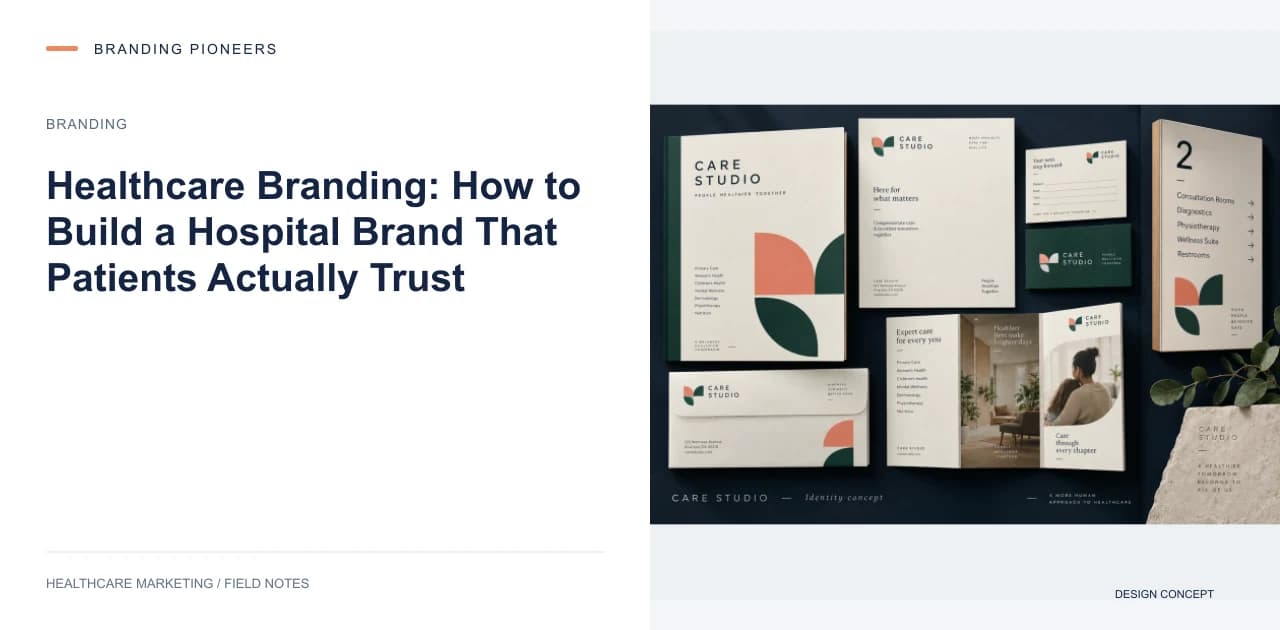
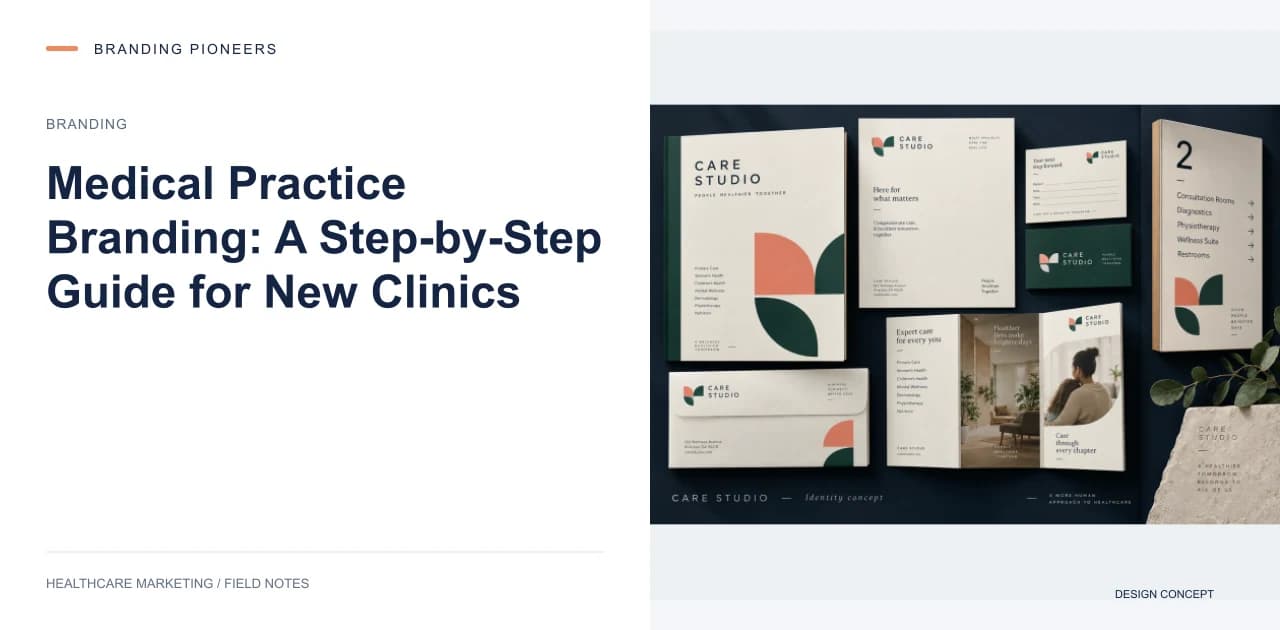
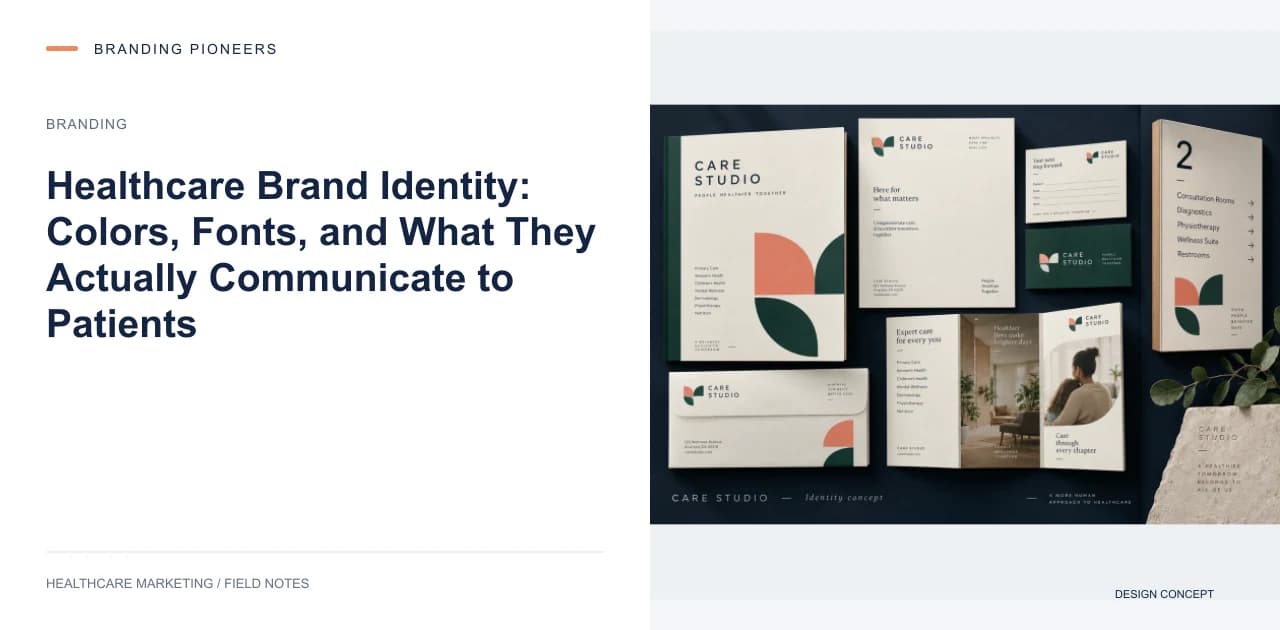
Healthcare visual design communicates trust before the patient reads a single word. The choices are not arbitrary:
Color psychology in healthcare:
- Blue: trust, reliability, competence (most common in healthcare for good reason)
- Green: health, growth, freshness (wellness-oriented practices)
- White + Blue: clinical precision, cleanliness (surgical and specialty hospitals)
- Warm tones (terracotta, sage): approachability, comfort (women's health, pediatrics, wellness)
- Purple: premium, specialized (cosmetic, fertility, private practices)
Typography: Sans-serif fonts (like the one you are reading) communicate modernity and clarity. Serif fonts communicate tradition and authority. Most healthcare brands should use sans-serif for body text and can use serif for headlines if they want to convey established expertise.
Photography: Real photos of your actual facility, staff, and (with consent) patients. Stock photos of smiling models in white coats holding stethoscopes actively damage trust. Patients can tell. And when they arrive at a facility that looks nothing like the website photos, trust erodes before the first interaction.
Voice and tone:
Your brand voice is how your hospital sounds in writing. It should be consistent across your website, social media, patient communications, and advertising.
We define healthcare brand voice across four dimensions:
| Dimension | Spectrum | Example |
|---|
| Formality | Casual ← → Formal | "Book your appointment" vs "Schedule a consultation with our specialist" |
| Warmth | Clinical ← → Empathetic | "Post-operative care protocol" vs "Here is how we take care of you after surgery" |
| Confidence | Humble ← → Authoritative | "We try our best" vs "10,000 procedures. Zero compromises." |
| Complexity | Simple ← → Technical | "Heart check" vs "Comprehensive cardiac risk assessment" |
Most hospitals should sit slightly right of center on formality (professional but not stiff), strongly right on warmth (patients are scared — be human), right on confidence (patients want to trust that you know what you are doing), and left of center on complexity (patients are not doctors — speak their language).
Layer 3: Brand Experience — What Patients Actually Feel
This is where most healthcare branding efforts fail. The logo is beautiful. The website is polished. And then the patient calls and sits on hold for 8 minutes, arrives at a reception desk where nobody makes eye contact, and sits in a waiting room with flickering fluorescent lights and a TV playing news at full volume.
The brand experience is every interaction a patient has with your hospital. It includes:
Pre-visit: Website usability. Phone answering speed and tone. Appointment booking ease. Confirmation and reminder messages.
Arrival: Parking and wayfinding. Reception desk warmth and efficiency. Waiting room environment (cleanliness, comfort, ambiance). Wait time.
During visit: Doctor's bedside manner. Staff attentiveness. Communication clarity. Perceived competence.
Post-visit: Billing transparency and ease. Follow-up communication. Discharge instructions clarity. Review request experience.
Every touchpoint either reinforces or undermines your brand promise. A hospital that promises "patient-first care" but makes patients wait 45 minutes past their appointment time is a hospital with a branding problem — not a marketing problem.
The brand experience audit: have someone who is not on staff go through the complete patient journey as a mystery patient. Document every touchpoint. Identify the 3 to 5 moments that most strongly shape the patient's perception. Fix those first.
Layer 4: Brand Communication — How You Tell the Story
With positioning, identity, and experience aligned, now you can communicate effectively.
Website: Your digital front door. It should communicate who you are in 5 seconds. Not through a mission statement — through visual design, headline copy, and the overall feeling. A visitor should instantly understand: what kind of hospital this is, what specialties you are known for, and whether this feels like the right place for them.
Social media: Where your brand becomes human. Behind-the-scenes clinic content, doctor introductions, patient stories (with consent), health tips in your brand voice. Consistency matters more than frequency — a post every other day that matches your voice is better than daily posts that feel random.
Patient communications: Every email, SMS, and WhatsApp message your hospital sends is a branding moment. Is the tone consistent? Does the message feel like it comes from the same organization as your website? Templates save time but must reflect your brand voice.
Advertising: Your ads are often the first impression. They must match the experience the patient will have. If your ads promise a luxury experience and the patient arrives to peeling paint, you have broken the brand promise. Advertise what you actually deliver — not an aspirational version.
The Branding Mistakes That Cost Hospitals Patients
Mistake 1: Copying competitor branding. If your brand looks, sounds, and feels like every other hospital in your market, you have no brand. You have camouflage. Study competitors to understand the landscape, then deliberately position differently.
Mistake 2: Branding by committee. When 12 people have input on the logo, you get a logo that offends nobody and inspires nobody. Branding decisions should be made by a small team (2 to 3 people) with clear decision-making authority. Seek input broadly. Decide narrowly.
Mistake 3: Prioritizing aesthetics over clarity. A beautiful logo that patients cannot read or remember is worse than a plain logo that is clear. Healthcare branding must prioritize legibility, recognition, and trust over creative cleverness.
Mistake 4: Inconsistency across locations. A hospital chain where each location has a slightly different logo, different website design, and different patient experience is not a brand. It is a collection of businesses. Multi-location consistency is one of the hardest and most valuable branding investments.
Mistake 5: Neglecting internal branding. Your staff are your brand ambassadors. If they do not understand the brand positioning, values, and voice, they cannot deliver the brand experience. Internal brand training is not a luxury — it is the mechanism that turns brand strategy into patient reality.
What Healthcare Branding Costs
| Scope | Investment | Timeline |
|---|
| Logo and basic identity | 50,000-2,00,000 | 2-4 weeks |
| Full brand identity system | 2,00,000-8,00,000 | 4-8 weeks |
| Brand strategy + identity + guidelines | 5,00,000-15,00,000 | 6-12 weeks |
| Complete rebrand (strategy + identity + website + collateral) | 10,00,000-40,00,000 | 3-6 months |
| Multi-location brand system | 15,00,000-60,00,000 | 4-8 months |
The ROI: a hospital that repositions from generic to differentiated typically sees a meaningful increase in new patient inquiries within 6 months. For a hospital generating 50 lakh per month in revenue, even a modest percentage increase translates into real monthly revenue — enough that the branding investment pays for itself within the first quarter.
Build Your Hospital Brand — Free Strategy Consultation →