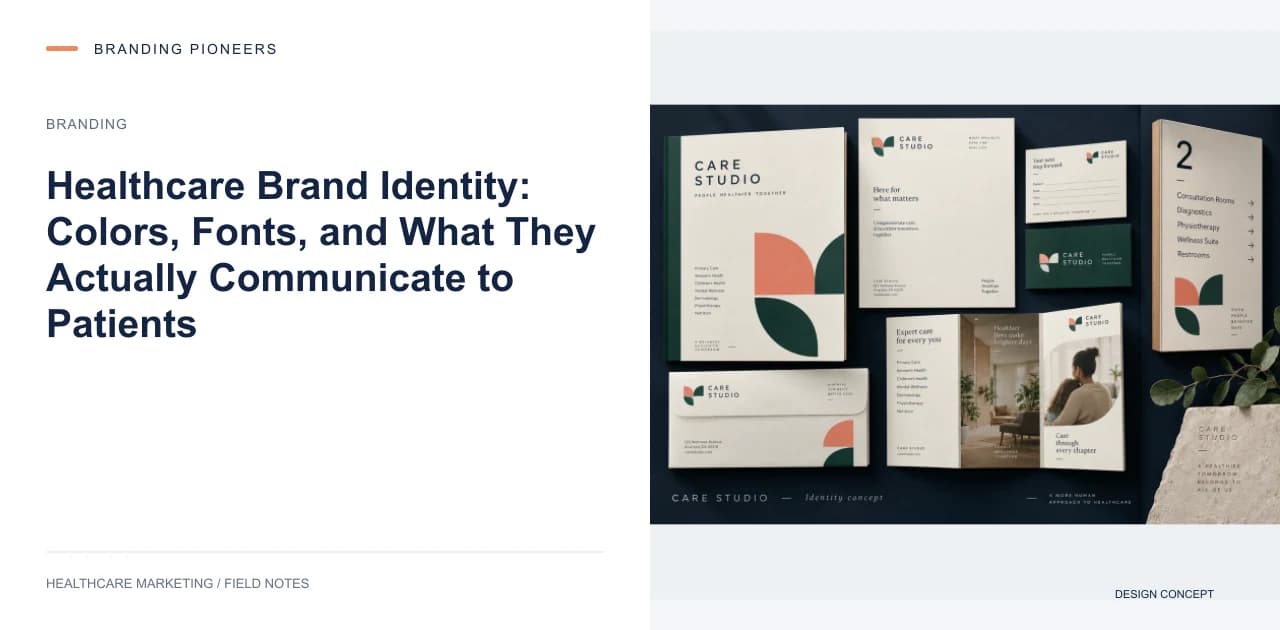
Patients Judge Your Hospital in 0.05 Seconds. Design Determines That Judgment.
A patient lands on your website. In 50 milliseconds — before they read the headline, before they see the services, before they know anything about your doctors — their brain has already formed an impression. Professional or amateur. Modern or outdated. Trustworthy or sketchy.
That judgment is made entirely by visual design: colors, typography, spacing, imagery, and overall composition. Research on first impressions consistently shows that visual complexity and color are among the primary drivers of trust judgments for websites, often before a visitor consciously processes any content. Not content. Not testimonials. The look.
For healthcare — where trust is the entire buying mechanism — this means your visual identity is not a cosmetic decision. It is a clinical one. A hospital with a dated website and cheap-looking logo is losing patients who never stayed long enough to discover the excellent doctors inside.
We have designed visual identities for 350+ healthcare brands. Here is what actually communicates trust, competence, and care — and what accidentally communicates the opposite.
Color Psychology in Healthcare: What the Research Shows
Color is not arbitrary in healthcare design. It triggers specific psychological associations that are remarkably consistent across cultures and demographics.
Blue: The Default for Good Reason
Blue is the most common color in healthcare branding, and the research supports why. Blue triggers associations of trust, reliability, competence, and calm. In a healthcare context, those associations translate directly into patient confidence.
When to use blue: Hospitals, multi-specialty centers, surgical practices, diagnostic chains. Any healthcare brand where the primary message is "you can trust us with your health."
The risk of blue: It is so common that it provides zero differentiation. If your city has 20 blue hospital logos, yours becomes invisible. The solution is not to avoid blue — it is to use a distinctive shade, combine it with an unexpected accent color, or use blue as a secondary element rather than the dominant one.
Shades matter:
- Navy/dark blue: authority, expertise, premium positioning
- Medium blue: approachable trust, corporate healthcare
- Light/sky blue: gentle, non-threatening (pediatrics, wellness)
- Teal (blue-green): modern, innovative, progressive
Green: Health, Growth, and Natural Medicine
Green communicates health, vitality, renewal, and nature. It is the second most common healthcare color.
When to use green: Wellness clinics, naturopathic practices, rehabilitation centers, fertility clinics (growth/new life association), hospitals emphasizing holistic care.
The risk of green: Overused in "wellness" branding to the point of cliche. If your logo is a green leaf, you are one of approximately 10,000 healthcare brands with the same concept.
White: Clinical Precision
White communicates cleanliness, sterility, and precision. In healthcare, it is the most powerful background color — it lets other elements breathe and creates the sense of clinical order patients expect.
When to use white: Generous white space in your website design. White is almost never a primary brand color but is always the dominant background.
Warm Colors: Approachability and Comfort
Orange: Energy, warmth, approachability. Works well for pediatric practices, urgent care, and dental (especially cosmetic dental).
Coral/terracotta: Modern warmth. Trending in women's health, maternity, and aesthetic medicine. Communicates premium approachability.
Yellow accents: Optimism and friendliness. Best used sparingly as an accent, not a primary color. Too much yellow reads as caution (the opposite of what you want in healthcare).
Red: Use With Extreme Caution
Red communicates urgency, intensity, and passion. In healthcare, it also communicates danger, blood, and emergencies. We generally advise against red as a primary brand color for healthcare practices.
The exception: Emergency medicine branding, blood banks, cardiac care (where the heart icon is inherently red), and some Indian hospital brands where red carries auspicious cultural connotations.
Purple: Premium and Specialized
Purple communicates luxury, specialization, and wisdom. It is underused in healthcare and therefore differentiating.
When to use purple: Cosmetic surgery, fertility clinics, private psychiatry practices, premium wellness centers, anti-aging medicine.
Typography: What Your Fonts Tell Patients
Typography communicates as powerfully as color but receives far less attention in healthcare branding.
Sans-Serif vs. Serif
Sans-serif fonts (Helvetica, Inter, Open Sans, Montserrat) communicate modernity, clarity, and accessibility. They are easier to read on screens. Most modern healthcare brands use sans-serif fonts for body text and digital interfaces.
Serif fonts (Times, Georgia, Merriweather, Playfair Display) communicate tradition, authority, and academic credibility. They work well for hospital brands wanting to convey established expertise and history.
Our recommendation: Sans-serif for body text across all digital touchpoints. Serif optional for headlines and print materials if the brand positioning emphasizes heritage and established authority.
Font Weight and Patient Perception
Light weights (thin fonts) communicate elegance and premium positioning. Best for cosmetic, wellness, and private practice brands.
Regular weights communicate neutrality and professionalism. Safe default for most healthcare brands.
Bold weights communicate confidence and strength. Best for surgical practices, emergency medicine, and brands wanting to project decisiveness.
Typography Mistakes in Healthcare
Using more than 2 font families. One for headlines, one for body text. That is it. Three or more fonts create visual chaos that reads as unprofessional.
Using decorative or script fonts for medical content. A script font for a hospital name might look elegant on a business card. It is illegible at small sizes, unreadable on mobile, and communicates frivolity — the opposite of what a patient wants from their surgeon.
Inconsistent font sizing. Body text should be 16px minimum on web (many hospital websites still use 12 or 14px, forcing patients to squint). Heading hierarchy should be clear and consistent.
Logo Design for Healthcare: What Works
A healthcare logo needs to accomplish four things:
- Be instantly recognizable at any size (from a website favicon to a building sign)
- Communicate the specialty or positioning at a glance
- Feel trustworthy and professional
- Be distinct from competitors in the same market
Logo Types That Work
Wordmark (text only): The practice name in a distinctive typeface. Clean, simple, versatile. Works best when the name is short and distinctive. Examples: Apollo, Max Healthcare.
Lettermark (initials): For hospitals with long names. "AIIMS" works better as a lettermark than "All India Institute of Medical Sciences" as a wordmark.
Icon + wordmark: A symbol alongside the name. The most common approach in healthcare. The icon provides visual recognition; the wordmark provides clarity. Works well for practices building a new brand.
Logo Elements to Avoid
- The caduceus (two snakes on a winged staff). Overused to the point of meaninglessness. It also technically represents commerce, not medicine — the Rod of Asclepius (one snake, no wings) is the actual medical symbol. But even that is a cliche.
- A red cross. The red cross is a protected symbol (owned by the International Red Cross). Using it without authorization is technically illegal in many jurisdictions and communicates ignorance.
- Heart shapes for cardiac hospitals. Too obvious. Also used by dating apps, Valentine's Day cards, and charity organizations. Your cardiac center deserves more creative thinking.
- Generic leaf/tree/sun/globe icons. These communicate nothing specific about healthcare and look like 10,000 other logos across various industries.
What Works Instead
Abstract marks that suggest concepts related to your specialty without being literal. A subtle suggestion of a spine curve for an orthopedic brand. Overlapping circles suggesting connection for a fertility clinic. A clean geometric form that feels modern and precise.
The best healthcare logos we have designed share one trait: they are simple enough to be recognizable at 16x16 pixels (favicon size) and distinctive enough to be remembered after one exposure.
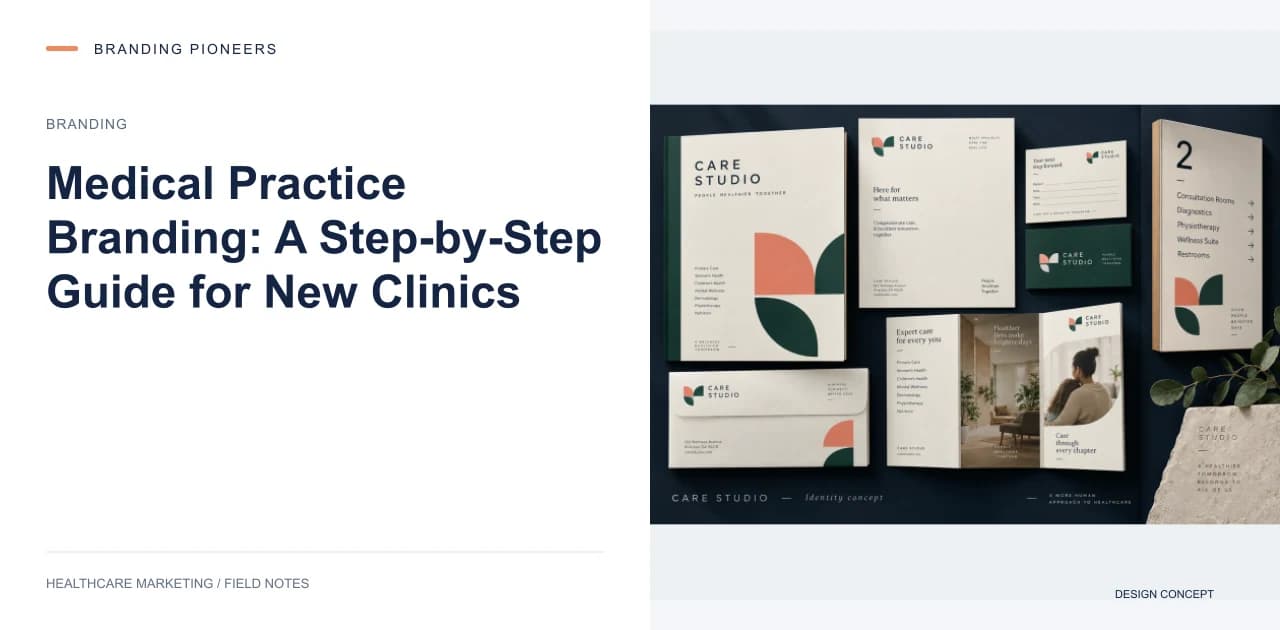
Putting It All Together: The Brand Style Guide
Every healthcare brand needs a documented style guide that ensures consistency. Minimum contents:
- Logo usage: Primary logo, secondary versions, minimum sizes, clear space rules, what not to do
- Color palette: Primary colors with hex codes, secondary colors, usage ratios
- Typography: Font families, weights, sizes for different applications
- Photography style: Guidelines for imagery — real photos, style, lighting, composition
- Voice and tone: How the brand sounds in writing (covered in our branding article)
- Application examples: Business cards, letterhead, signage, website, social media templates
This guide becomes the reference document for everyone who creates anything for your hospital — from the marketing team to the signage vendor to the website developer. Without it, brand consistency is impossible.
Design Your Healthcare Brand Identity — Free Consultation →
Filed underhealthcare brand identityhospital color psychologymedical brand designhealthcare visual identityhospital logo design

About the author
Nishu Sharma
Founder & CEO · Gurugram, India
Nishu founded Branding Pioneers in 2016 with one rule that hasn't changed since: healthcare only. She'd run digital strategy at a top-10 Indian agency and watched generalist marketing underserve medical clients who needed something built for how patients actually search and decide. So she left to build the specialist instead. It's now an 80-person team working with healthcare brands worldwide.
Free guide · 17 pages
The Patient Acquisition Blueprint
A 90-day plan from first search to booked appointment.