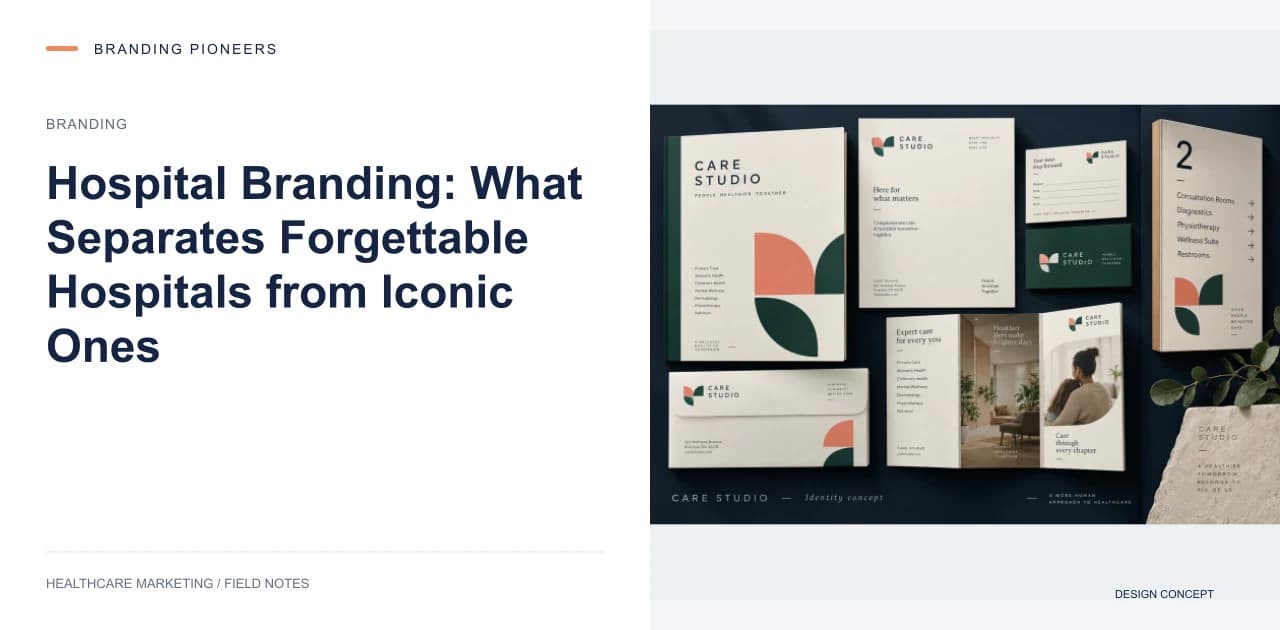
Two Hospitals. Same City. Same Specialties. One Has a 6-Month Waiting List. The Other Has Empty Beds.
In every major city, this story exists. Two hospitals with similar capabilities, similar accreditations, similar doctor credentials. One is the name that comes to mind when anyone mentions healthcare. The other is the one you drive past without noticing.
The difference is not clinical quality. It is not infrastructure. It is brand.
The iconic hospital has a clear identity that patients, doctors, and the community understand. When someone says "I need heart surgery," a specific hospital name comes to mind. That mental association — the automatic connection between a need and a name — is the ultimate branding achievement.
We have built brands for hundreds of healthcare organizations. Some of them were already known but unfocused. Others were starting from zero. The principles that elevate a hospital from forgettable to iconic are consistent across markets, sizes, and specialties.
What Makes a Hospital Brand Iconic
Principle 1: Own a Category, Not a Feature
Forgettable hospitals list their features: "500 beds, 30 specialties, latest technology, experienced doctors." Every hospital says this. It is background noise.
Iconic hospitals own a category in the patient's mind:
- Narayana Health owns affordable cardiac care. Not just cardiac. Not just affordable. The specific intersection of world-class heart surgery at prices accessible to ordinary Indians.
- Memorial Sloan Kettering owns cancer treatment. If you say "cancer hospital" to an American, MSK is in the first three names they think of.
- Moorfields Eye Hospital (London) owns ophthalmology. Not a multi-specialty hospital that also does eyes. Eyes. That is it.
You do not need to be a single-specialty hospital to own a category. Apollo is multi-specialty but owns "premium corporate healthcare in India." Max owns "technology-forward healthcare" in Delhi NCR. Manipal owns "academic medical excellence in South India."
The question for your hospital: when someone says your name, what category does it occupy in their mind? If the answer is "it's a hospital," you have a positioning problem.
Principle 2: One Story, Told Consistently
Iconic hospital brands have a origin story, a mission narrative, and a patient promise that everyone — from the CEO to the security guard — can articulate.
Narayana Health's story: Dr. Devi Shetty wanted to make heart surgery affordable for every Indian. That narrative drives every decision — from pricing to hospital design to location choices. Every employee understands it. Every patient feels it.
Your story does not need to be as dramatic. But it needs to exist:
- Why was this hospital founded?
- What problem were the founders trying to solve?
- What does this hospital believe about healthcare that competitors do not?
- What would patients lose if this hospital did not exist?
We have helped women's hospitals find their story this way: a founder who was a gynecologist frustrated by how impersonal large hospitals treated pregnancy — like a medical condition instead of a life event. The hospital is built around the idea that birth is a celebration, not a procedure. That story then permeates everything — the website, the interior design, the staff training, the marketing. It becomes a story patients remember and repeat.
Principle 3: Consistency Across Every Touchpoint
This is where most hospitals fail. They invest in a beautiful logo and website, then the patient calls and hears a robotic IVR menu, waits in a dingy reception, and receives a discharge summary printed on cheap paper with a different logo than the website.
Every touchpoint is a brand moment. The hospital brand is the sum of all these moments:
| Touchpoint | Brand-Building Example | Brand-Damaging Example |
|---|---|---|
| Website | Fast, clear, easy booking | Slow, cluttered, broken on mobile |
| Phone call | Answered in 2 rings, warm greeting | Hold music for 5 minutes, robotic tone |
| Reception | Eye contact, name used, clear directions | Nobody looks up, "take a number" |
| Waiting area | Clean, comfortable, engaging, on-time | Crowded, noisy, 45-minute wait past appointment |
| Doctor interaction | Listens, explains clearly, unhurried | Rushed, jargon-heavy, dismissive |
| Billing | Transparent, explained upfront, easy payment | Surprise charges, confusing itemization |
| Follow-up | Personal check-in call or message | Nothing until the next appointment |
The hospitals we brand go through a touchpoint audit. We document every patient interaction and score it against the brand promise. The gaps between promise and reality become the priority fixes — before we touch the logo or website.
Principle 4: Invest in What Patients See First
The sequence of how patients encounter your brand matters. Most patients experience your hospital in this order:
- Google search result (name, rating, snippet)
- Website (homepage, service page, doctor profile)
- Phone call or WhatsApp (first human interaction)
- Physical arrival (building exterior, parking, reception)
- Clinical experience (doctor, staff, treatment)
Most hospitals invest heavily in #5 (clinical quality) and #4 (facility design) while neglecting #1, #2, and #3. But patients form their initial trust judgment before they ever see your building. If the Google result looks poor, the website feels outdated, and the phone call is frustrating — many patients never get to experience the excellent clinical care inside.
The iconic hospitals invest in the entire sequence. The Google presence is optimized. The website is world-class. The phone experience is warm and efficient. The facility matches the promise. And the clinical care delivers.