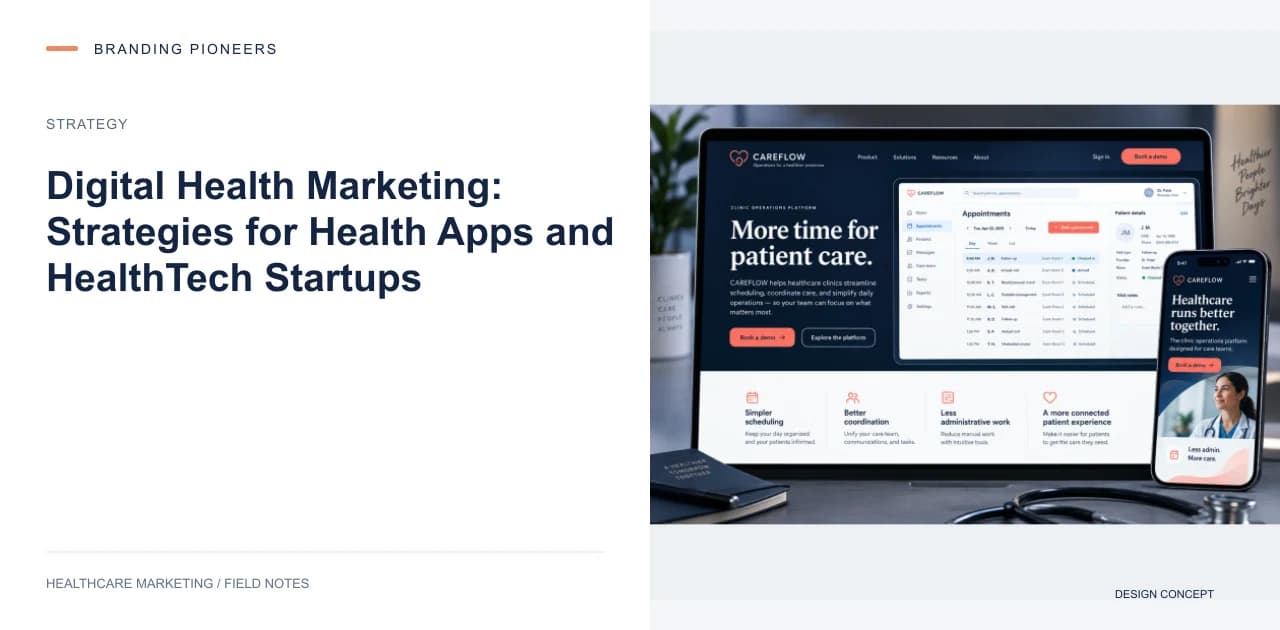
Health Apps Have a Usage Problem, Not a Download Problem
India has over 4,000 health apps listed on the App Store and Google Play. Most of them have decent download numbers. Almost none of them have decent retention numbers.
The average health app loses the vast majority of its users in the first three days. Pharmacy apps, fitness trackers, chronic disease management apps, mental health apps — the pattern holds across categories. Patients download, open once, and disappear.
This is not primarily a product problem. It is a marketing problem — specifically, a mismatch between what the marketing promises and what the product delivers in the first session. And it is compounded by a fundamental misunderstanding of how healthcare adoption works.
Healthcare decisions follow a different logic than consumer app decisions. A patient who downloads a food delivery app wants immediate gratification. A patient who downloads a diabetes management app is in a health crisis, anxious, and looking for evidence — not a gamified onboarding flow designed by a 24-year-old product manager who has never managed a chronic disease.
HealthTech marketing that works understands this distinction. Here is what it looks like in practice.
The Two-Audience Problem Every HealthTech Brand Faces
Most health apps and platforms have two distinct audiences, and marketing to one often undermines the other.
The clinician audience: Doctors, nurses, hospital administrators, and health system procurement teams. They care about clinical validity, interoperability with existing systems (ABDM compliance, HL7, FHIR), regulatory standing, and — critically — whether using your product will embarrass them professionally if it gives bad advice.
The patient audience: People managing a health condition, monitoring their wellness, or looking for access to care they cannot easily get otherwise. They care about simplicity, trust, privacy, and whether the product actually helps them feel better or understand their health.
Marketing to clinicians with patient-facing messaging (gamification, lifestyle branding, motivational messaging) gets you dismissed before you get to the demo. Marketing to patients with clinician-facing messaging (clinical validation, regulatory credentials, EHR integration specs) confuses and intimidates people who just want to know if the app can remind them to take their metformin.
The brands that crack both simultaneously — 1mg, mfine, Niramai (breast cancer screening AI), Innovaccer — do so by maintaining clear separation between B2B and B2C marketing strategies, even if the underlying product is the same.
Marketing to Clinicians: What Actually Works
Channel 1: Medical Conferences and CME Events
The Indian medical conference circuit — AIIMS CMEs, IMA regional events, specialty society meetings (Cardiological Society of India, API, IAP) — is where clinical adoption starts. Not through a booth with a roll-up banner, but through clinical presentations.
Get your medical advisor or a respected physician who uses your product to present a case study. "How [App Name] reduced glycemic variability in 200 Type 2 patients at [Named Hospital]" is infinitely more persuasive to a room of endocrinologists than any marketing material.
The follow-up matters more than the presentation. Have a system for collecting cards and following up within 48 hours with the clinical data presented, the evidence base, and a personal demo invite.
Channel 2: PubMed-Indexed Validation
Nothing moves a hospital procurement decision faster than a peer-reviewed paper. If your product has been validated in a clinical study, get it published. Even a small pilot study in a respected Indian medical journal carries enormous weight.
The paper becomes the marketing asset. Share it on LinkedIn, attach it to demo requests, put it on your website, reference it in sales conversations.
Portea Medical built significant institutional credibility through clinical outcome publications in their early years. The studies did not just validate efficacy — they gave sales teams a credibility accelerant that no ad campaign could replicate.
Channel 3: Integration With Hospital Procurement Channels
In India, hospital software adoption increasingly follows ABDM (Ayushman Bharat Digital Mission) integration pathways. If your app is ABDM-compliant and integrates with popular HMIS systems like HIS Infor, Epic India implementations, or locally built systems, that is a procurement checkbox that gets you past the IT department gatekeeper.
Market this integration explicitly. Not buried in a features page — on your homepage, in your sales deck, and in LinkedIn content targeted to CIOs and CMOs at hospital groups.
Marketing to Patients: The Retention-First Framework
Step 1: Fix the First-Week Experience Before Scaling Ads
Every rupee spent acquiring patients into an app that loses the vast majority of users in three days is wasted. Before running user acquisition campaigns, measure and fix your Day 3 and Day 7 retention.
What drives retention in health apps:
- A meaningful insight delivered in the first session (not setup screens and permissions — an actual piece of information the patient did not have before)
- A clear reason to return tomorrow (reminder, scheduled check-in, daily log)
- Human touchpoint within the first 48 hours (automated but personalized message from a health coach or care navigator)
Tricog Health (cardiac diagnostics) maintained high user retention by ensuring that every first scan produced a report that patients received, understood, and could discuss with their doctor. The first experience was meaningful because it delivered clinical value immediately.
Step 2: Content Marketing That Addresses Real Fears
Patients researching health apps search with fear-based queries. "Is diabetes management app safe?" "Can I trust [app name] with my health data?" "Does app replace doctor?"
Content that addresses these fears directly — not deflects them — builds trust and drives downloads from high-intent searchers.
Blog content framework for health apps:
- "[Condition] self-monitoring: what you can track yourself and when you need a doctor"
- "How we protect your health data: [App name]'s privacy approach"
- "What a health app can and cannot do for your [condition]"
- Patient stories: specific people, specific conditions, specific outcomes
Step 3: Influencer Channels That Are Actually Relevant
Health app marketing through generic lifestyle influencers has a terrible track record. A fitness influencer with 500,000 followers promoting a diabetes management app to their audience of 25-year-old gym-goers is a category mismatch.
The influencers that work for health apps:
Doctor-creators: not for endorsements. Physicians with YouTube channels or Instagram accounts reach exactly the right audience, which is why paid app endorsements by doctors used to be a staple of health-app launches. In India that route is now closed: the National Medical Commission's guidelines of 6 October 2026 bar a registered doctor from giving any approval, recommendation or endorsement for a health or commercial product, paid or unpaid (para 8.1(iv)), and from letting their name, image or voice be used to promote one (para 8.1(ii)). A doctor can still advise you on clinical content, or take part in disclosed, non-promotional public-health education. See our NMC guide.
Patient community leaders: Moderators of large Facebook groups for diabetes, thyroid, PCOS, cancer recovery. These people have deep trust with exactly your target audience. Many will partner for free or for nominal fees if the product genuinely helps their community.
Condition-specific creators: YouTube channels that explain living with a chronic condition. Search "diabetes India YouTube" and you will find creators with 100,000 to 500,000 subscribers who produce content specifically for diabetic patients. A review or integration of your app into their content can drive highly qualified downloads.
Step 4: App Store Optimization — The Overlooked Channel
ASO (App Store Optimization) is the health app equivalent of SEO and most startups ignore it completely. Google Play and App Store search accounts for the majority of app discoveries.
Optimize for:
- Title: include your primary condition keyword ("Diabetes Management App")
- Subtitle: secondary benefit ("Track Blood Sugar, Meals, Medications")
- Description: include all relevant condition terms patients might search
- Screenshots: show actual patient benefits, not UI design porn
- Reviews: prompt satisfied users to review; respond to every negative review publicly
Apps in the health category that have strong ASO see far higher organic download rates than similar apps with weak store optimization.
Pricing and Monetization Messaging
Indian patients are extremely price-sensitive about health apps. Even apps with clear clinical value face resistance at subscription price points above ₹200/month.
Marketing must make the value-vs-cost calculation obvious:
- "₹199/month vs ₹2,000 per specialist consultation" (comparison framing)
- "Free for the first month — see if it helps before paying" (risk reversal)
- "Hospital partners get family plans at ₹99/month" (partnership pricing)
The freemium model with clear upgrade triggers is the most successful monetization path in Indian health apps. The free tier must deliver real value — not crippled functionality that frustrates users into paying.
The Regulatory Reality of Health App Marketing in India
Digital health apps in India face specific advertising restrictions:
- Claims of treating, curing, or preventing any disease are prohibited without clinical evidence and regulatory approval
- Apps that process health data must be PDPB-compliant (Personal Data Protection Bill framework)
- Mental health apps face specific guidelines from the NIMHANS model framework
Phrases to avoid in marketing: "cures," "treats," "reverses," "eliminates disease." Phrases that are fine: "helps manage," "supports monitoring," "assists in tracking."
Your legal team should review all marketing copy before publication. One regulatory violation can ground an entire marketing campaign.
Scale Your HealthTech Startup — Marketing Strategy Session →
Filed underdigital health marketinghealth app marketinghealthtech startup marketinghealthcare SaaS marketingpatient engagement app marketing

About the author
Nishu Sharma
Founder & CEO · Gurugram, India
Nishu founded Branding Pioneers in 2016 with one rule that hasn't changed since: healthcare only. She'd run digital strategy at a top-10 Indian agency and watched generalist marketing underserve medical clients who needed something built for how patients actually search and decide. So she left to build the specialist instead. It's now an 80-person team working with healthcare brands worldwide.
Free guide · 17 pages
The Patient Acquisition Blueprint
A 90-day plan from first search to booked appointment.