The National Capital Region is treated as one market by almost every healthcare marketing plan written for it, and that is the first mistake. Delhi, Gurugram, Noida, Ghaziabad and Faridabad have distinct patient populations, distinct price expectations, distinct competitive fields, and — critically — distinct travel behaviour. A patient in Noida will cross into Delhi for a major surgical procedure. They will not cross for a dermatology follow-up.
The practical rule: for outpatient volume, market to your own sub-region. For high-acuity and surgical work, market to the whole region and beyond it.
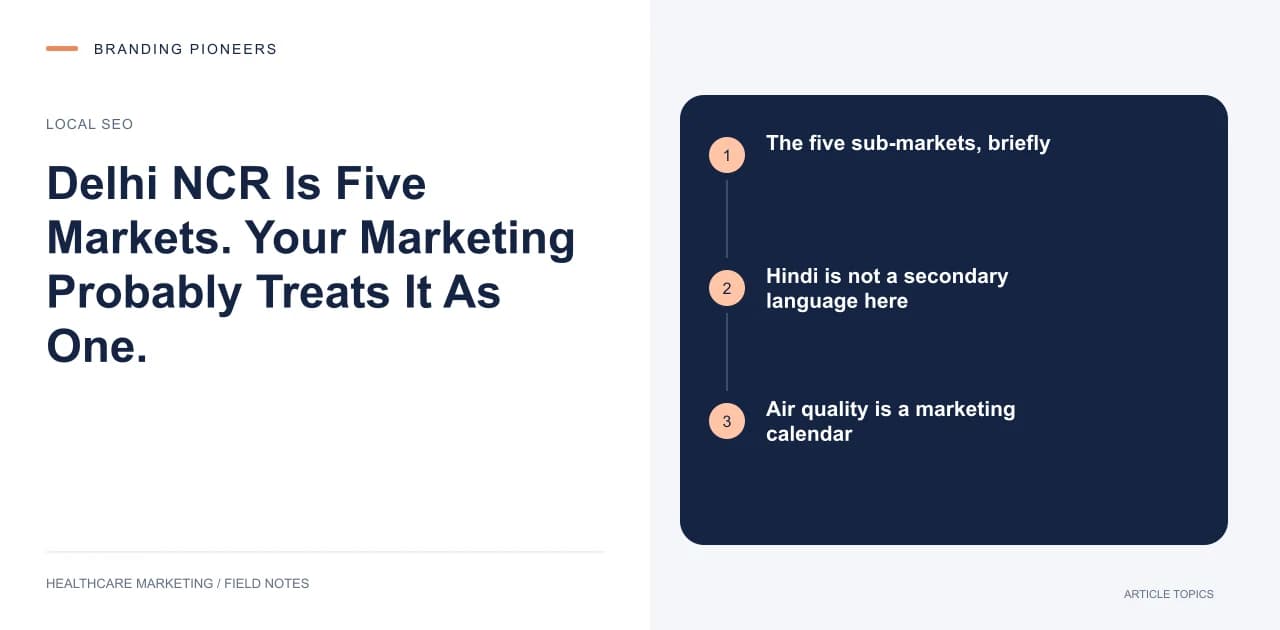
The five sub-markets, briefly
Central and South Delhi — the densest concentration of established institutions and senior consultants, brand-heavy search results, and patients who often come by referral rather than search.
Gurugram — corporate-employed, comprehensively insured, English-first, high expectations about booking and access, and a strong preventive and elective segment.
Noida and Greater Noida — a growing, younger population with substantial new capacity, less entrenched brand loyalty, and therefore more genuinely winnable search demand.
Ghaziabad and East Delhi — highly price-aware, Hindi-first search, strong reliance on local reputation and word of mouth.
Faridabad and the southern edge — mixed, with meaningful catchment drawn from Haryana beyond the NCR boundary.
Deciding which of these you actually serve, and building for it, will do more than any tactical change.
Hindi is not a secondary language here
A very large share of NCR health search happens in Hindi — mostly transliterated into Roman script rather than Devanagari, and increasingly by voice. Older patients, and the adult children searching on their behalf, phrase queries conversationally and in Hindi even when they will happily consult in English.
What that means in practice: build your keyword picture from how patients actually phrase symptoms in Hindi, not from a translated English list. Structure content around questions, because that is the shape of voice search. And write any Hindi content natively — translated clinical Hindi is immediately recognisable and it works against you.
Air quality is a marketing calendar
NCR has one of the most predictable disease seasonalities of any Indian market, and remarkably few practices plan around it.
- October to January brings a sustained rise in respiratory presentations across paediatrics, pulmonology, ENT, allergy and ophthalmology as air quality deteriorates.
- August to October brings vector-borne illness after the monsoon.
- Winter shifts cardiac presentations.
- Summer brings heat-related illness and dermatological presentations.
Content published six to eight weeks ahead of each of these captures demand as it forms. Published during the peak, it arrives after patients have already chosen. This is the single easiest planning improvement available to an NCR practice, and it is genuinely useful content rather than promotional filler — which is why it works.
The inbound medical travel flow
NCR receives the largest volume of international patients travelling to India for treatment, particularly from Bangladesh, Afghanistan, Central Asia, parts of Africa and the CIS countries. For practices in cardiac care, orthopaedics, oncology, transplant, fertility and neurology, this is a substantial and under-served demand pool.
It is also a completely different marketing build:
- Language. Genuine content in the languages of your actual patient origin countries, written rather than translated, and staff who can hold a conversation.
- The whole journey. Total duration, where accompanying family stays, what the all-in cost range looks like including everything that is not the surgical fee, and what follow-up looks like after the patient goes home.
- Remote first opinion. The decision to travel is made before the enquiry converts. Whoever provides a considered remote opinion usually receives the patient.
- Response time in the patient's time zone. An enquiry answered eighteen hours later has already been answered by someone else.
- Documentation clarity. Visa category, medical documentation, attendant permissions. Publishing this plainly builds more trust than any brand claim.
Regulatory care matters here too: outcome claims, success-rate figures and comparative superlatives are restricted for Indian practitioners regardless of which country the patient is reading from.
The second-opinion market
NCR patients seek second opinions at a high rate, especially for surgical recommendations and oncology. That behaviour is a marketing channel most practices do not serve deliberately. A clear, well-explained second-opinion pathway — what to send, what it costs, how long it takes, what you will and will not be able to say remotely — captures patients at exactly the moment they are reconsidering. It is honest, useful, and competitively distinct.
Local fundamentals, done properly
None of the above substitutes for the basics, which most practices still get wrong:
- Google Business Profile per genuine location, correct primary category, accurate hours, real photographs including the entrance and parking, and directions written the way people actually navigate — nearest metro station and the landmark on the corner.
- Own your name. Searching a practitioner's name should return their own profile page, not an aggregator listing.
- Multi-location consultants handled cleanly. A listing only where genuine scheduled hours exist; the website profile carries the full picture. Duplicate and unsupported listings get suspended, and recovery is painful.
- WhatsApp as the primary enquiry channel, answered fast. Forms underperform badly in this market.
- Reviews replied to briefly and factually, never confirming that anyone was a patient.
What not to do
Competition here pushes practices toward claims they should not make — best in Delhi, highest success rate, guaranteed results. Beyond the regulatory exposure (the NMC's 2026 advertising guidelines name "best" and success-rate claims explicitly, in paras 8.1(iii) and 8.1(ix)), this segment of the market has seen enough of it that the claims now read as low-trust. Depth, transparency and responsiveness are both safer and, in this particular field, more persuasive.
Our market pages for Delhi, Gurugram and Noida cover the sub-regions, and the medical tourism guide covers the inbound build. If you want help deciding which NCR market you are actually competing in, we will map it with you.
Filed underdoctor marketing Delhi NCRclinic SEO Gurugramhealthcare marketing Delhimedical tourism Delhihospital marketing Noida

About the author
Nishu Sharma
Founder & CEO · Gurugram, India
Nishu founded Branding Pioneers in 2016 with one rule that hasn't changed since: healthcare only. She'd run digital strategy at a top-10 Indian agency and watched generalist marketing underserve medical clients who needed something built for how patients actually search and decide. So she left to build the specialist instead. It's now an 80-person team working with healthcare brands worldwide.
Free guide · 17 pages
The Patient Acquisition Blueprint
A 90-day plan from first search to booked appointment.