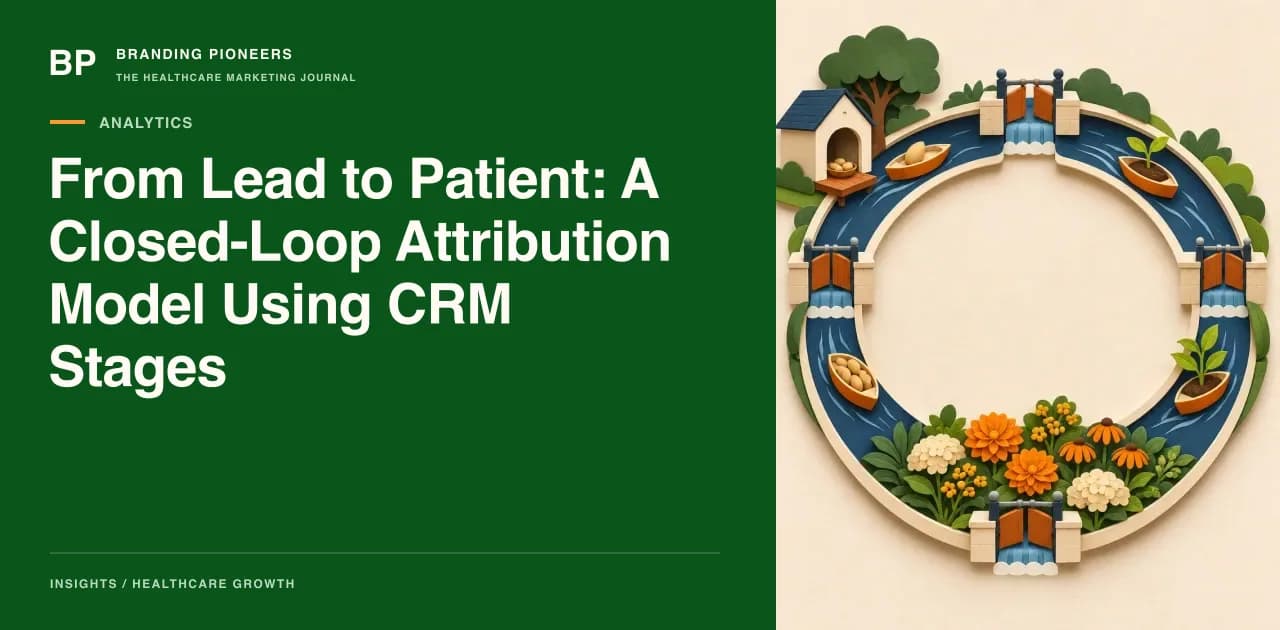
This post is for hospital marketing heads and analytics owners who can already see leads by channel in their ad platforms and want to know which channels produce patients. It assumes you have, or are about to set up, a CRM where enquiries are logged. The method is a stage model: a short list of lead states, a small set of fields stored on each lead, and rules for giving a channel credit at each stage.
The reason to do this is that platform reports stop at the form fill or the call. A campaign that produces many cheap enquiries can look excellent in the ad account and still deliver few consultations. Another campaign with fewer, more expensive enquiries can be the one that fills the operating list. Only a record that follows the person from first click to consultation to procedure can tell you which is which.
Nothing here requires patient-level clinical data to reach marketing. The model works on stage names, timestamps, source fields and, later, a revenue band. Clinical content stays in the hospital information system, and any procedure advice stays with the treating team.
Why platform conversions are the wrong finish line
Ad platforms optimise toward the event you give them. If the only event is a form submission, the system learns to find people who submit forms. In healthcare that population includes people comparing prices, people with the wrong condition for the department, students, and duplicate enquiries from relatives. None of them are bad people, but they are not the same as people who attend a consultation.
Google's own guidance on offline conversion import describes the principle: capture the click identifier when the lead is created, then send a later conversion back against that click. The current offline conversion import help page calls the file-based method legacy and points to other routes, but the logic of importing a later stage is unchanged. The enhanced conversions for leads documentation describes the related route that matches hashed first-party data from the lead form to an imported offline conversion.
A closed-loop model is the discipline that makes those imports possible. Before you can send "consult done" back to an ad platform, the CRM must know that a consult was done, for which lead, and where that lead came from.
Define six stages and write them down
Stage definitions fail when they are vague. Agree them with the call centre, the front desk and the department coordinators, then publish them as a one-page definition. A workable set for a hospital:
| Stage | Definition | Who sets it |
|---|---|---|
| New lead | Enquiry received by form, call, chat or walk-in log | Automatic or call centre |
| Qualified | Right department, reachable, genuine intent to book | Call centre |
| Consult booked | Slot confirmed with a doctor and date | Call centre or front desk |
| Consult done | Patient attended; visit confirmed by front desk | Front desk |
| Treatment advised | Doctor has recommended a procedure or course | Department coordinator |
| Procedure done | Admission or procedure completed and billed | Billing, via a stage update |
Two rules keep this honest. A stage can only be set by the person or system named for it. And a stage change always records a timestamp, because the gaps between timestamps are the data you will use later for payback and for channel comparison.
Add terminal states as well: lost with a reason (price, location, went elsewhere, no response, wrong department) and duplicate. A lead without a reason code is a missing data point, not a neutral outcome.
Store these fields on every lead
Attribution quality depends on what you capture at the moment of creation. A minimal record:
lead_id: your own identifier, never a phone number or name.created_atandchannel_of_entry: form, call, WhatsApp, walk-in.first_source,first_medium,first_campaign: the UTM values at first visit.last_source,last_medium,last_campaign: the values from the visit that produced the enquiry.click_idandclick_id_type: the Google or Meta click identifier, where present.departmentandservice_line: for example orthopaedics, joint replacement.stageandstage_updated_at, plus one timestamp column per stage.lost_reason.revenue_band: a coarse band such as A, B or C, filled in at the last stage.
Google's URL builder guidance notes that campaign parameter values are case sensitive and that missing parameters appear as (not set) in reporting. The same is true in a CRM. If one team writes "Google" and another "google", you will count two sources. Normalise to lower case on entry.
Keep personal data out of marketing URLs. Google's guidance on avoiding PII in Analytics says that neither the URL path nor its parameters should contain personally identifiable information, and that this includes campaign parameters. Use the lead_id for joining, not an email address or phone number in a link.
Rules for giving a channel credit
You have two separate jobs: understand which channels start journeys, and decide which channels deserve budget. Different rules suit each.
Origination credit goes to the first source on the lead. It answers: where did this patient first come from? It suits brand and discovery channels such as YouTube, local search and social video, which rarely close the loop on their own.
Conversion credit goes to the last non-direct source before the enquiry. It answers: what prompted the enquiry? It suits search ads, WhatsApp click-to-chat and call extensions.
Report both side by side at every stage rather than choosing one. If a channel looks strong on origination credit and weak on conversion credit, it is feeding other channels. If it is strong on conversion credit and weak on origination, you are harvesting demand someone else created, which is fine until the creating channel is cut.
For phone and walk-in enquiries, a rule is needed for the unknown. Do not leave them as "direct". Tag them with the call-tracking number's source if you use dynamic numbers, or with the visit code process described in the offline attribution method. An enquiry marked "unknown" should be visible on the dashboard as its own line so its share is not hidden.