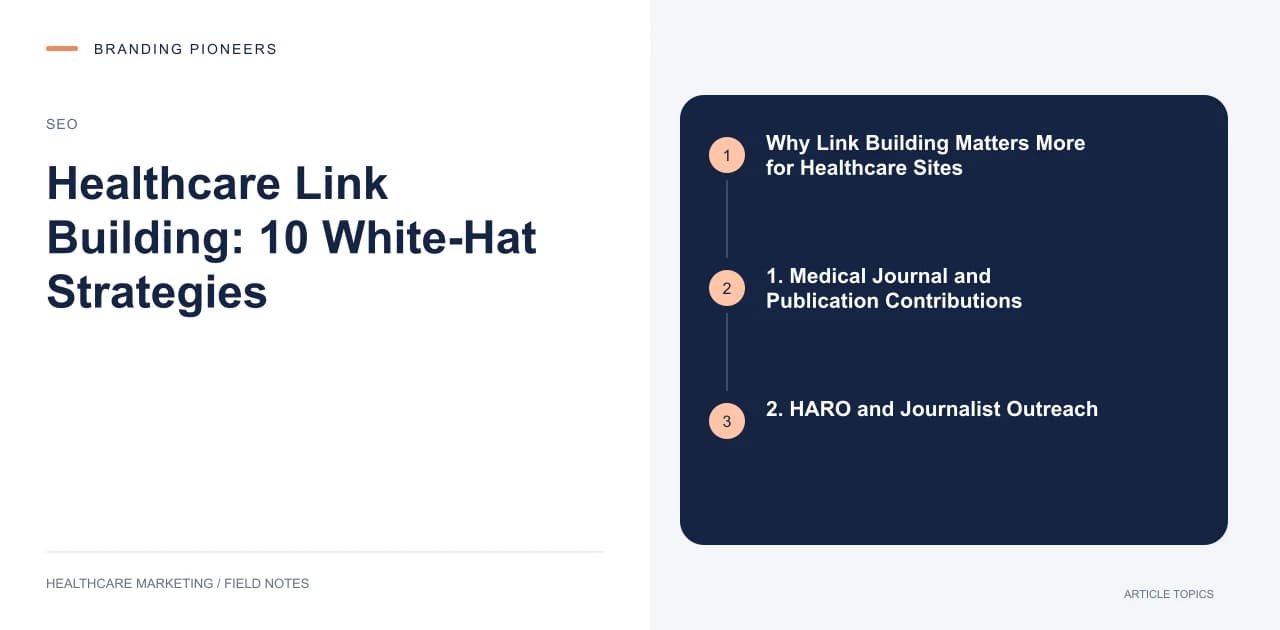
Why Link Building Matters More for Healthcare Sites
Backlinks remain one of Google's top three ranking factors. For healthcare websites — where E-E-A-T requirements are highest — links from authoritative sources carry even more weight. A single link from a medical journal or hospital association can move your rankings more than 50 links from generic directories.
But healthcare link building is also uniquely challenging. You cannot use aggressive guest posting on low-quality sites or participate in link exchanges. Google scrutinizes medical site backlink profiles more carefully than most industries. The strategies below are all white-hat approaches that build lasting authority.
1. Medical Journal and Publication Contributions
Many medical journals and healthcare publications accept contributed articles from practicing physicians. Peer-reviewed publications carry enormous SEO authority, and most allow an author bio with a link back to your practice website.
Start with open-access journals in your specialty. Services like MDPI and Frontiers have lower barriers to entry than top-tier journals. Also look for state and regional medical society publications that accept clinical case reports.
2. HARO and Journalist Outreach
Help A Reporter Out (now part of Connectively) connects journalists with expert sources. Create a profile and set alerts for healthcare queries. When a journalist needs a medical expert comment for an article in a major publication, your quote and practice link appear in the finished piece.
The key is speed — respond within two hours of the query posting. Include your credentials, a concise and quotable answer, and an offer to answer follow-up questions by phone.
3. Local Business and Community Partnerships
Partner with complementary local businesses for cross-promotion. A physical therapy practice could partner with orthopedic surgeons, sports facilities, and yoga studios. Create co-authored content, sponsor community health events, or offer educational workshops.
Each partnership often produces a link from the partner's website, a citation in local media coverage, and social media mentions — all of which strengthen your local SEO authority.
4. Original Research and Data Studies
Content that presents original data attracts backlinks naturally. Conduct a patient satisfaction survey and publish the results. Analyze treatment outcomes across your patient base (anonymized, of course). Create annual reports on health trends in your community.
A dermatology practice that publishes a well-designed study analyzing its own acne treatment outcomes can get picked up by health publications within months, generating high-authority backlinks that would have cost thousands of dollars to acquire through other means.
5. Health Education Resources for Schools and Universities
Create free health education materials and offer them to local schools and universities. Nutrition guides, mental health awareness handouts, or injury prevention posters for athletic programs all work well. Educational institutions typically link to the source of materials they use.