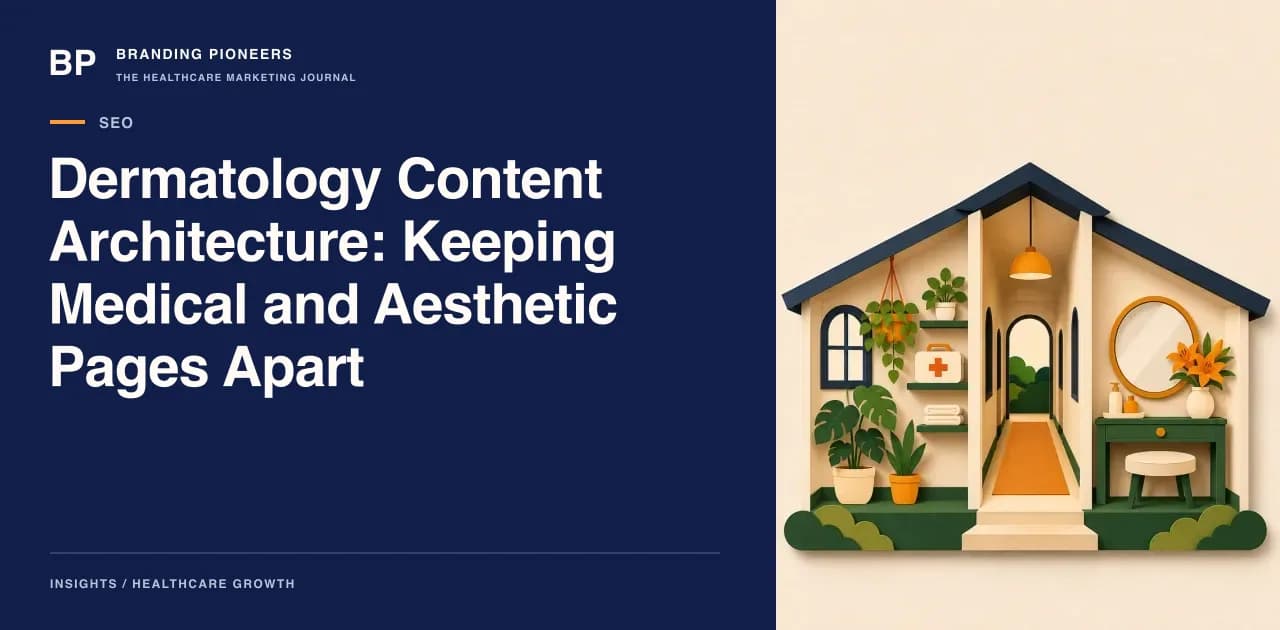
Many dermatology practices run two businesses under one roof. One treats acne, eczema, psoriasis, fungal infections and hair loss. The other sells peels, laser sessions, fillers and skin brightening. Their websites often treat them as one, with a single "Services" page that lists everything and a homepage hero that promises "glowing skin".
This is a problem for search, for patients and for compliance. This article is for dermatologists, clinic managers and the marketers who build their sites. It assumes you already have pages for both sides of the practice. The goal is to separate medical and aesthetic intent so each ranks for its own queries, avoid cannibalisation, and keep the riskier aesthetic content away from medical pages.
It is a planning framework, not clinical or legal advice. The treating dermatologist must review clinical statements.
Why one site, two intents, causes problems
A person searching "psoriasis treatment" and a person searching "laser hair removal cost" want different things. The first is likely to have a diagnosis or a persistent symptom and wants to understand options and see a specialist. The second has a goal and is comparing providers on price, technology and convenience.
When both land on pages that look alike, three things go wrong:
- Cannibalisation. Pages for "acne treatment" and "acne scar treatment" overlap, because acne scars are cosmetic while acne is medical. Search engines may rank the wrong page for each, or neither.
- Trust mismatch. A visitor with a medical condition lands on a page full of discount banners and before-and-after photos and wonders whether the clinic is a medical practice.
- Policy conflicts. Advertising platforms treat cosmetic procedures and medical conditions differently, and the NMC rules constrain cosmetic promotion in particular ways. Mixing them on one page can put medical pages at risk when aesthetic content triggers a review.
Draw the line by intent, not by body part
The split is not "face versus body". Use intent.
| Medical dermatology intent | Aesthetic intent |
|---|---|
| Symptoms, diagnosis, long-term conditions | Appearance goals, treatments chosen by the patient |
| "psoriasis causes", "eczema in children" | "chemical peel cost", "laser for pigmentation" |
| Prescription treatment, monitoring, follow-up | Procedures, sessions, maintenance |
| Referral and insurance often relevant | Out-of-pocket by default |
| Needs a clinician's assessment first | Consultation but patient-led goals |
Some topics straddle the line: acne scars, melasma, hair loss, warts, nail disorders. Decide each one deliberately. Melasma, for example, has a medical diagnosis but is often treated with cosmetic procedures. Write one page for the condition (what it is, how it is assessed, medical options) and a separate page for the procedures offered, then link them. Do not merge them.
A two-branch site structure
A practical layout uses two top-level sections with a shared "About" and "Doctors" area.
Medical dermatology (URL such as /skin-conditions/)
- Condition pages: acne, eczema, psoriasis, vitiligo, fungal infections, scabies, urticaria, skin allergies, alopecia
- Paediatric and adolescent skin
- Diagnostics: patch testing, skin biopsy, dermoscopy explained generally
- When to see a dermatologist: red-flag lesions, rapidly changing moles, widespread rash, signs of infection
Aesthetic dermatology (URL such as /skin-aesthetics/)
- Procedure pages: peels, laser (hair removal, pigmentation), microneedling, injectables, skin boosters
- Concern pages: acne scars, dark circles, ageing, uneven tone, stretch marks
- Process pages: consultation, patch tests, aftercare, maintenance schedules
A shared area covers the clinic, doctors, locations, contact and appointment forms.
URL structure makes the separation visible to people and crawlers. If your existing URLs are mixed, think about moving in stages, with 301 redirects and careful updating of internal links. Our website redesign service handles such moves in a way that protects existing rankings.
Resolving cannibalisation with data
You can test whether your site has the problem using Search Console.
- Export queries for the past 16 months with page and impressions.
- Filter for a medical term such as "acne", then for a cosmetic term such as "acne scar".
- For each, list the URLs that receive impressions. If the same URL answers both, or if two URLs alternate for the same query, you have an overlap.
- Decide the intended page for each query. Then look at the on-page signals: title, H1, first paragraph, internal anchors. Make each page state its own scope in those four places.
- Where two pages say the same thing, merge them and redirect.
The Google documentation on consolidating duplicate URLs explains how redirects and canonical signals work. Remember that canonical is a hint, so the cleanest fix for two competing pages is usually content separation or a redirect.
Check the in-body links as well. A common cause is an acne page with the anchor text "acne scar treatment" pointing to itself, or an aesthetic page linking to the medical condition with the same anchor text. Distinct anchors help.
Keeping compliance exposure contained
Medical dermatology content has relatively wide scope under the 2026 NMC guidance: it is educational, factual and clinically reviewed. Aesthetic content is where problems arise. The October 2026 NMC notice bars promotional before-and-after photographs, success claims, testimonials, discounts and inducements. Hospitals can describe services factually; individual doctors face tighter rules. Our summary in NMC advertising guidelines 2026 covers the phrases and practices to remove, and the compliance guide on before-and-after content goes through galleries and case posts in detail.
Practically, separation helps:
- Keep medical pages free of offer banners, discount language and procedure promotion. They are educational.
- Keep aesthetic pages free of outcome promises and results galleries, and keep any case material strictly within what the guidelines allow for scientific or educational purposes.
- Use separate templates so a banner on the aesthetic section cannot appear on a psoriasis page by accident.
- Keep the advertising account structure separate too. Ad platforms apply their own policies for health and cosmetic content, and our article on advertising cosmetic surgery without getting banned on Google explains the pattern; confirm current policies in the platform's own documentation before launching.