Dental implants are one of the few treatments where patients arrive having already done a lot of research. They know the term "implant", often the name of a system, and they have usually seen a price somewhere. They are comparing clinics, materials and procedures, and they search in layers: brand, cost, procedure, then aftercare.
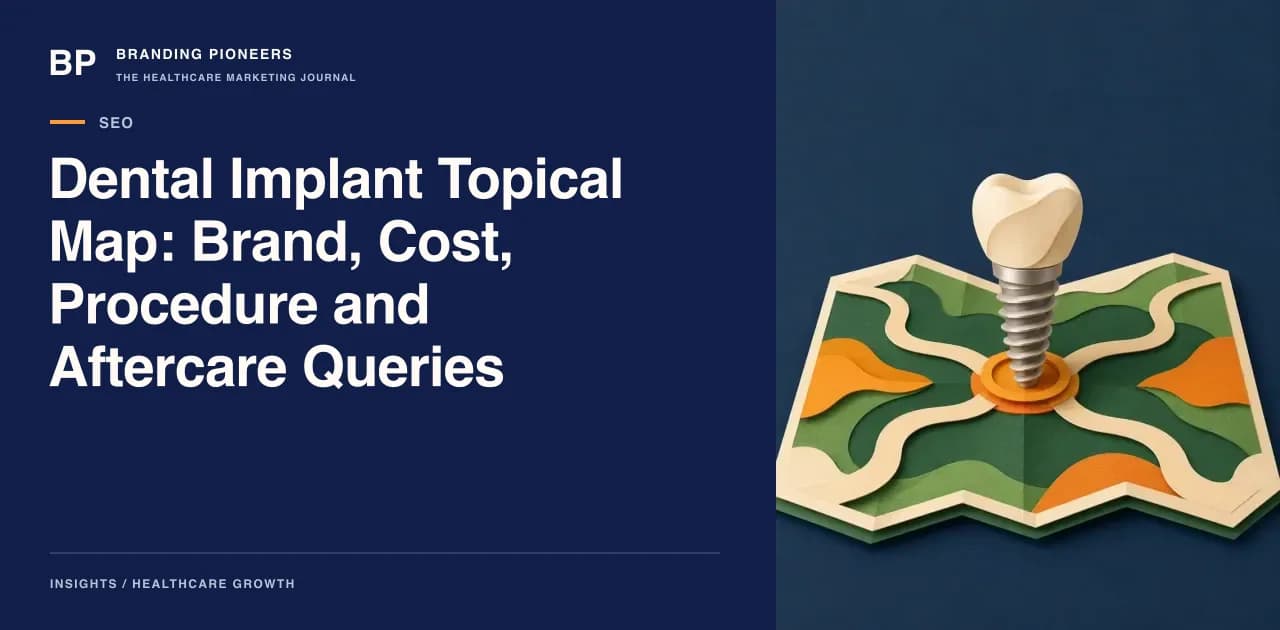
This article is for dental clinic owners and their marketers. It assumes you have a "Dental Implants" service page and perhaps a few blog posts. The aim is to turn them into a topical map, a set of linked pages where each answers a different query and none repeats another. We cover four query families: implant-system brand queries, full-arch versus single-tooth comparisons, cost per tooth, and aftercare.
Clinical content needs review by the treating implantologist, and Indian dentists should check the Dental Council of India's Code of Ethics and any later regulator notices before publishing. Secondary summaries of the code disagree on details, so use the primary text.
The map at a glance
| Layer | Example pages | Query intent |
|---|---|---|
| Hub | Dental implants: types, process, who they are for | Broad research |
| Brand | Implant systems we place and how we choose between them | "Which implant brand is best" |
| Procedure | Single-tooth implant; multiple teeth; full-arch fixed teeth; implant-supported dentures | "What is the procedure" |
| Cost | Cost per tooth and cost drivers; cost of full-arch treatment | "How much does it cost" |
| Suitability | Bone loss and grafting; sinus lift; implants for diabetics, smokers | "Can I get an implant if" |
| Aftercare | First week, first month, long-term cleaning, signs to call the clinic | "After implant" |
| Practical | Insurance and payment, travel for treatment, second opinion | Decision support |
Seven layers is not seven pages. It might be fifteen to twenty-five pages for a busy practice. The point is that each page has one job and each query family lands on the page built for it. If your clinic works in a few cities, the local SEO approach for dental practices tells you how to attach location without cloning the content.
Brand queries: answer the question being asked
Patients search for implant-system names, sometimes with "price", "review" or "vs". A practice has three bad options. It can ignore the query, it can praise one brand without evidence, or it can run down another. The good option is a page that explains how the clinic chooses a system.
A useful "implant systems we place" page can cover:
- Which systems the clinic uses and why, written by the implantologist in terms of clinical factors (bone type, restoration plan, availability of parts and servicing, evidence base)
- That the system is one factor among several, and that the surgeon's technique, planning and maintenance matter too
- How the clinic handles future parts: whether a patient moving cities can find a dentist who can service the implant
- Where the patient can verify authenticity, such as packaging information or implant cards provided by the manufacturer
Avoid ranking brands, calling any "best", or making comparative claims you cannot substantiate. These raise problems under the NMC's October 2026 guidelines (for doctors and hospitals) and consumer-law rules on misleading advertising. Our summary of the NMC advertising notice applies to doctors; dentists are regulated by their own council, so confirm which applies.
Trademarks are another point. Some treatment names are protected brand names rather than generic clinical terms, and "All-on-4" is one that is commonly linked to a specific manufacturer. Check the trademark position with the manufacturer or an adviser before using such names in titles, headings or ad copy, and consider a generic term such as "full-arch fixed teeth on four to six implants" for the main headline, with the named concept explained lower down.
Full-arch versus single-tooth: two procedures, two pages
"All-on-4 vs single-tooth implants" is a comparison query, but the underlying treatments are different clinical pathways, so they need their own pages before a comparison page. Do not try to explain both in the hub.
Single-tooth implant page. Cover who it suits, the steps from assessment to final crown, what imaging is used, healing phases in general terms, and what can influence whether a graft is needed. Include typical consultation questions.
Full-arch page. Explain how a set of fixed teeth can be supported by a smaller number of implants, when this approach is considered, what the temporary and final stages are, and how maintenance differs. Make clear that suitability depends on bone, health and the clinician's assessment.
Comparison page. Only now compare: what problem each solves, the number of appointments, hygiene routines, repair issues, and cost structure in general terms. Link both procedure pages, do not repeat them. Keep the tone informational. Phrases like "permanent teeth in a day", "painless" and "no bone graft needed" are outcome promises and belong nowhere.
Cost per tooth: structure the page around drivers
"Dental implant cost per tooth" is one of the highest-intent queries in the cluster. Our companion discussion on publishing prices within advertising rules is a separate topic; here the question is placement in the map. Give cost its own page, with a short, honest summary on the procedure pages that links to it.
A cost-per-tooth page should explain what a quote covers (implant fixture, abutment, crown, imaging, surgery fee, follow-up), what drives variation (number of implants, crown material, grafting, anaesthesia, clinician experience), and why per-tooth arithmetic can mislead. If a clinic quotes per tooth for a single implant but a different structure for several, say so.
If you publish figures, follow the rules in the Indian advertising framework: date the page, state what is included, avoid urgency and discount language, and do not advertise "free" items that are charged elsewhere. The CCPA guidelines on misleading advertisements are the baseline reference. For multi-city groups, avoid creating a cost page per city unless real inputs differ; our note on location pages at scale explains the thinking.
Link the cost page from every procedure page and from the hub. It will draw traffic from searchers who are not yet ready to read about technique.
Aftercare: the most neglected layer
Aftercare content is rarely written well, even though it has real value. Patients search it after treatment, which makes it a post-conversion asset. It also reduces avoidable calls and shows that the clinic stays involved after the procedure.
Write aftercare in three time frames: the first days, the first weeks and the long term. For each, cover what is normal, what to do, and what should prompt a call to the clinic. The details are for the implantologist to provide and sign off; marketing should not improvise instructions about medication, rinses or diet.
Add a clearly marked section on when to contact the clinic urgently. Pair it with the practice's real contact route and out-of-hours arrangement. If your clinic does not provide emergency support, say so honestly.
Aftercare pages also help in a different way: they are usually read by existing patients and their families, which creates a base of engagement signals and, when helpful, links from patient-facing resources. Do not ask patients for reviews on these pages; keep the content purely informational.