Open any dental implant ad in any city and it says the same thing: a price, per implant, in large type.
The patient reading it has already seen four versions of that ad. They also know, by now, that the number excludes the abutment, probably excludes the crown, almost certainly excludes a graft or a sinus lift, and says nothing about the implant system being used. So the number does not persuade them. It only teaches them that implant pricing is untrustworthy, which makes them slower to book anywhere.
That is the actual problem with implant marketing. The discount war does not just compress margins. It trains the market to distrust the category, and then everyone has to sell through that distrust.
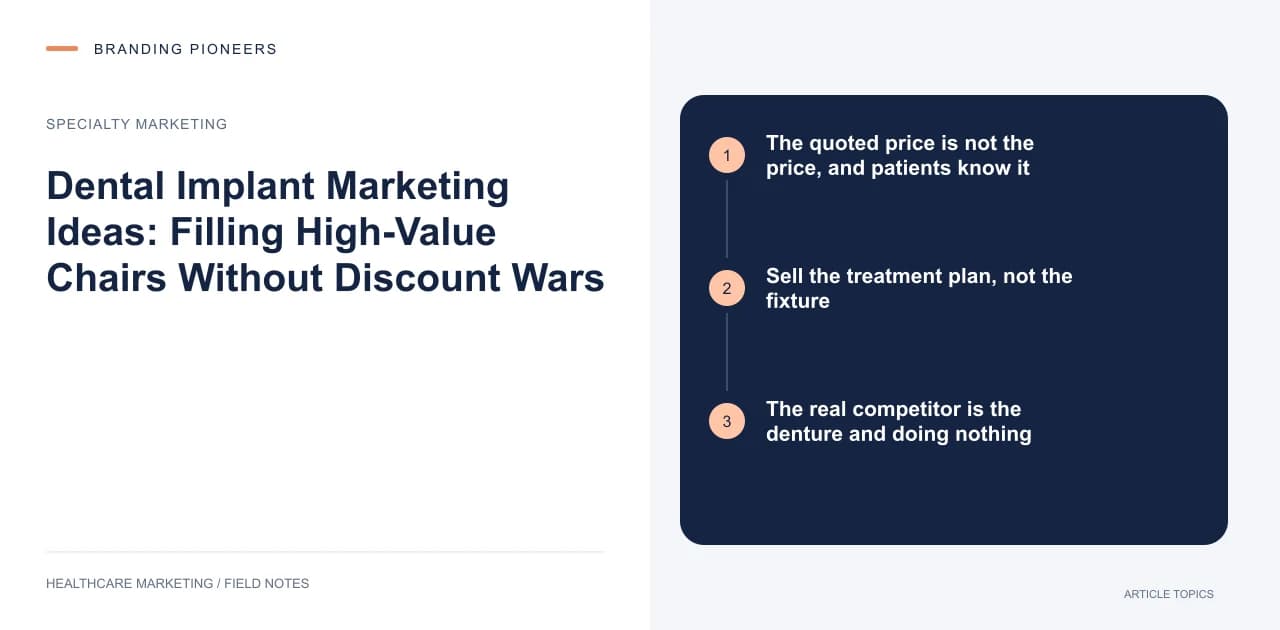
The quoted price is not the price, and patients know it
The way out is not a higher price with better adjectives. It is being the clinic that explains the structure.
A page that lays out what an implant case is actually made of — the fixture, the abutment, the crown, the imaging, any grafting, the number of visits, the healing period — does more for conversion than any offer. It gives the patient a framework to compare quotes with, and the clinic that supplied the framework is the one they compare everything against.
You can do this without publishing a single figure. "Here is what a straightforward single-tooth case includes, here is what makes a case more complex, here is what we would need to see on a scan before quoting" is more useful than a number and far more defensible.
Sell the treatment plan, not the fixture
Implant patients do not want an implant. They want to chew on that side again, or to stop the bridge coming loose, or to not wear a denture at their daughter's wedding.
Marketing that leads with brands, surfaces and osseointegration is written for the dentist. Marketing that leads with the situation — a missing back tooth that is now tipping the ones beside it, a failed root canal, a full lower denture that will not stay in — is written for the person paying.
Build one page per clinical situation rather than one page for "Dental Implants". Single missing tooth. Multiple missing teeth in a row. Full arch. Implant after extraction. Replacing a failing bridge. Denture stabilisation. Each of these is a different search, a different value, and a different objection. Our dental implant marketing pages are structured this way for exactly that reason.
The real competitor is the denture and doing nothing
Most implant marketing is aimed at the clinic down the road. Most implant cases are lost to inaction.
The patient has a gap. It is not painful. It is at the back. They have been meaning to sort it out for two years. The thing that eventually moves them is rarely a discount; it is understanding a consequence they did not know about — bone loss at the site, the opposing tooth over-erupting, the neighbouring teeth drifting, a partial denture that will need remaking anyway.
Write that consequence content plainly and put it where the searching happens. It converts the delayers, and the delayers are the largest untapped group in the market.
Where implant enquiries actually come from
Three channels do most of the work, in this order.
The Google Business Profile, because "dental implants near me" and "implant dentist near me" resolve in the map pack before anyone reaches a website. Complete it properly: the right primary category, implant services named the way patients say them, current photographs of the actual surgery, hours that are true, and a booking link that works on a phone. Reviews carry more weight here than in general dentistry, because the spend is higher and the patient is looking for reassurance rather than convenience.
Your own existing patient base, because the person who needs an implant is very often already in your recall list with a failing tooth documented in their notes. Most practices never systematically contact them.
Referral from general dentists who do not place implants. This channel is underworked almost everywhere. A referring dentist needs to know you will send the patient back, what you will and will not do, and how quickly you can see their case. Say all three in writing.
For the wider picture — recall, reviews, local search and the rest of the practice's demand system — the dental marketing guide covers the mechanics, and generating dental patients covers the funnel that sits under it.
The consultation is the product
Implant marketing does not sell implants. It sells a consultation that ends with a plan.
Which means the consultation has to be worth attending and the page has to say what happens in it. Will there be a scan on the day? Will they get a written plan? Will they see the plan on a screen? Will somebody explain payment options without pressure? How long will it take?
An implant consultation described in detail converts far better than one described as "free". Free is what everyone says, and it signals a sales meeting. Specific is what almost nobody says, and it signals a clinic.
Before-and-after images, and what you are allowed to show
The rules differ by market and they are checkable, so check them rather than copying what a competitor is doing.
In India, dentists are governed by the Dentists Act and the Dental Council of India's code of ethics, which restricts advertising and solicitation; doctors sit under the National Medical Commission, whose ethical advertising guidelines of 6 October 2026 bar before-and-after photos for promotion unless they are strictly scientific or educational with anonymised consent (para 8.1(v)). In the United Kingdom, the General Dental Council's standards govern advertising claims and the Advertising Standards Authority enforces the CAP Code. In the United States, state dental boards regulate specialist and credential claims, and the FTC governs whether an advertised claim can be substantiated.
On top of that sits platform policy, which applies everywhere. Meta's advertising standards restrict before-and-after images and images implying unexpected or unlikely results — a rule written for weight loss and cosmetics that catches dental full-arch cases routinely. Ads get rejected for this constantly and clinics assume it is an error. It is not.
What survives in the markets that allow these images at all: the patient's own recorded consent, honest framing of the case complexity, no implication that the result is typical, and no claim of superiority over named competitors.
Full arch is a different business from single tooth
Practices market both from the same page and then wonder why the mix is wrong.
A single-tooth patient is usually solving a recent, specific problem and comparing clinics on convenience and price. A full-arch patient is usually ending a long relationship with a failing dentition or a denture they hate, and comparing clinics on whether they will still be able to eat and speak properly afterwards. The decision takes months, involves a partner, and often involves travel.
They need different assets. Single tooth needs clarity and speed: what it involves, how long, what it includes, book. Full arch needs evidence of experience, a named surgeon, a description of the surgical day from arrival to discharge, an honest account of the provisional phase and what teeth look like during it, and somebody to talk to more than once before committing.
If you are part of a group, that split also determines what belongs at practice level and what belongs at brand level. Our pages for dental chains cover how multi-site groups keep local demand and brand demand from cannibalising each other.
Video does the work that photographs cannot
Implant patients want to know whether it will hurt and what they will look like in the interim. A photograph cannot answer either question; a dentist talking to camera for ninety seconds can.
Keep them short and single-purpose. What the surgical appointment feels like. What you eat in the first week. What happens if an implant fails. Why a scan is needed before a quote. Why some cases need a graft.
No production values required. The actual clinician, an accurate answer and no sales framing will outperform a polished brand film, and these clips sit naturally on the situation page they belong to.
Finance without a discount war
Payment plans are not a discount, and they are the answer to the objection that actually blocks full-arch cases.
Present them as structure rather than as a sale: what the plan covers, what it costs to use, what happens if a case turns out to need grafting. And keep the offer language out of it. A clinic that is transparent about cost structure and offers a payment route reads as established. A clinic that runs a monthly implant sale reads as one that needs the money.
Measure to the chair, not to the form
Implant lead generation is measured badly almost everywhere, because the form fill is easy to count and the case is not.
The numbers that matter: enquiries that book a consultation, consultations that attend, attendances that accept a plan, plans that start. If you only see the first, you will optimise towards a channel that produces plenty of enquiries from people who wanted a price and nothing else.
Call recording and a disciplined front desk usually improve implant conversion more than any change to the ads. The phone is where implant cases are won and lost, and it is the part of the funnel nobody audits.
Where to start
- One page per clinical situation, not one page for implants.
- The cost-structure explainer, with no headline price.
- Google Business Profile completed, with implant services named properly.
- Recall outreach to patients already in your own notes.
- A consultation page that describes the consultation.
- Paid search last, on treatment-intent terms.
---
If you want to see where your implant pages sit against the clinics you compete with — rankings, profile gaps, and where the enquiry path leaks — get a free audit. Or book a strategy call and we will go through it with you.
Filed underdental implant marketing ideasdental implant lead generationdental implant leadsdental implant marketing agency

About the author
Nishu Sharma
Founder & CEO · Gurugram, India
Nishu founded Branding Pioneers in 2016 with one rule that hasn't changed since: healthcare only. She'd run digital strategy at a top-10 Indian agency and watched generalist marketing underserve medical clients who needed something built for how patients actually search and decide. So she left to build the specialist instead. It's now an 80-person team working with healthcare brands worldwide.
Free guide · 17 pages
The Patient Acquisition Blueprint
A 90-day plan from first search to booked appointment.