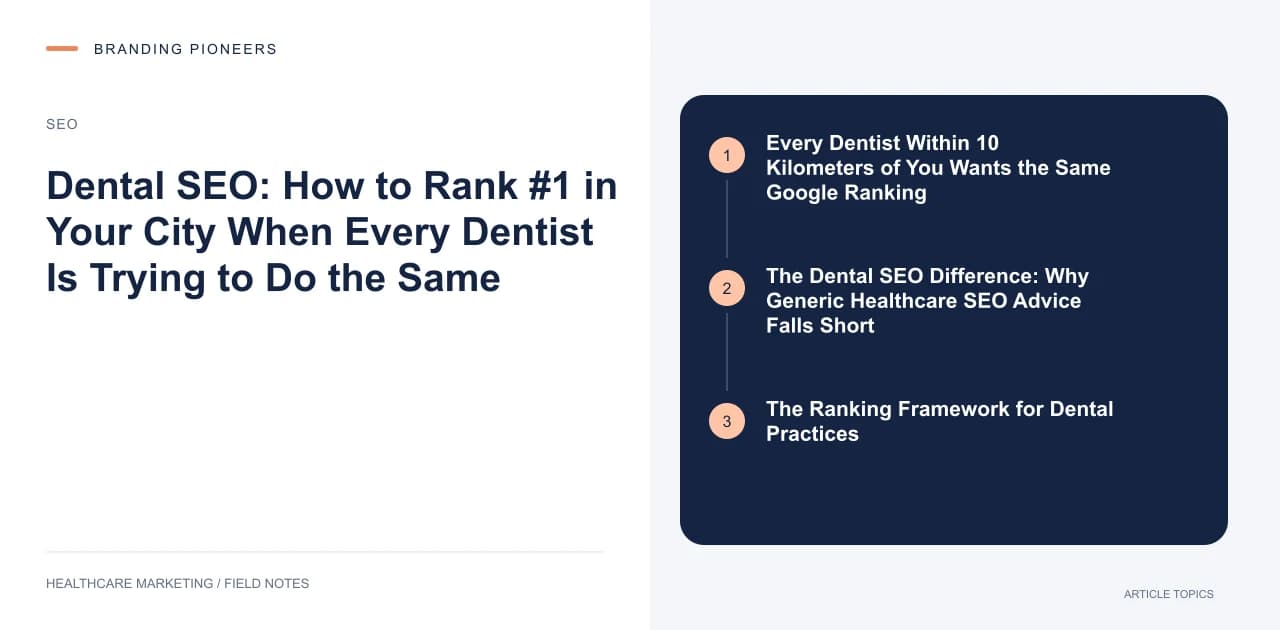
Every Dentist Within 10 Kilometers of You Wants the Same Google Ranking
Dental is the most crowded vertical in healthcare SEO. It is not close.
There are more dental practices per square kilometer in most cities than any other medical specialty. In South Delhi alone, Google Maps lists over 800 dental clinics. In Manhattan, over 2,000. Each one wants to rank for "dentist near me."
The math is brutal: three map pack spots, 800 practices. Your chances of ranking through generic SEO tactics are roughly 0.4 percent. Which is why most dental SEO campaigns fail — they do everything that the generic guides recommend and end up on page three with 790 other practices doing the exact same thing.
The practices that rank #1 do something different. Not more. Different.
We work with dental practices on their SEO. Chains with 20+ locations, solo practitioners, specialists, DSOs (dental service organizations). The ranking factors that separate page-one practices from page-three practices are more specific than most dental SEO guides acknowledge.
The Dental SEO Difference: Why Generic Healthcare SEO Advice Falls Short
Dental SEO is different from general healthcare SEO for three reasons:
Higher local density. In cardiology, you might compete with 15 practices in your city. In dentistry, you compete with 500. The local pack rankings are more contested, and every ranking factor is weighted more heavily.
Service overlap. Every general dentist offers cleanings, fillings, crowns, and root canals. Unlike an orthopedic surgeon who specializes in knee replacement, dentists often offer identical services. Differentiation is harder.
Lower patient lifetime value per transaction. A dental cleaning generates less revenue than a hip replacement. This means dental practices have smaller marketing budgets, which means the SEO strategy needs to be more efficient — you cannot outspend the competition, so you need to outsmart it.
These differences demand a dental-specific SEO strategy, not a healthcare SEO strategy applied to dental.
The Ranking Framework for Dental Practices
Win the Niche Before You Win the Category
Here is the single most important tactical shift: stop trying to rank for "dentist near me" first. Start by dominating a specific niche within dentistry.
"Dental implant specialist in Dwarka" has far less competition than "dentist in Delhi." "Invisalign provider South Mumbai" is less contested than "dentist Mumbai." "Pediatric dentist Indiranagar Bangalore" is a fraction of the difficulty of "dentist Bangalore."
When you rank for niche terms, two things happen: you start getting patients immediately (high-intent, ready-to-book patients), and you build the domain authority and engagement signals that eventually let you rank for the broader terms.
We call this the "specialist first" strategy. Even general dentists should lead with a specialization in their SEO. If you do more cosmetic work, lead with cosmetic dentistry keywords. If your location is near a school district, lead with pediatric dentistry. If you have invested in an implant system, lead with dental implant keywords.
Solo practices that focus exclusively on dental implant keywords instead of "dentist near me" often go from zero organic patients to a steady stream within a few months. They do not touch "dentist near me" until later. By then, the site has built up enough authority from the implant content that "dentist near me" rankings tend to come naturally.
Service Pages That Actually Rank
Most dental websites have a "Services" dropdown with 10 items, each linking to a 200-word page that says the dental equivalent of "we do this thing, call us."
That does not rank. Here is what does:
One dedicated page per service. Not per category — per service. "Dental Implants" and "All-on-4 Dental Implants" need separate pages. "Teeth Whitening" and "Zoom Whitening" need separate pages. Each page targets a different keyword cluster.
Minimum 1,200 words per service page. Cover what the procedure involves, who it is for, how long it takes, what recovery looks like, how much it costs (ranges are fine), and why your practice specifically.
Visual explanation, not patient showcases. Dental is visual, so show the procedure: diagrams of an implant in the jaw, a short clip of the dentist explaining each stage on a model, photos of the equipment and the treatment room. That earns image-search traffic and time on page without a patient in the frame.
A note on before-and-after galleries and patient testimonial videos. These used to be our default advice for dental service pages. In India, the direction of travel is firmly against them: the National Medical Commission's 6 October 2026 guidelines bar before-and-after photos, success stories and patient testimonials for doctors and hospitals, and say patient consent does not make them permissible (paras 6.2, 8.1(v); Explanation V to para 3.2). Dentists answer to the Dental Council of India's code rather than the NMC, but a dental department inside a hospital is covered, and we now advise every Indian dental client to treat these formats as off the table. See our NMC guidelines hub. Outside India the rules vary: Australia's AHPRA bans testimonials about clinical aspects and sets strict before-and-after conditions, while the US and UK allow genuine, permissioned ones.
The Review Strategy That Beats Practices With 500+ Reviews
You probably cannot catch the practice in your area that has 500 Google reviews built up over 10 years. You do not need to.
Review velocity beats total count. Google wants to see that patients are currently choosing you, not that patients chose you in 2018.
Say a practice with 80 Google reviews is gaining 8 new ones per month — it will tend to outrank a practice sitting on 500 Google reviews but gaining only 1 per month. We have seen this pattern play out in competitive dental markets across Delhi, Mumbai, and Bangalore.
The velocity system for dental:
After every appointment, the front desk gives every patient the same neutral invitation, never only the ones who seem pleased: a card with a private feedback link and the Google review link side by side. No incentives, no tablet thrust into the patient's hands, no pressure. (For medical, not dental, practices in India, skip the ask entirely: under the NMC's 2026 guidelines a doctor shall not request patient reviews for promotion.)
For patients who don't take a card, one follow-up WhatsApp a couple of hours later with the same two links is enough.
Target: 8 to 12 new reviews per month. At that velocity, you will overtake practices with many times your review count within 6 months.
Content That Drives Dental Patients
The dental practices that win organic search produce two types of content consistently:
Treatment decision content. "Dental Implants vs. Bridges — Which Is Right for You?" "Invisalign vs. Braces: Cost, Timeline, and Results Compared." "Dental Crown vs. Veneer — Understanding the Difference."
These comparison posts capture patients who are actively deciding between treatments. Conversion rates are high because the patient is already committed to doing something — they just need help choosing what.
Cost transparency content. "How Much Do Dental Implants Cost in India? (2026 Price Guide)" These pages rank quickly, attract high-intent traffic, and build trust by being upfront about something most dental practices hide.
We have built cost guides like this for dental chains that now rank #1 for their target cost keywords, driving a steady stream of qualified inquiries every month. The page costs essentially nothing to create — just honest pricing information presented clearly.
Technical SEO for Multi-Location Dental Practices
If you operate more than one location, your technical SEO needs are different from a single-practice office.
Unique location pages. Each location needs its own page with a unique title, description, address, team members, services offered at that location, photos of that specific office, and embedded Google Map. Not a template with the address swapped.
Location-specific GBP listings. Each location is a separate Google Business Profile. Each needs its own review generation effort, its own posting schedule, and its own photo updates.
Hreflang and location targeting. If you serve patients who speak different languages (Hindi and English in India, Spanish and English in US border states), implement hreflang tags so Google shows the right language version.
Canonical URLs. Prevent duplicate content issues when multiple locations offer the same service. The "Dental Implants" content on your Delhi page and your Gurgaon page cannot be identical.
The 90-Day Dental SEO Playbook
Days 1-14: Technical audit and fix. Page speed optimization. Schema markup implementation. GBP optimization for every location.
Days 15-30: Service page expansion. Write or rewrite one service page per day. Start with your highest-revenue services. Target niche keywords first.
Days 30-60: Content production. Two blog posts per week targeting symptom and treatment keywords. Cost guide pages for your top 5 services. Review generation system fully operational.
Days 60-90: Local link building. Dental community partnerships. Guest content in local publications. Monitor ranking progress and double down on what is working.
Expected results at 90 days: Rankings for 20 to 30 niche keywords. 15 to 25 additional organic patient inquiries per month. GBP impressions up substantially. Foundation laid for competitive term rankings in months 4 to 8.
Get Your Free Dental SEO Audit →