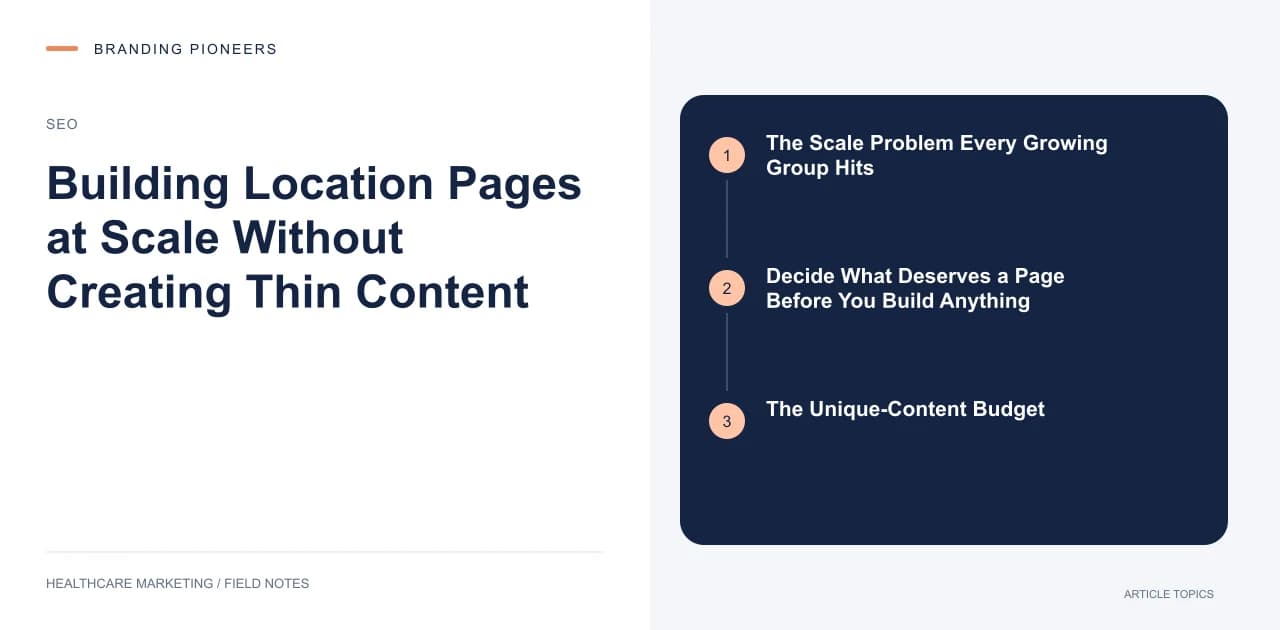
Building Location Pages at Scale Without Creating Thin Content
Multi-location healthcare groups need hundreds of service-plus-city pages, but templated pages get filtered as thin content. Here is how to build them at scale and keep them indexed.
A single-clinic practice needs a handful of service pages. A group with twelve centres across four cities offering nine services needs, on paper, over a hundred service-plus-location pages. Do it manually and it takes a year. Do it with a template and a spreadsheet and you can publish it in a week — and watch most of it fail to rank, or fail to index at all.
The reason is not that Google dislikes templated pages. It is that Google evaluates whether a page adds anything the rest of the web does not already have. A hundred pages that differ only in the city name, with the same four paragraphs and the same stock image, add nothing. They also drag on your site quality signals in aggregate, which can suppress the pages you actually care about.
The goal is not to avoid templates. It is to build templates that are structurally identical and substantively different.
The first discipline is subtraction. Not every service-city combination deserves a URL.
Build a page only where three conditions hold. There is real search demand for that combination — check volume, and check whether the local pack even appears. You have a genuine physical presence or a genuinely served catchment for that location. And you can supply at least four location-specific facts that no competitor page has.
If you cannot meet all three, do not create the page. Fold that demand into a broader city page or a broader service page. A group with twelve centres might find that only sixty of its theoretical hundred and eight combinations qualify. Sixty strong pages will outperform a hundred and eight weak ones, and the maintenance burden is halved.
For low-demand combinations, an internal section on a parent page with a proper anchor and a clear heading captures the same intent without spawning a page that has nothing to say.
Set a rule and enforce it in your CMS: every location page must carry a minimum quantity of content that exists nowhere else on your site or anyone else's. A workable threshold is around forty percent unique by word count, but percentages are easier to game than substance, so define it by required components instead.
Required per page, sourced from the actual centre:
The specific clinicians who practise at that location, with their real credentials, their consultation days, and a link to their profile. This alone differentiates the page more than any amount of rewritten body copy, and it is the single most useful thing to the patient.
Equipment, technology, and facilities actually present at that centre. A branch with a specific scanner, a dedicated day-care theatre, or an in-house lab should say so. Patients comparing centres care about this and competitors rarely publish it.
Practical access detail written by someone who has been there. Nearest metro station and which exit. Where parking actually is and whether it fills up. Which floor. Landmarks that locals use rather than the ones on the map. Whether there is wheelchair access and step-free entry. This content is impossible to scrape and immediately useful.
Location-specific operational facts. Opening hours including the exceptions, which insurance and cashless panels are accepted at that centre, languages spoken by the front desk, and whether walk-ins are taken.
Genuine local proof. Reviews left for that specific branch, pulled from that branch's Google Business Profile. Never mix reviews across locations.
Notice that none of these require a copywriter to invent anything. They require someone to collect facts from the centre manager. That is an operations task, and it is why programmatic location pages succeed or fail on data collection rather than on writing.
Keep the skeleton consistent so patients and crawlers can predict it, and so you can update all pages at once when something changes.
A workable structure: an H1 that names the service and the location naturally, an opening paragraph that leads with the location-specific fact rather than generic service description, the clinician panel, the facility and equipment section, a what-to-expect section that can be shared across the service, the practical access block, branch-specific reviews, a location-specific FAQ, and clear contact and booking options for that branch.
Two things must be page-specific and are frequently botched: the phone number and the embedded map. A group-wide central number on every location page destroys the local signal and confuses patients. If you must route through a central line, use branch-specific tracking numbers that display consistently.
Add LocalBusiness or MedicalClinic schema per page with the exact address, geo coordinates, opening hours, and the department or specialty. Reference the parent organisation so the relationship is explicit rather than implied.
Internal linking. A hundred orphaned pages linked only from a footer directory will crawl slowly and rank poorly. Build a real hierarchy: city hub links to its centres, each centre links to its services, each service page links to the same service at nearby locations and to the parent service page. Every page should be reachable within three clicks from the homepage.
Near-duplicate cannibalisation. If two of your centres are eight kilometres apart, their pages will compete with each other. Decide which one owns which suburb, differentiate the pages accordingly, and do not build both if the catchments genuinely overlap.
Publishing all at once. Releasing a hundred and twenty pages on a Tuesday is a pattern that invites scrutiny and gives you no way to diagnose problems. Ship in batches of ten to fifteen, a batch a week. Check indexation and early impressions on each batch before releasing the next. If batch one underperforms, you have fixed the template before pages twenty through a hundred exist.
No maintenance plan. Doctors move between branches, timings change, panels change. A location page with a doctor who left eighteen months ago is worse than no page. Assign each centre's page to its centre manager for a quarterly accuracy check, and treat it as an operational SOP rather than a marketing favour.
Watch three things per batch. Indexation rate — anything under about eighty percent indexed after four weeks means the pages are being judged as insufficient, and the fix is more unique substance, not more pages. Impressions for location-modified queries. And enquiries attributed to that branch, which is the only number that matters at the end.
If a page has been live for a quarter, is indexed, and has produced no impressions for any query containing its location, that combination did not deserve a page. Merge it upward and move on. Pruning is part of the method, not an admission of failure.
Writing on healthcare growth, AI-powered patient acquisition, and the operational reality of marketing inside hospitals and clinics.
The exact 90-day patient-acquisition system, step by step.
The healthcare SEO landscape has shifted dramatically. AI Overviews, tighter E-E-A-T enforcement, and new local ranking …
Large hospitals need SEO strategies that work at the department level. Here is how to structure keyword targeting, provi…
Schema markup helps Google understand your medical website. This guide covers the exact schema types healthcare sites ne…
Six reasons hospitals, clinics, and doctors pick a healthcare-only firm over a generalist agency.
It's all we do. No retail, no fintech — the whole team thinks in patient journeys, clinical trust, and the way people actually choose a doctor.
Receptionists, WhatsApp triage, and attribution built in-house — we answer patients in seconds and tie every click to a booked appointment.
HIPAA, ASCI, NABH and GDPR sign-off baked into every campaign — our standard, not an upcharge or an afterthought.
The senior who pitched you stays on the engagement. No bait-and-switch to juniors learning on your budget.
Patient-level attribution across calls, forms, and walk-ins. Monthly reports show booked patients — not just clicks and impressions.
We name our clients and show the work. Quarterly reviews with the numbers attached, every cycle.
Adjacent practices, the relevant tools, and the case files where we shipped this thinking against real patient-acquisition targets.