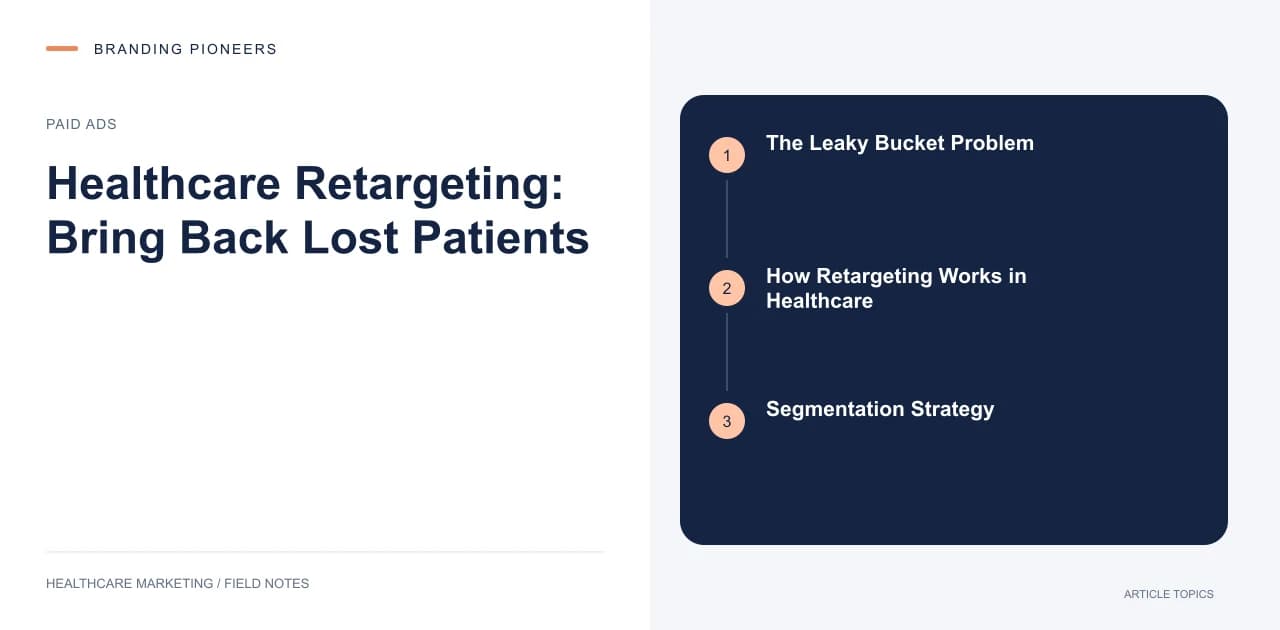
Healthcare Retargeting: Bring Back Lost Patients
97 percent of healthcare website visitors leave without booking. Retargeting brings them back at a fraction of the cost of acquiring new visitors.
Sources & References
97 percent of healthcare website visitors leave without booking. Retargeting brings them back at a fraction of the cost of acquiring new visitors.
Your website is a leaky bucket. For every 100 visitors to your practice website, roughly three will book an appointment. The other 97 leave — not because they are not interested, but because they are still researching, got distracted, wanted to check one more option, or simply were not ready yet.
Retargeting (also called remarketing) shows ads to those 97 people after they leave your site. It is the most cost-effective form of healthcare advertising because you are reaching people who already know your practice and have demonstrated interest through their website behavior.
Retargeting typically delivers a cost per lead that is 50 to 70 percent lower than cold advertising. It is not unusual for retargeting campaigns to convert at two to four times the rate of prospecting campaigns.
When someone visits your website, a tracking pixel (Google Ads pixel, Facebook pixel, or both) places an anonymous cookie in their browser. When that person later browses other websites, YouTube, Facebook, or Instagram, your retargeting ad appears.
The key to effective healthcare retargeting is segmentation. Not all visitors have the same intent, and they should not see the same ad.
Someone who spent time on your knee replacement page should see a retargeting ad about knee replacement — a patient testimonial, a "What to Expect" guide offer, or a free consultation CTA. Do not show them a generic hospital ad.
Create separate retargeting audiences for each major service page or service category. A dental practice might have segments for implants, cosmetic dentistry, orthodontics, and general dentistry.
Visitors who read your blog posts are earlier in their journey. They are educating themselves, not yet shopping for a provider. Retarget them with more educational content — a downloadable guide, a webinar invitation, or a related blog post that moves them closer to decision.
These are your hottest leads. Someone went all the way to your appointment booking page and left without completing the form. Retarget them aggressively with a clear, low-friction CTA: "Still looking for an appointment? Book online in 60 seconds" with a direct link back to the booking form.
This segment often converts at 10 to 15 percent — far higher than any other audience.
Upload your patient email list to Google and Facebook to create matched audiences. Retarget past patients with recall reminders (annual checkups, follow-up visits), new services you offer, and referral incentive programs.
Past patient retargeting strengthens lifetime value and drives word-of-mouth. A reminder ad for an annual skin check to someone who visited your dermatology practice 10 months ago is genuinely helpful, not intrusive.
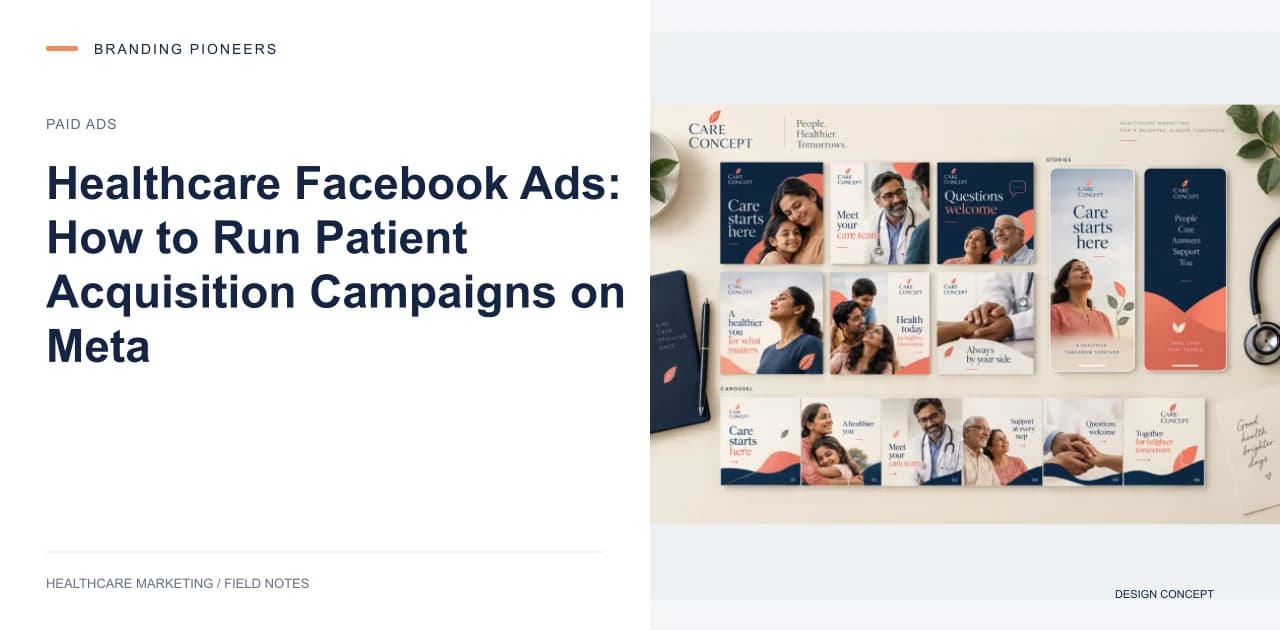
Patient testimonials and review highlights work exceptionally well for retargeting. The visitor already knows your practice — what they need now is reassurance that others had a good experience.
Address common hesitations: "Worried about cost? We offer flexible payment plans." or "Not sure if you need surgery? Get a second opinion — free consultation." Identify the objections that prevent people from booking and address them directly in your retargeting creative.
"Dr. Patel has 3 appointments available this week" or "Limited slots for our free screening event" create legitimate urgency. Do not fabricate scarcity, but if you genuinely have limited availability, saying so in retargeting ads accelerates bookings.
Healthcare retargeting requires careful frequency management. Showing the same ad 20 times in a week feels invasive, especially for sensitive health topics. Set frequency caps of three to five impressions per user per week.
Rotate your creative every two to three weeks. Ad fatigue sets in quickly with retargeting because you are showing ads to the same people repeatedly. Fresh creative maintains engagement.
Healthcare retargeting must respect patient privacy. Never use retargeting ads that reveal or imply a health condition. "Still dealing with depression?" as an ad headline is both a privacy violation and a bad practice. Keep retargeting copy focused on your practice and services, not the patient's assumed condition.
Track view-through conversions (people who saw your ad but did not click, then later visited your site and booked) in addition to click-through conversions. Retargeting often works through impressions rather than clicks — the repeated exposure keeps your practice top of mind until the patient is ready.
Writing on healthcare growth, AI-powered patient acquisition, and the operational reality of marketing inside hospitals and clinics.
The exact 90-day patient-acquisition system, step by step.
After auditing 300+ healthcare Google Ads accounts, these are the ten most common and costly mistakes we see. Each one i…
Local Service Ads appear above regular Google Ads and you only pay for actual leads. Here is how to set them up for your…
Healthcare keywords are among the most expensive in Google Ads. Here are proven tactics to cut your cost per click witho…
Six reasons hospitals, clinics, and doctors pick a healthcare-only firm over a generalist agency.
It's all we do. No retail, no fintech — the whole team thinks in patient journeys, clinical trust, and the way people actually choose a doctor.
Receptionists, WhatsApp triage, and attribution built in-house — we answer patients in seconds and tie every click to a booked appointment.
HIPAA, ASCI, NABH and GDPR sign-off baked into every campaign — our standard, not an upcharge or an afterthought.
The senior who pitched you stays on the engagement. No bait-and-switch to juniors learning on your budget.
Patient-level attribution across calls, forms, and walk-ins. Monthly reports show booked patients — not just clicks and impressions.
We name our clients and show the work. Quarterly reviews with the numbers attached, every cycle.
Adjacent practices, the relevant tools, and the case files where we shipped this thinking against real patient-acquisition targets.