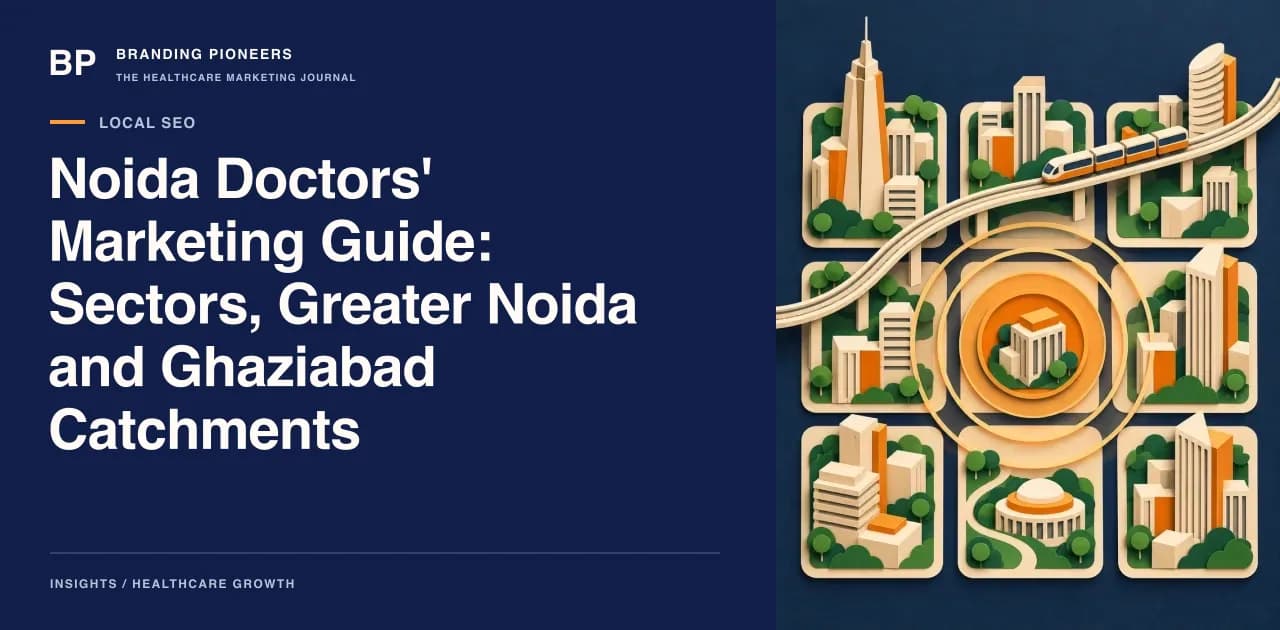
This guide is for doctors, clinic owners and hospital marketing teams in Noida, Greater Noida and the neighbouring parts of Ghaziabad. It explains how patients in this belt look for care, where the competition sits, which channels deserve effort first, and which advertising rules apply.
Noida is a planned city built on sectors, and that structure shapes how people search. Patients tend to name their sector, a society or a landmark rather than a neighbourhood. A resident of Sector 137 and a resident of Sector 18 may both say "Noida", but they will not travel the same distance for a GP visit. A marketing plan that treats the whole city as one catchment wastes effort.
For the regional view, our Delhi NCR doctors' marketing guide covers the wider market. This post stays with Noida, and our Noida healthcare marketing page lists the services available here.
How the catchment actually works
Sector clusters. Noida's older sectors, its expressway sectors and the newer high-rise belts behave as separate micro-markets. Patients prefer a doctor within a short drive or a short auto ride of home. The searches that convert are of the form "dermatologist Sector 62", "dentist Sector 50", "paediatrician Sector 137".
Metro corridors. The Noida Metro Aqua Line runs between Sector 51 in Noida and Depot station in Greater Noida, as described on its Wikipedia entry), and a walkway links Sector 51 to the Delhi Metro Blue Line. For a clinic, this matters in two ways. Patients and staff often judge distance by station, so naming the nearest metro stop on the Business Profile and the website helps. And a clinic near an interchange draws patients from more than one sector.
Greater Noida and Ghaziabad. Greater Noida has its own residential and educational clusters, and some patients come in from Ghaziabad and the Delhi border. They are less likely to say "Noida" and more likely to name their own area. A clinic that wants them should publish pages and profile text that use those place names truthfully.
The pull of Delhi. Many families here have jobs, relatives or long-term doctors in Delhi, and will travel there for specialist care. A Noida practice should not assume loyalty. It wins when the visit is convenient and the information is clear: fees, timings, what to bring, and how to book.
Language. Searches are a mix of English and Hinglish, written in Roman script: "bachon ke doctor Noida", "daant ka doctor near me". Voice search on mobile makes this more common. Pages written in plain English with the common Hindi terms where natural can match both.
The competitive set
Well-known hospitals in the area include Fortis Hospital Noida, Jaypee Hospital, Kailash Hospital and Yatharth Hospital. We mention them as market context only. They tend to hold the generic hospital terms. A smaller practice should therefore pick sector-level and condition-level searches.
A hypothetical example: a physiotherapy clinic in Sector 62 might build pages for "back pain physiotherapy Sector 62" and "post-surgery rehabilitation near Noida City Centre", rather than competing for "physiotherapy in Noida". That is an illustration, not a reported result.
Which channels to prioritise
Google Business Profile first
For a sector-based city, Maps is the main discovery tool. Choose a specific category, add the sector and nearest metro station to the description, upload real photos of the entrance and waiting area (patients look for parking and ease of access), and keep hours accurate. Posts and Q&A can answer practical questions about parking and appointments. Our team handles this under Google Business Profile management in Noida. If you want to understand how Maps ranking decisions are made, read the Google Business Profile guide for doctors.
Local SEO second
A website needs one page for each service and, for multi-doctor practices, one page for each doctor. Each service page should name the area it serves, explain the visit and show the address with a map. Avoid copying the same text across multiple location pages; Google treats near-identical pages as thin content. Healthcare SEO in Noida is built around this structure.
WhatsApp third
In a commuter city, a patient often wants to book without calling during work hours. A WhatsApp number on the Business Profile, a clear greeting message and a defined response time convert interest into appointments. Keep the inbox owned by a named person. Use it for appointment confirmations, directions and reminders that patients have asked for, not for cold promotion.
Google Ads fourth
Paid search suits services with clear demand and enough capacity: dental, dermatology, IVF consultations, diagnostics, physiotherapy. Radius targeting around the clinic, ad extensions for calls and directions, and landing pages that match the ad are the basics. See Google Ads for healthcare in Noida for how we structure this. As the NMC guidelines restrict how claims are made, keep ad copy factual and avoid superlatives.
Instagram and YouTube last
Video suits specialties where patients research for weeks. Doctors who explain procedures calmly and in Hindi or English build trust over time. These channels do not replace the Business Profile and website. Do not use TikTok, which has been banned in India since 2020.
What to fix first
- Audit the Business Profile. Ensure name, address, phone and hours match the website. Remove or merge duplicates, which are common when clinics move between sectors.
- Add the sector, landmark and nearest metro stop to profile text and the website footer.
- Fix mobile speed and booking flow. A patient on a phone should reach a call button or WhatsApp link in one tap.
- Create service pages that match local searches. One page per service, one clear question per page.
- Install call and form tracking. Without it, you cannot know which channel works.
- Set a review routine. Ask patients who are willing, reply politely, and never discuss clinical details publicly.
For the website build or rebuild, see healthcare website development in Noida.