Most specialties compete for attention. Urology competes with procrastination.
The patient usually knows something is wrong. They have searched the symptom, late at night, on a phone, in a private browser tab. They have read enough to be worried and not enough to be reassured. And then, very often, they do nothing for another four months.
That gap — between the first search and the first appointment — is where urology marketing is won or lost. Not at the top of the funnel, where the demand already exists, but in the middle, where embarrassment and uncertainty do the work that a competitor's advertising never could.
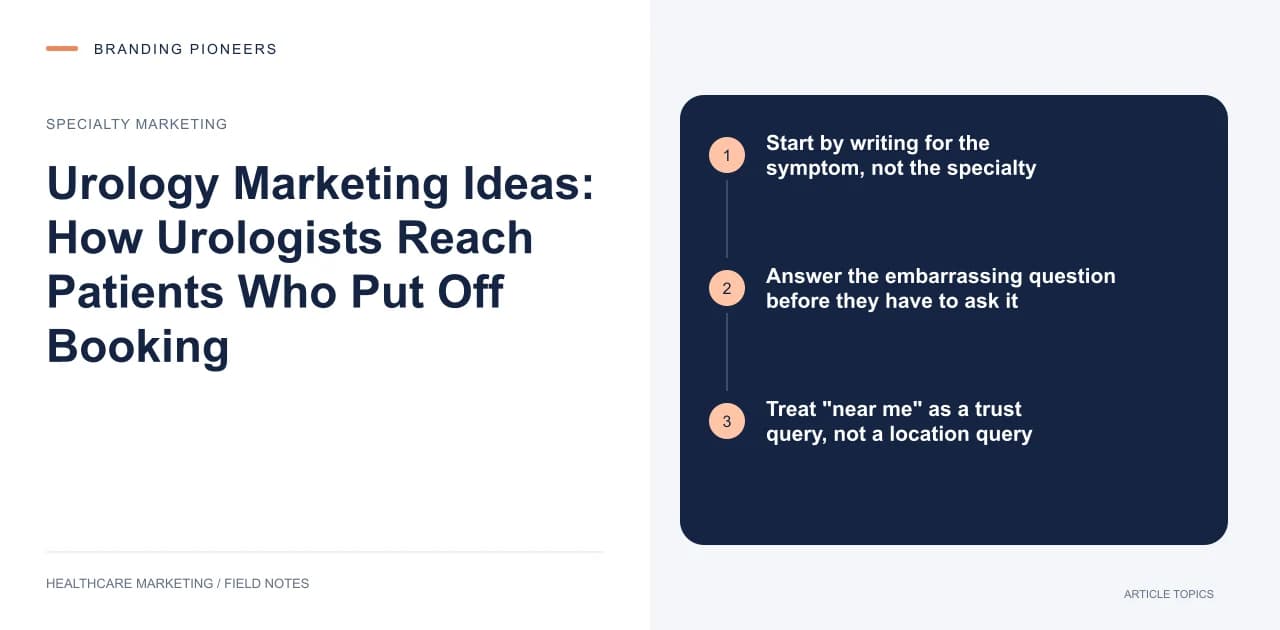
Start by writing for the symptom, not the specialty
Nobody searches "urologist" first. They search what is happening to them.
Frequent urination at night. Blood in urine. Difficulty starting. Pain after sitting. Low testosterone symptoms. Erectile difficulty after fifty. These are the entry points, and each one is a different patient at a different stage of alarm.
A site organised around the department — Urology, Andrology, Endourology — is organised for the hospital, not the patient. A site organised around symptoms meets people where the search actually starts and then routes them to the right consultant.
The practical version of this: one page per presenting symptom, written in the words a patient would use, linking through to the condition and then to the treatment. Three layers, not one. Our urology marketing pages are built on exactly this structure, and it is the single change that moves the most volume for a urology service line.
Answer the embarrassing question before they have to ask it
Urology carries more shame than almost any other specialty. That shame has direct commercial consequences: it is why patients delay, why they prefer to research rather than call, and why they will read four thousand words on a website before they will say a sentence out loud to a receptionist.
So put the awkward information on the page. What the examination involves. Whether they will be asked to undress. Whether a female doctor is available. Whether a partner can come in. How long they will be in the room. What happens if the test is uncomfortable.
Practices leave this out because it feels unpromotional. It is the most promotional content on the site, because it removes the exact reason someone is not booking.
Treat "near me" as a trust query, not a location query
When a patient searches "urologist near me", proximity is a filter, not a decision. What they do next is compare three profiles and pick the one that looks like it will not embarrass them.
That makes your Google Business Profile a clinical-credibility surface, not a directory listing. Complete it properly: the right primary category, every service named the way patients say it, current photographs of the actual reception and consulting rooms, hours that are true, and a booking link that works on a phone.
Reviews matter here more than in most fields, and they are harder to get, because urology patients are the least likely to write one. The practices that do accumulate them ask at the right moment — after a resolved course of treatment rather than after a first consultation — and they ask by message rather than in person, which removes the awkwardness of a face-to-face request about a urology visit. (Check the market first: in India, the NMC's 2026 guidelines bar a doctor from requesting patient reviews for promotion, so there you let reviews arrive unprompted — see our NMC guide.)
Build the referral side as deliberately as the patient side
A large share of urology volume arrives through general practice, and most practices do nothing at all to support that channel because it does not look like marketing.
It is. A referring GP is choosing between consultants with the same information problem a patient has, and usually less time. What helps them: a referral page with direct contact details that reach a human, clear sub-specialty interests so they know who to send what to, typical waiting times stated honestly, and a report that comes back quickly enough that they refer again.
None of that requires ad spend. It requires that someone owns it.
Paid search: bid on the decision, not the diagnosis
Urology paid search fails in a predictable way. The account bids on condition terms, collects a lot of clicks from people who are researching rather than booking, and reports a cost per lead that makes the channel look broken.
The fix is not a bigger budget. It is a tighter definition of which searches are worth paying for. Terms that carry treatment intent — a named procedure, "consultation", "appointment", "specialist" plus a city — convert. Terms that carry symptom intent are better served by content that ranks organically and costs nothing per click.
Two account-level habits do most of the work: a negative-keyword list that removes the symptom-research and self-treatment queries, and conversion tracking that counts a booked appointment rather than a form submission. Those two changes usually matter more than anything in the ad copy.
Platform policy is worth knowing before you write anything. Google restricts some sexual-health and hormone advertising, and the rules differ by country. Meta's health and wellness policy restricts targeting based on inferred health conditions everywhere. Neither platform will sign a business associate agreement, so no patient-identifying data should reach them at all — which constrains what you can track, and is a good reason to be careful with how your tags are configured.
Video does more here than it does elsewhere
For a specialty defined by discomfort, a consultant talking to camera for ninety seconds does something that text cannot: it shows the patient the person they would have to say this to.
Keep them short and answer one question each. What happens at a first appointment. Whether this symptom is common at this age. What the test involves. Who should not wait.
These do not need production values. They need the actual doctor, an accurate answer, and no promotional framing. Post them on the condition page they belong to and on the profile, and they will carry more conversion weight than the rest of the page.
Write for the answer engines too, because this is where they get used
Urology is close to the ideal case for an AI answer engine. The question is private, the asker would rather not say it out loud, and the answer is factual. A patient who would never phone a clinic will happily ask a chatbot whether blood in urine always means cancer.
What gets a practice named in those answers is not different from what earns a featured snippet, but it is stricter. The content has to state the answer plainly near the top rather than building to it. It has to be attributable — a named clinician with real credentials, a date, and a page that says who reviewed it. And it has to be free of the hedging that makes medical content unquotable, without becoming advice it has no business giving.
The practices that show up in these answers tend to have three things in common: a question-shaped heading, a direct two-sentence answer underneath it, and an author who is a real doctor at a real address. None of that is a trick. It is the same E-E-A-T requirement search has been applying to health content for years, now with a second consumer.
One caution. Answer engines summarise, and a summary of a medical page can lose the qualifier that made it safe. Write the qualifier into the sentence rather than the paragraph after it — "most cases are benign, but any visible blood in urine needs investigating" survives summarisation, while a reassuring paragraph followed by a separate warning does not.
Measure the delay, not just the leads
The number worth watching in urology is not enquiries. It is how long a patient takes to move from first visit to booked appointment, and how many never make the move at all.
Most practices cannot see this because their analytics stop at the form. If you can connect a booking back to the first session — even roughly, even with self-reported "how did you hear about us" data — you will usually find that the majority of bookings come from people who visited more than once over several weeks.
That finding changes the plan. It means remarketing to previous visitors is worth more than new reach. It means the follow-up sequence after an enquiry should be measured in weeks, not hours. And it means judging a campaign on its first thirty days will understate it, because the patients it reached have not decided yet.
What to do first
If you are starting from nothing, the order that works:
- Symptom pages for your five highest-value presentations, written plainly.
- The Google Business Profile completed properly, with a working mobile booking path.
- The awkward-questions content — what the appointment involves — on every one of those pages.
- A referral page that reaches a human.
- Paid search, last, and only on treatment-intent terms.
Most urology practices run that list in reverse, starting with ads because ads are the thing you can buy. The ads work better when they are last.
---
If you want a view of where your urology pages currently sit — what they rank for, what the profile is missing, and which symptom terms you are absent from — get a free audit and we will send the findings whether or not you work with us. Or book a strategy call if you would rather talk it through.
Filed underurology marketing ideasurology marketinghospital marketing ideasurologist marketing

About the author
Nishu Sharma
Founder & CEO · Gurugram, India
Nishu founded Branding Pioneers in 2016 with one rule that hasn't changed since: healthcare only. She'd run digital strategy at a top-10 Indian agency and watched generalist marketing underserve medical clients who needed something built for how patients actually search and decide. So she left to build the specialist instead. It's now an 80-person team working with healthcare brands worldwide.
Free guide · 17 pages
The Patient Acquisition Blueprint
A 90-day plan from first search to booked appointment.