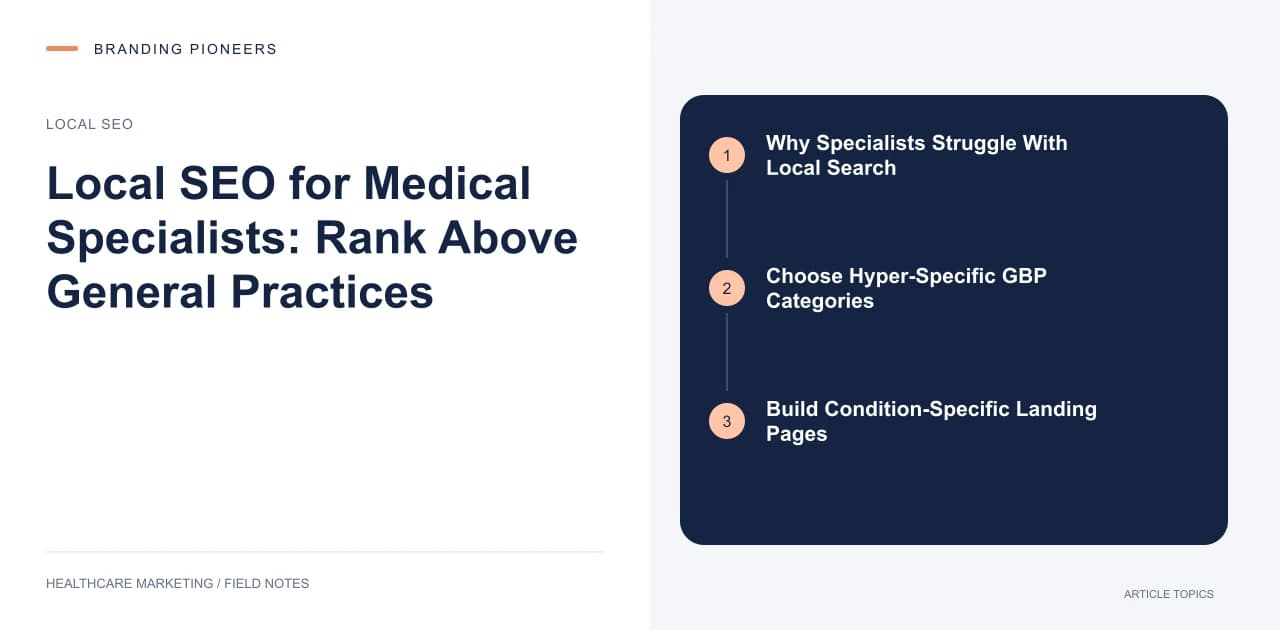
Why Specialists Struggle With Local Search
General practitioners own the local pack for most healthcare searches. A patient searching "doctor near me" will see GPs and urgent care clinics — not cardiologists or neurologists. For specialists, the path to local visibility requires a different playbook entirely.
The core issue is search volume distribution. Broad terms like "doctor near me" get 40 times more monthly searches than "cardiologist near me." But the specialist searches carry dramatically higher intent and patient value. A cardiology consultation generates 8 to 15 times the revenue of a GP visit, and the patient is further along in their decision journey.
The good news: competition for specialist local keywords is significantly lower. While 300 GPs might compete for the local pack in a metro city, only 15 to 30 cardiologists will be competing for theirs. The barrier to ranking is lower — you just need to know exactly what to optimize.
Choose Hyper-Specific GBP Categories
Your Google Business Profile primary category should be as specific as possible. Google offers highly granular healthcare categories: "Cardiologist," "Gastroenterologist," "Neurologist," "Orthopedic Surgeon," and dozens more. Never default to "Doctor" or "Medical Clinic" if a specialty-specific category exists.
In our experience, practices that use a specialty-specific primary category tend to rank noticeably higher in local pack results for specialty queries than those using a generic category.
Add secondary categories for subspecialties. A cardiologist who also does interventional procedures should add "Interventional Cardiologist" as a secondary category. Each additional relevant category expands the search queries that can trigger your listing.
Build Condition-Specific Landing Pages
Specialists need landing pages that target condition-based searches, not just specialty-based ones. Patients rarely search "cardiologist near me" — they search "chest pain doctor near me," "heart palpitations specialist," or "atrial fibrillation treatment in Delhi."
Create a dedicated page for each major condition you treat. Each page should include the condition name in the title tag and H1, symptoms patients might experience, your specific approach to diagnosis and treatment, your credentials and experience with this condition, and a clear call-to-action for booking a consultation.
These pages serve double duty: they rank for long-tail condition queries in organic search and they reinforce your GBP relevance for those same terms.
Leverage Physician-to-Physician Referral SEO
Unlike general practices, many specialist patients come through physician referrals. This creates an SEO opportunity that most specialists miss: optimizing for referring physician searches.
When a GP needs to refer a patient to a cardiologist, they often search "cardiologist near [location]" or "best interventional cardiologist referral [city]." Create a dedicated referral page on your website that speaks directly to referring physicians: your specialties, your turnaround times, your communication protocols, and how easy you make the referral process.
Link to this page from your GBP and ensure it includes structured data for your physician credentials. Practices that build referral-optimized pages report 20 to 35 percent increases in physician referral volume within six months.
Reviews That Mention Your Specialty
Generic reviews help, but reviews that mention your specialty and specific conditions carry outsized weight in local ranking algorithms. When a patient leaves a review saying "Dr. Sharma treated my knee replacement with exceptional skill," Google uses that content to understand and rank your practice for knee replacement searches.
You cannot (and should not) script patient reviews. But you can ask specific questions when requesting feedback: "What condition brought you to our practice?" and "What procedure did we perform?" Patients naturally incorporate these details into their reviews when prompted.
Practices with 20 or more reviews mentioning specific conditions rank measurably better for those condition-related local searches. The correlation is strong and consistent across specialties.
Schema Markup for Specialists
Implement MedicalBusiness schema with specialty-specific properties. Include your medical specialty, conditions treated, procedures offered, hospital affiliations, and board certifications. This structured data helps Google understand exactly what type of specialist you are and what searches your listing should appear for.
Go beyond basic schema. Use the MedicalProcedure schema type for each major procedure page, and connect it to your physician schema with the appropriate relationships. Specialists who implement comprehensive medical schema see their rich results appearance increase by 25 to 40 percent.
Content Authority Through Case Studies
Specialists have an advantage that GPs do not: complex cases that demonstrate genuine expertise. Publishing anonymized case studies — with patient consent and full de-identification — signals the kind of deep expertise that Google's E-E-A-T framework rewards.
A neurosurgeon who publishes detailed case discussions about challenging spinal procedures builds topical authority that no amount of generic content can match. Aim for one case study per month, written in accessible language that both patients and referring physicians can understand.
Local Link Building for Specialists
The most valuable local links for specialists come from hospital websites, medical association chapters, and physician directories. If you have admitting privileges at a hospital, ensure their online physician directory links to your practice website. If you belong to a specialty medical society, claim your profile and add your website link.
These authoritative, healthcare-specific links carry significantly more ranking weight than generic local directory listings. A single link from a major hospital website can be worth more than 50 standard directory citations.
Measuring Specialist Local SEO Success
Track these metrics monthly: local pack impressions for specialty-specific queries, click-through rate from GBP listing, phone calls from GBP, direction requests, and website visits from local search. Use Google Search Console to identify which condition-specific queries drive the most impressions and clicks.
For specialists, quality of traffic matters more than quantity. A ranking improvement that brings 10 additional monthly visitors searching for "knee replacement surgeon" is worth more than 100 visitors searching generic terms. Focus your tracking on the high-value specialty queries that match your most profitable service lines.
Filed underlocal SEO specialistsspecialist doctor local searchcardiologist SEOmedical specialist Google ranking

About the author
Arush Thapar
Co-Founder & CTO · Gurugram, India
Arush builds the systems the rest of the company runs on — the patient-acquisition pipelines, the AI chatbots, the analytics that tie a single click to a booked appointment. If a campaign reports a number, it's because something his team built is tracking it.
Free guide · 17 pages
The Patient Acquisition Blueprint
A 90-day plan from first search to booked appointment.