Obstetrics has an unusual shape. The decision is made early and fast, and then it holds for the better part of a year.
A woman who has just confirmed a pregnancy typically chooses a doctor within a couple of weeks, often on a recommendation plus a quick search to check the recommendation. After that, she rarely reconsiders unless something goes wrong. Everything a hospital does to win obstetric volume has to happen inside that short opening window, because after it closes the patient is not in the market.
Gynaecology, sharing the same department and often the same doctors, behaves in the opposite way — episodic, symptom-driven, spread across decades of a patient's life, and largely invisible to the hospital's marketing.
They are two businesses, and most OB-GYN marketing treats them as one.
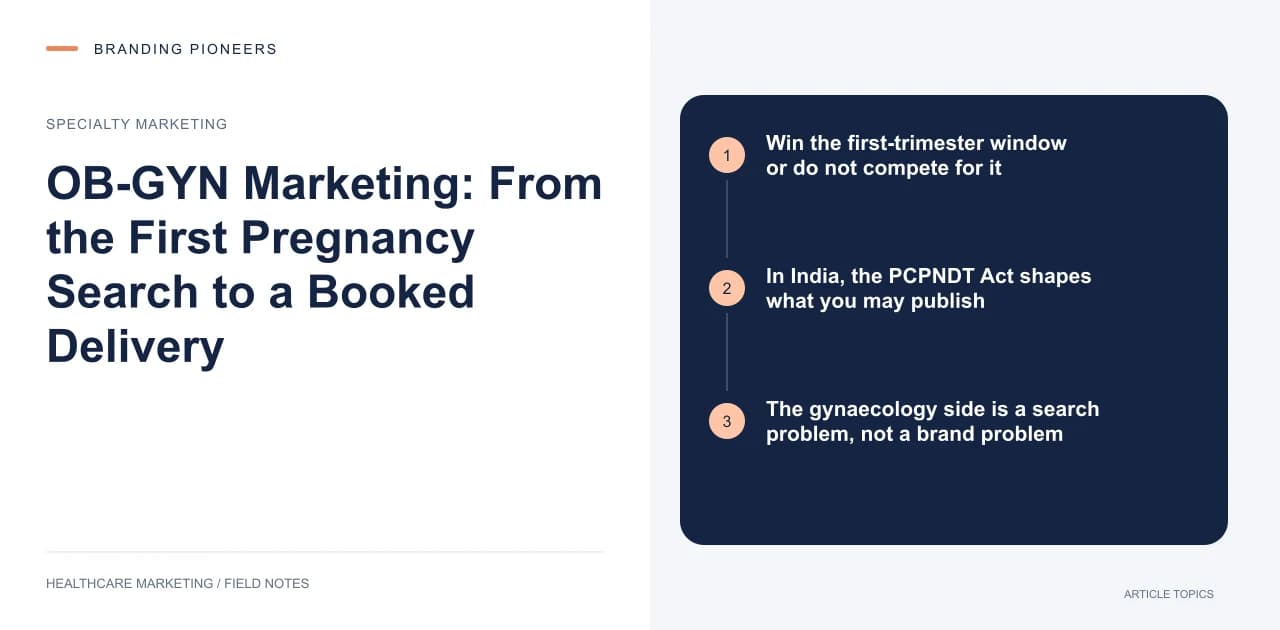
Win the first-trimester window or do not compete for it
In the two or three weeks after a positive test, a woman is looking for a specific set of answers: who will actually deliver the baby, at which hospital, what happens if it is at three in the morning, whether she can meet the doctor before committing, and what the package covers.
Most hospital sites answer none of that. They list consultants, list facilities, and mention a level-three NICU without explaining what a level-three NICU means to somebody who has never needed one.
Write the page that answers the real questions instead. Which doctor sees her at each antenatal visit and whether it is the same person each time. Who is present at delivery if her consultant is unavailable. What the hospital's approach is to induction and to caesarean section — discussed as an approach rather than as a rate she cannot interpret. Whether a birth companion is allowed and who qualifies. What happens if the baby needs the NICU. What the antenatal package includes and what is billed separately.
This is the content that converts, and it is sitting unwritten on almost every hospital website. Our obstetrics and gynaecology marketing pages are organised around those questions rather than around the department structure.
In India, the PCPNDT Act shapes what you may publish
This is not optional and it is frequently mishandled by agencies who have not read it.
The Pre-Conception and Pre-Natal Diagnostic Techniques (Prohibition of Sex Selection) Act, 1994 prohibits advertising relating to pre-natal determination of sex, and Section 22 makes it an offence — including for the person who publishes the advertisement. Registered facilities are required to display the prescribed notice stating that sex determination is not carried out there.
Practical consequences for marketing. Any page about ultrasound, foetal scans or foetal medicine should carry the notice, not hide it. Nothing in your copy, your creative or your keyword targeting should be capable of being read as offering sex determination — and that includes bidding on queries that seek it. If your ultrasound page is generating that kind of enquiry, the answer is a negative keyword list and clearer copy, not silence.
The Medical Termination of Pregnancy Act, 1971 as amended also governs what may be said about termination services, and the National Medical Commission's ethical advertising guidelines of 6 October 2026 govern what a registered practitioner and a hospital may advertise generally: no superlatives, success stories, testimonials or offers (see our NMC guidelines hub).
The gynaecology side is a search problem, not a brand problem
Gynaecology demand is symptom-led and mostly anonymous. Heavy periods. Irregular cycles. PCOS. Fibroids. Pain during intercourse. Recurrent urinary infections. Menopause symptoms. Post-partum problems nobody warned her about.
Each of those is a search, written in a patient's own words, made privately. Hospitals answer them with a page called "Gynaecology" that lists procedures.
The fix is the same structure that works in every private specialty: one page per presenting symptom, in plain language, linking to the condition and then to the treatment. Written by or reviewed by a named doctor, dated, and free of the hedging that makes health content unusable.
Menopause deserves specific mention because demand is rising, coverage is poor almost everywhere, and the searches are long, specific and easy to serve well.
Reviews attach to the doctor, not the hospital
In obstetrics more than in most specialties, patients recommend a person. The hospital is a detail attached to the person.
That means the doctor profile is the page that matters, not the department page — and it should read as patient information. Real photograph, qualifications, registration details including the State Medical Council registration number, languages spoken, clinic timings that are true, the sub-areas she actually focuses on, and a booking route that works on a phone.
It does not mean asking new mothers to review the doctor by name. In India, the NMC guidelines bar a registered practitioner from requesting or sharing patient reviews for professional promotion (Explanation V to para 3.2), and having staff ask in her name is the same thing done indirectly (para 8.1(xi)). Reviews patients choose to leave are not prohibited; reply courteously and never confirm that someone was a patient. Our guidance on the Google Business Profile covers the profile mechanics that make those reviews visible in local search.
Referral and the antenatal ecosystem
Obstetric referrals come from general physicians, fertility clinics, pathology labs and, in India, from a dense informal network that nobody maps.
Fertility is the most direct and the most neglected. A couple who conceive through treatment need obstetric care immediately afterwards, and the handover is usually left to chance. If your hospital has a fertility service, connect the two properly on the site as well as clinically — see fertility and IVF marketing for how that demand behaves before it arrives at your door.