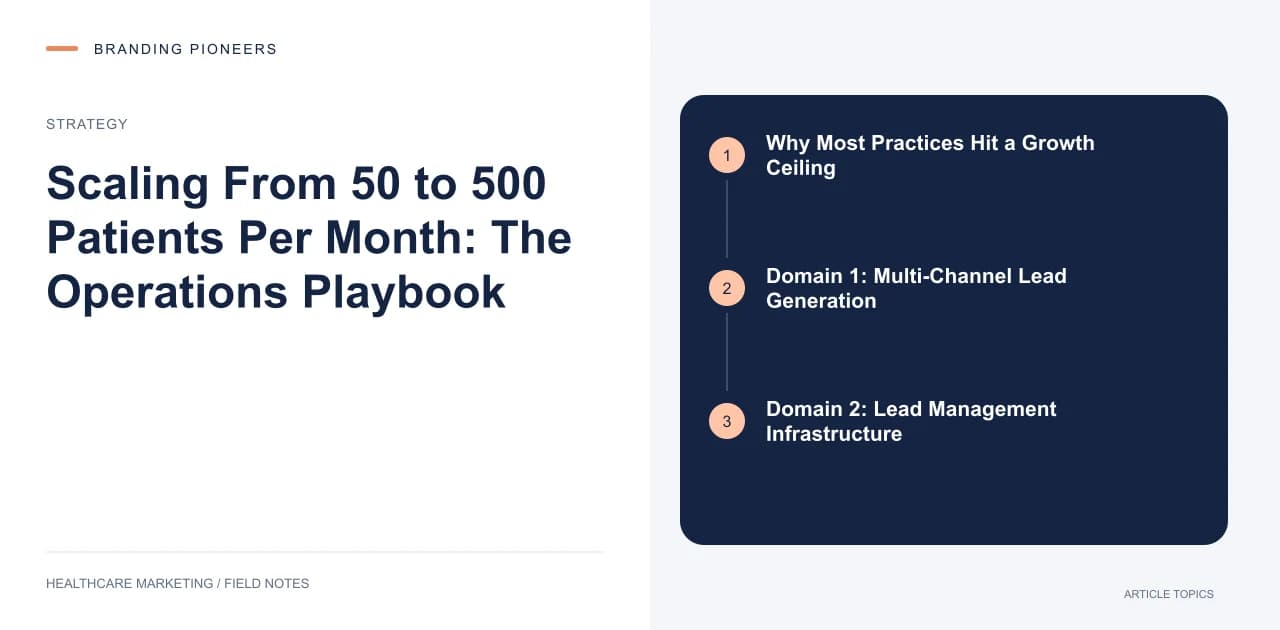
Why Most Practices Hit a Growth Ceiling
Every healthcare practice hits a ceiling. You increase ad spend but cost per patient rises. You add marketing channels but your front desk cannot keep up with the volume. You get more leads but conversion rates drop. The patient count flatlines between 50 and 100 per month regardless of how much you spend.
This ceiling is not a marketing problem — it is an operations problem. Your marketing can generate 500 leads per month, but if your operations can only convert and serve 80, the other 420 are wasted spend.
Scaling from 50 to 500 patients per month requires synchronized growth across four domains: lead generation, lead management, conversion infrastructure, and clinical capacity. Here is the framework.
Domain 1: Multi-Channel Lead Generation
At 50 patients per month, a single lead source (usually Google Ads) is sufficient. At 500, you need a diversified portfolio of lead sources, each contributing a reliable portion of total volume:
Google Search Ads (25 to 30 percent of leads). Scale by expanding keyword coverage, adding service-line-specific campaigns, and implementing Performance Max alongside traditional search campaigns. At scale, aim for 8 to 12 campaigns covering your major service lines.
SEO and organic content (20 to 25 percent of leads). The most cost-efficient channel at scale. A mature content operation producing 15 to 20 articles per month across your service lines should generate 1,000 to 3,000 organic leads per month after 12 to 18 months. At zero marginal cost per lead, this channel dramatically lowers your blended acquisition cost.
Google Local Service Ads (10 to 15 percent). Pay-per-lead model with high lead quality. Particularly effective for general practice, dentistry, and diagnostics.
Social media ads (10 to 15 percent). Facebook and Instagram ads for brand awareness and cosmetic/elective procedure marketing. WhatsApp click-to-chat ads for direct lead generation.
Referral programs (10 to 15 percent). At scale, a structured referral program should contribute 50 to 75 patients per month. These patients have the highest conversion rates and lifetime values of any channel.
WhatsApp and organic social (5 to 10 percent). Community building, content distribution, and organic patient acquisition through social media presence.
The key insight: no single channel can sustainably deliver 500 patients per month. Diversification is not just risk management — it is a mathematical requirement.
Domain 2: Lead Management Infrastructure
At 50 leads per month, a receptionist with a spreadsheet can manage the volume. At 500, you need a CRM system with automated workflows:
CRM implementation. Deploy a healthcare CRM (HubSpot, GoHighLevel, or Salesforce Health Cloud) to centralize all leads from all channels. Every lead — web form, phone call, WhatsApp message, walk-in — enters the CRM with source attribution, timestamp, and inquiry details.
Automated lead routing. When a lead enters the CRM, it should be automatically assigned to the right team member based on specialty, lead score, and channel. A high-value surgical inquiry should route to a senior patient coordinator, while a general consultation inquiry can be handled by the standard team.
Speed-to-response automation. Implement automated first-response messages that fire within 60 seconds of any lead submission. WhatsApp and SMS acknowledgments that say "Thank you for your inquiry. A team member will contact you within 15 minutes" keep leads warm while your team prepares a personalized response.
Pipeline tracking. Visualize your lead pipeline: new leads, contacted, consultation booked, consultation attended, treatment planned, treatment completed. At scale, without pipeline visibility, leads fall through the cracks — and at 500 leads per month, even a 5 percent leak rate means 25 lost patients monthly.
Domain 3: Conversion Infrastructure
Lead volume means nothing without conversion. Scaling requires systematic improvements across every conversion touchpoint:
Dedicated patient coordinators. At scale, front-desk staff cannot handle both walk-in patients and lead conversion simultaneously. Hire dedicated patient coordinators whose sole job is converting leads to appointments. Train them extensively on consultation skills, objection handling, and the specific value proposition of each service line.
Call handling protocols. Script the first 60 seconds of every inbound call: greeting, qualification question, appointment offer. Track conversion rate by coordinator and by shift. The best-performing coordinators should handle the highest-value leads.
Multi-channel booking. Offer booking through phone, WhatsApp, online widget, and in-person. Each channel should funnel into the same system with the same tracking. Patients who cannot book through their preferred channel are patients you lose to competitors.
Follow-up automation. Implement the 21-day follow-up sequence for every unbooked lead. At 500 leads per month, manual follow-up is impossible. Automated sequences recover 20 to 30 percent of leads that would otherwise be lost.
Domain 4: Clinical Capacity
This is where many ambitious practices fail. They scale marketing and lead management but do not scale clinical capacity to match. The result: 6-week wait times, frustrated patients, negative reviews, and a reputation that undermines all the marketing investment.
Capacity planning. Before scaling marketing, model your capacity constraints: how many consultations per day per doctor, how many procedures per week per operating room, and how many patients your support staff can manage. Identify the bottleneck and plan to resolve it before it constrains growth.
Physician recruitment. If your growth target requires more clinical capacity than your current team can deliver, begin physician recruitment 6 to 12 months before the capacity is needed. Recruiting and onboarding a specialist takes 3 to 6 months minimum.
Operational efficiency. Before adding headcount, optimize existing capacity. Reduce average appointment time through better pre-visit preparation, implement group orientation sessions for common procedures, and use telemedicine for follow-up visits that do not require physical examination.
The Scaling Timeline
Months 1-3: Implement CRM, set up automated first-response and follow-up sequences, train patient coordinators, and audit current conversion rates. Goal: improve conversion rate by 30 to 50 percent from existing lead volume.
Months 4-6: Launch additional marketing channels (add 2 to 3 new channels to existing mix), begin content production at scale, and implement lead scoring. Goal: increase lead volume by 50 to 100 percent.
Months 7-9: Optimize based on 6 months of data: reallocate budget to highest-performing channels, refine lead scoring, upgrade training for coordinators. Goal: 200 to 300 patients per month.
Months 10-12: Full-scale operation: all channels active, all automation running, clinical capacity aligned with demand. Goal: 400 to 500 patients per month with sustainable unit economics.
Unit Economics at Scale
The metric that determines whether scaling is profitable: marginal cost per patient should decrease, not increase, as you scale. If your cost per patient rises as you add volume, you are scaling the wrong channels or your conversion infrastructure is not keeping up with lead volume.
Target unit economics at 500 patients per month: blended cost per patient acquisition should be 25 to 40 percent lower than at 50 patients per month, because high-efficiency channels (SEO, referrals) contribute a larger share of total volume. If your unit economics are moving in the wrong direction, pause scaling and fix the bottleneck before resuming.
Filed underscaling patient acquisitionhealthcare growth strategyscale medical practicepatient volume growth

About the author
Arush Thapar
Co-Founder & CTO · Gurugram, India
Arush builds the systems the rest of the company runs on — the patient-acquisition pipelines, the AI chatbots, the analytics that tie a single click to a booked appointment. If a campaign reports a number, it's because something his team built is tracking it.
Free guide · 17 pages
The Patient Acquisition Blueprint
A 90-day plan from first search to booked appointment.