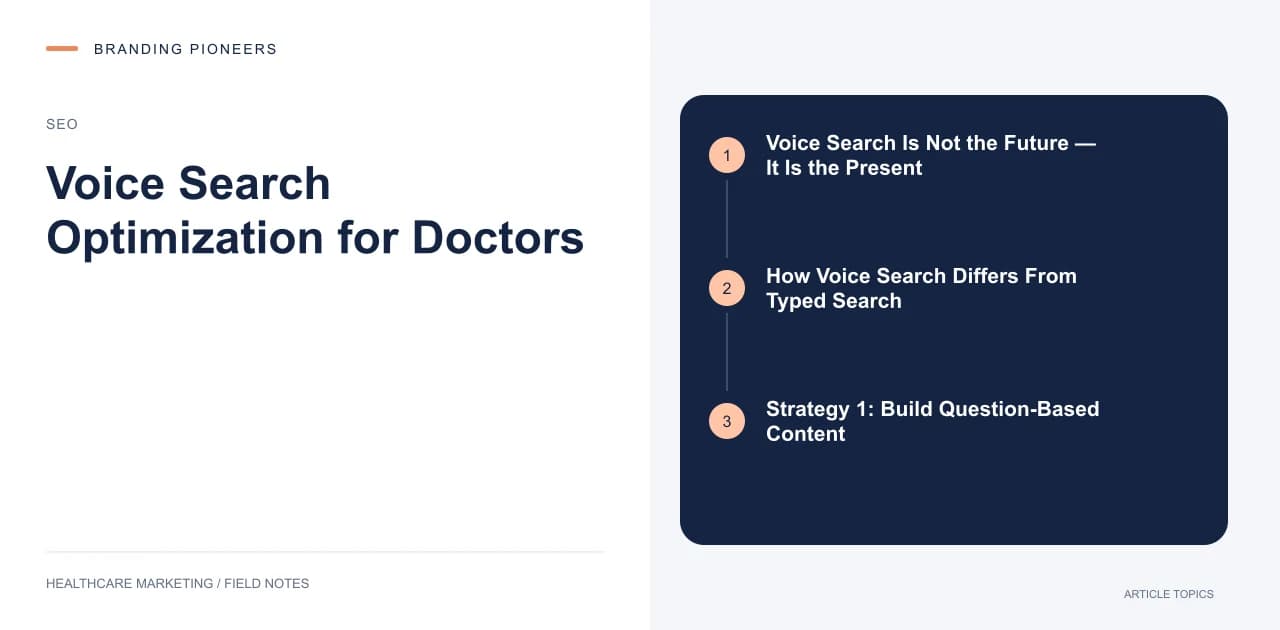
Voice Search Optimization for Doctors
One in four health searches now happens by voice. Here is how to optimize your medical practice for Siri, Alexa, and Google Assistant queries.
Sources & References
One in four health searches now happens by voice. Here is how to optimize your medical practice for Siri, Alexa, and Google Assistant queries.
Roughly 25 percent of health-related mobile searches now use voice input. That number climbs to 40 percent for patients over 55 — a critical demographic for many medical specialties. When someone says "Hey Google, find me a cardiologist near me who takes Blue Cross," they are expressing high purchase intent. These are patients ready to book.
The challenge is that voice search queries look fundamentally different from typed queries. They are longer, conversational, and often phrased as complete questions. Optimizing for voice search requires a different approach than traditional keyword targeting.
A typed search might be "dermatologist Gurgaon." The voice equivalent is more like "Who is the best dermatologist in Gurgaon for acne scars?" Notice the differences: the voice query is a complete question, includes qualifiers like "best," specifies a condition, and includes the location naturally.
Voice search results also behave differently. Google typically reads back a single answer (Position Zero or the featured snippet), not a list of ten results. If you are not the featured snippet, you do not exist in voice search. This makes featured snippet optimization the cornerstone of voice search strategy.
Create content structured around the exact questions patients ask out loud. Use your Google Search Console data to identify queries that start with "how," "what," "where," "when," "who," "can I," "should I," and "is it." These are your voice search targets.
For each question, create a section on a relevant page that directly answers it in the first two to three sentences, then provides supporting detail. The direct answer should be 40 to 60 words — long enough to be helpful but short enough for Google to read aloud.
Example: a FAQ section on your ACL surgery page might include "How long is recovery after ACL surgery?" with the answer "Most patients return to desk work within two weeks after ACL surgery and resume full physical activity in six to nine months. Recovery speed depends on the graft type used, adherence to physical therapy, and overall health."
"Near me" voice queries are the highest-converting searches in healthcare. When someone asks their phone for a "pediatrician near me open right now," they want to call or visit immediately.
Optimize for these queries by ensuring your Google Business Profile hours are accurate and up to date, including "after hours" and "emergency" availability. Add service-specific details to your GBP listing. Use LocalBusiness schema markup with your exact coordinates. And create content that naturally includes your neighborhoods, city, and region names.
Create dedicated pages or blog posts that target conversational queries specific to your practice. For example, "What should I bring to my first visit to a cardiologist?" or "How much does a dental implant cost without insurance?" These long-tail conversational queries get relatively little competition but convert extremely well.
Structure these pages with the question as the H1 heading, a concise direct answer in the first paragraph, and then detailed supporting content. Include FAQ schema markup so Google can pull your answer into featured snippets.
Google Assistant and Siri prioritize fast-loading pages for voice results. Pages that load in under 2.5 seconds are significantly more likely to be selected as voice answers. Run your key pages through Google PageSpeed Insights and address any issues that push load time above that threshold.
For healthcare websites, the biggest speed gains usually come from optimizing images (use WebP format and lazy loading), implementing a CDN, and reducing JavaScript bundle size.
Beyond Google, patients use Siri (Apple Maps) and Alexa for healthcare searches. Ensure your practice is listed and optimized on Apple Maps Connect (mapsconnect.apple.com) and Yelp (which powers many Alexa healthcare queries). Keep your information consistent across all platforms.
Direct voice search analytics are limited, but you can use proxy metrics. In Google Search Console, filter for queries containing question words and conversational phrases. Track featured snippet appearances using a rank tracking tool. Monitor phone calls from your GBP listing, as many voice searches result in direct calls.
Focus on impression and click data for queries longer than five words — these are your most likely voice search queries. A growing share of long-tail query traffic typically indicates improving voice search visibility.
Writing on healthcare growth, AI-powered patient acquisition, and the operational reality of marketing inside hospitals and clinics.
The exact 90-day patient-acquisition system, step by step.
The healthcare SEO landscape has shifted dramatically. AI Overviews, tighter E-E-A-T enforcement, and new local ranking …
Large hospitals need SEO strategies that work at the department level. Here is how to structure keyword targeting, provi…
Schema markup helps Google understand your medical website. This guide covers the exact schema types healthcare sites ne…
Six reasons hospitals, clinics, and doctors pick a healthcare-only firm over a generalist agency.
It's all we do. No retail, no fintech — the whole team thinks in patient journeys, clinical trust, and the way people actually choose a doctor.
Receptionists, WhatsApp triage, and attribution built in-house — we answer patients in seconds and tie every click to a booked appointment.
HIPAA, ASCI, NABH and GDPR sign-off baked into every campaign — our standard, not an upcharge or an afterthought.
The senior who pitched you stays on the engagement. No bait-and-switch to juniors learning on your budget.
Patient-level attribution across calls, forms, and walk-ins. Monthly reports show booked patients — not just clicks and impressions.
We name our clients and show the work. Quarterly reviews with the numbers attached, every cycle.
Adjacent practices, the relevant tools, and the case files where we shipped this thinking against real patient-acquisition targets.