Every hospital has a marketing strategy. Most of them are wrong.
Not wrong because they picked bad tactics. Wrong because they started with tactics instead of strategy. "Let's run Google Ads" is not a strategy. "Let's be on Instagram" is not a strategy. "Let's launch a health blog" is not a strategy.
A strategy answers three questions first:
- 1Who are we trying to reach, and what do they need?
- 2What do we want them to do, and how will we know if it's working?
- 3What is the most effective way to get in front of them with the right message?
Tactics come after you've answered these questions. Not before.
This is how the best-run hospital marketing teams build plans that produce consistent, measurable patient growth. It's also how smaller hospitals can compete with them on smaller budgets.
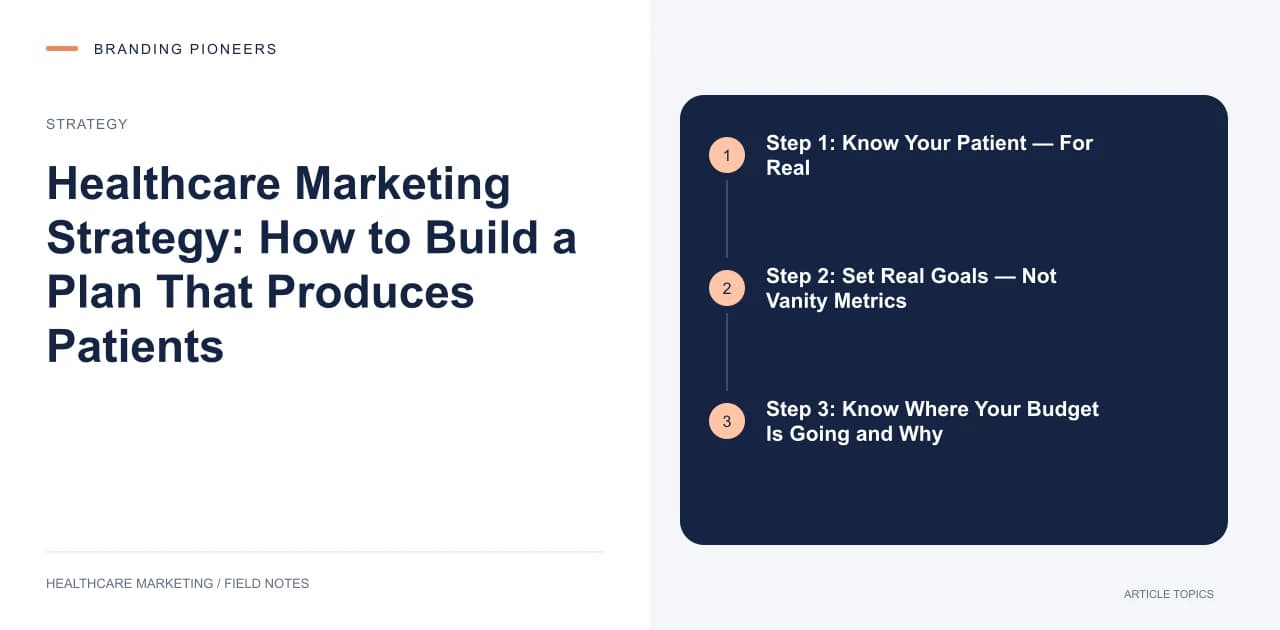
01Step 1: Know Your Patient — For Real
Most hospital marketing plans start with "our target audience is patients in Delhi NCR." That's not an audience. That's a geography.
A useful audience definition for marketing looks like this:
Primary audience for our knee replacement program:
- Age: 55–72
- Income: ₹12+ lakh household income (private hospital budget)
- Lives within 25 km of our hospital
- Has been experiencing knee pain for 6+ months
- Has already seen a GP or physiotherapist who hasn't resolved the problem
- Is researching surgical options but is anxious about recovery time and cost
- Primary information sources: Google search, family doctor recommendations, children who research on their behalf
This description tells you:
- Which channels to use (Google Search — they're actively searching; WhatsApp — their adult children will share information via messaging)
- What message to lead with (addressing anxiety about recovery and cost, not promoting cutting-edge technology)
- What content to create (recovery timeline guides, cost transparency pages, testimonials from patients in similar age/situation)
- Who influences the decision (adult children — so target 30–45-year-olds researching for parents)
Do this exercise for every specialty you want to grow.
02Step 2: Set Real Goals — Not Vanity Metrics
"Increase online presence" is not a goal. "Grow our social following by 20%" is not a useful goal. "Improve website traffic" is not a goal.
Goals for a healthcare marketing strategy should be:
- Number of new patients per month, by specialty
- Cost per patient acquired, by channel
- Revenue attributable to digital marketing
- Patient retention rate (for existing patient programs)
- Conversion rate from inquiry to consultation
Translated example:
Bad goal: "Grow our cardiology department's digital presence."
Good goal: "Acquire 80 new cardiology consultation patients per month from digital channels by Q3 2026, at a maximum CPA of ₹3,500, with a minimum 18% conversion rate from inquiry to booked appointment."
The good goal tells you exactly what success looks like and gives you numbers to track monthly.
03Step 3: Know Where Your Budget Is Going and Why
The most common budget mistake in hospital marketing: spending is divided proportionally across channels based on what worked last year (or what the agency recommended) without revisiting whether the allocation still makes sense.
A sound budget allocation starts with your goals and works backward.
Example for a hospital targeting 100 new OPD patients per month from digital:
If your historical average CPA is ₹3,000 and you want 100 patients, you need ₹3 lakh/month in digital spend to hit that goal — assuming you fix nothing. If you improve your website conversion rate from 1.5% to 3.5%, your CPA drops to ~₹1,300. Now you need ₹1.3 lakh to hit the same target.
This is why conversion rate optimization should come before you increase ad spend. Spending ₹80,000 on landing page optimization can save you ₹1.7 lakh per month in ongoing ad costs.
A reasonable channel allocation for a mid-sized hospital starting out:
- Google Search Ads: 35–45% (direct intent, highest quality leads)
- SEO (agency fees + content): 20–25% (long-term, compounding returns)
- Meta Ads (Facebook/Instagram): 10–15% (awareness and retargeting)
- WhatsApp Business setup + automation: 5–10%
- Content production: 10–15%
- Analytics and CRM tools: 5%
Adjust based on your specific performance data. If SEO is producing at ₹800 CPA vs Google Ads at ₹2,800, shift budget from ads to SEO. The data should drive allocation decisions.
04Step 4: Choose Channels Based on Your Audience, Not Trends
Instagram Reels are trending. Short-form video is trending. AI chatbots are trending. Influencer marketing is trending.
None of this matters if your audience — a 60-year-old executive in Delhi looking for cardiac surgery — doesn't get health information from Instagram.
Channel selection matrix for healthcare:
Pick the channels where your specific audience lives. Then do fewer channels better, rather than all channels poorly.
05Step 5: Build a Content Calendar Around Patient Decisions, Not Marketing Events
Content marketing for hospitals fails when the content calendar is built around marketing events (World Heart Day, National Cancer Awareness Month) rather than patient decision moments.
Patient decision moments for a cardiac hospital:
- "I've been having chest pain for 2 weeks — is it serious?"
- "My doctor told me I need an angioplasty. What does that mean?"
- "What's the difference between a stent and bypass surgery?"
- "How much does heart surgery cost in Delhi?"
- "What's recovery like after cardiac surgery?"
- "Which hospital in Delhi is best for heart surgery?"
Every piece of content should be answering one of these questions. Content that answers real patient questions gets found in Google Search, gets shared on WhatsApp, and positions your hospital as the authority at the moment a decision is being made.
06Step 6: Build Measurement Into the Plan From Day One
The most expensive mistake in healthcare marketing is running campaigns for 6 months without tracking their ROI, then being unable to justify the budget when asked.
Before any campaign goes live, set up:
- Google Analytics 4 with conversion events for form submissions, phone clicks, WhatsApp clicks, and appointment bookings
- UTM parameters on every ad URL so you know which campaign drove which lead
- A CRM that receives every lead from every source with source data attached
- Monthly reporting: leads by source, CPL by source, conversions by source, CPA by source
This is not complicated. It requires one day of setup and a commitment to maintaining it.
07The Strategy Document: What It Looks Like
A healthcare marketing strategy document should be:
- 8–15 pages maximum
- Specific about audiences, goals, channels, and budget
- Reviewed and updated quarterly based on actual performance data
- Owned by one person (your CMO or marketing lead) with clear accountability
It should NOT be:
- A 60-slide PowerPoint with market research nobody will use
- A wish list of tactics with no budget attached
- A document reviewed once a year regardless of performance
08Common Strategy Mistakes We See in Indian Hospitals
Copying competitor tactics without understanding the context. Fortis running Instagram Reels doesn't mean your 3-location orthopaedic chain should prioritize Instagram. Fortis has brand recognition that converts cold social traffic. You probably don't — yet.
Treating marketing as a cost center, not a revenue driver. When budgets get cut, marketing is first. This is backwards. The hospitals that grew during COVID were the ones that maintained marketing spend while others cut it — they emerged with meaningfully more market share.
Separating online and offline marketing completely. Patients who see an outdoor billboard search for you on Google. Patients who hear a radio ad check your Google reviews. Your online and offline marketing must be coordinated, with consistent messaging and a measurable connection.
Not allocating budget for testing. The best marketing strategy in the world still requires testing. Reserve 10–15% of your marketing budget for testing new channels, new messages, and new formats. The learnings from testing fund the next year's strategy.
If you want help building a proper marketing strategy for your hospital — one that starts with your patient and ends with measurable revenue — contact Branding Pioneers.