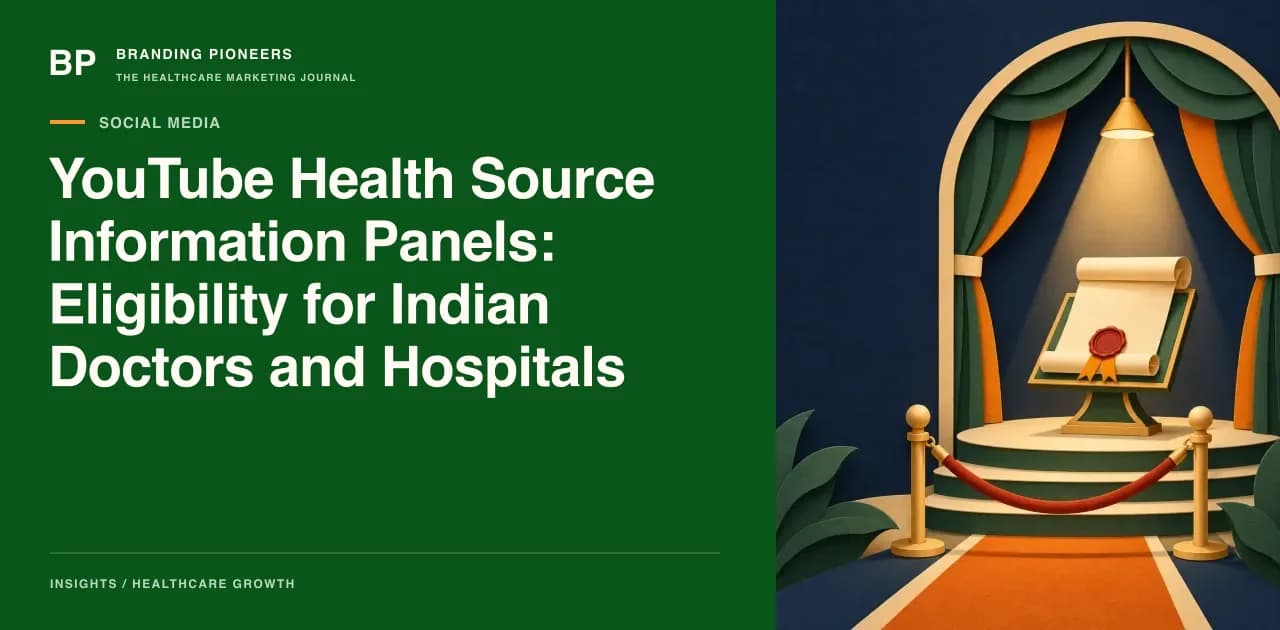
YouTube can attach a label to a doctor's or hospital's videos that tells viewers the source is a credible health provider, and it can place those videos in a shelf when people search health topics. For a surgeon or a hospital marketing team that has spent years building a channel, the feature is attractive. It is also easy to misunderstand, because the rules have changed over time and the eligibility pages vary by country.
This post is for doctors who run or plan a YouTube channel in India and for the teams that support them. It explains what the features are, who can apply according to Google's own pages, what the channel requirements are, and how to check your readiness before applying. It does not promise approval. Eligibility is decided by YouTube, and details can change, so read the current pages before you act.
Our approach throughout is to separate what Google has stated from what we cannot confirm. Where the sources disagree, we say so.
What the features are
YouTube describes two related health features. Health source information panels appear under videos from eligible channels and help viewers identify the channel as an authoritative source. Health content shelves highlight videos from eligible sources when viewers search for health topics.
These are not ranking guarantees. They are trust signals shown to viewers. The panel tells a person that the publisher is a licensed provider or an accredited institution. The shelf is a way for such videos to be seen in a health search. Neither replaces good content.
What Google said about India
In December 2024, Google announced that registered doctors, nurses, mental health professionals and health information providers in India could apply to make their channels eligible. Its announcement on the Google India blog says the applicant's medical licence will be verified, that channels must follow health information-sharing best practices drawn from the Council of Medical Specialty Societies, the National Academy of Medicine and the World Health Organization, and that the channel must be in good standing. It says more medical specialties will be added over time. Applications go through YouTube's health site, which the announcement names as health.youtube.
The Help page, covered below, also makes clear that accredited hospitals and institutions can be eligible through existing vetting. The individual-professional route is the newer part of the programme.
What the YouTube Help page requires
The YouTube Help page on eligibility for health features sets out the detailed requirements. When we read it, these points applied:
- Applicants must be licensed doctors, registered nurses, psychologists or equivalent, marriage and family therapists, or clinical social workers. Representatives of organisations must be licensed in one of these professions and oversee the organisation's YouTube content. Licences are verified by a third party, LegitScript.
- The channel must follow the YouTube Channel Monetisation Policies, whether or not it earns money, and must have no active Community Guidelines strikes.
- The channel must primarily cover health information.
- The channel needs more than 1,500 valid public watch hours in the last twelve months, or 1.5 million valid public Shorts views in the past ninety days.
- Applicants attest to health information sharing principles.
- Decisions typically take one to two months, and accepted channels may begin appearing in the features two to three months later. Eligibility is reassessed periodically.
- Accredited hospitals, academic medical institutions, public health departments and government organisations may be eligible through existing vetting, without an application. Certain for-profit healthcare brands, and channels run by pharmaceutical companies, health insurers or medical device companies, are excluded.
There is a discrepancy to flag. The list of countries on the Help page we read named a set of markets that did not include India, while the Google India announcement says Indian professionals can apply. We could not resolve that from the pages. The practical advice is to start from the application form on the health site and read the country notes shown there, not from an old article.
Who this suits in India
A few patterns, based on those stated rules:
- An individual doctor with a personal channel is the clearest fit, provided the registration is current and the channel is primarily health content. A channel that mixes clinical education with travel vlogs or product promotion is less likely to qualify as "primarily health information".
- A hospital should check whether it counts as an accredited institution. Ask the platform which route applies, and ensure the person who applies is a licensed professional who oversees the channel's content, as the Help page requires.
- A clinic chain or health brand may fall under the for-profit exclusion. Do not assume. Check the current wording.
- A pharma, medtech or insurer channel is excluded by the Help page.
- A marketing agency cannot hold the licence. The doctor or an authorised licensed professional must apply and be accountable.
Application readiness checklist
Before you apply, assemble this evidence.
- Licence documents. The registration number and issuing body for the doctor or oversight professional, with a current record that matches the name on the channel. Make sure the name on the licence matches the name used on the channel and in any application.
- Watch time and Shorts proof. From YouTube Studio analytics, check valid public watch hours over the last twelve months or valid public Shorts views over ninety days against the thresholds. If you are close, wait.
- Channel focus. Review your last fifty uploads. If most are not health information, clean up or retire off-topic videos.
- Strike history. Confirm no active Community Guidelines strikes.
- Monetisation policy compliance. Read the policies and fix reused content, misleading metadata and similar issues.
- Health information principles. Read the sharing principles you will attest to and check that your content process matches them. Our E-E-A-T framework for healthcare content provides a practical review method.
- Editorial record. Keep a log of who writes, medically reviews and approves each video. YouTube has not said it asks for this, but it supports the attestation.
- NMC alignment. For doctors in India, make sure the content follows the rules on advertising and solicitation. See our NMC compliance handbook and our post on 2026 NMC advertising changes.