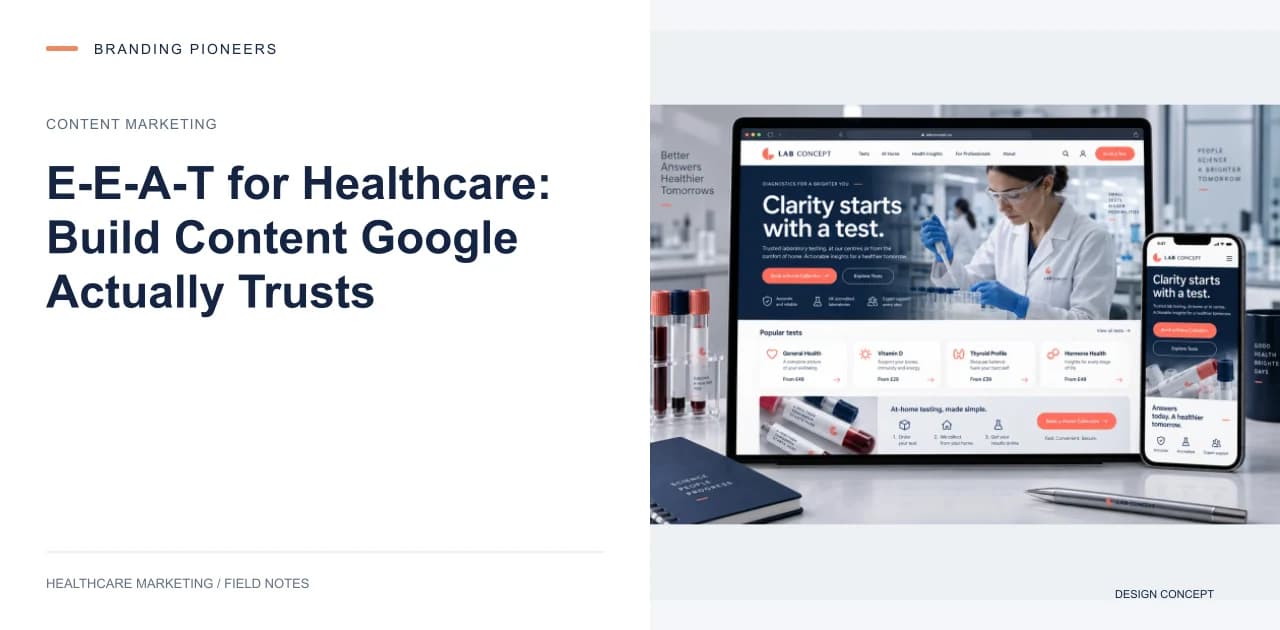
Why E-E-A-T Is Life or Death for Healthcare Websites
Google classifies healthcare content as YMYL — Your Money or Your Life. This means medical websites are held to the strictest quality standards in Google's evaluation framework. The reason is obvious: inaccurate medical content can harm or kill people. Google takes this responsibility seriously, and so should you.
Websites that fail to demonstrate E-E-A-T — Experience, Expertise, Authoritativeness, and Trustworthiness — face devastating consequences during core algorithm updates. Healthcare sites have lost the majority of their organic traffic in a single update because their content lacked credible author attribution, clinical references, or editorial oversight signals.
The good news: E-E-A-T is not a mysterious algorithmic factor. It is a set of concrete, implementable signals that you can build systematically.
Experience: Show That You Have Done the Work
The first E in E-E-A-T stands for Experience — evidence that the content creator has real-world experience with the topic. For healthcare, this means demonstrating that your content is written or reviewed by someone who has actually treated patients with the condition being discussed.
Practical implementation: every clinical content page should display the author's name, photo, credentials, and a brief statement of their clinical experience with the topic. "Dr. Anita Verma is a board-certified cardiologist with 18 years of experience managing atrial fibrillation. She has treated over 2,000 patients with this condition."
Beyond author attribution, include experiential details in the content itself. Phrases like "in my clinical experience," "patients I have treated typically report," and "a common concern I hear from patients is" signal real-world experience that Google's quality evaluators look for.
Expertise: Demonstrate Deep Knowledge
Expertise is demonstrated through depth, accuracy, and appropriate use of medical terminology (explained for lay audiences). Shallow content that superficially covers a topic signals lack of expertise, even if the author has strong credentials.
Depth markers: Cover the topic comprehensively. A page about knee replacement should address who is a candidate, pre-surgical evaluation, surgical techniques, anesthesia options, recovery timeline, rehabilitation protocol, potential complications, long-term outcomes, and alternatives to surgery. Thin content covering only 2 to 3 of these subtopics signals surface-level knowledge.
Accuracy markers: Reference clinical guidelines, peer-reviewed research, or professional consensus where relevant. You do not need to cite every statement, but claims about treatment effectiveness, risk rates, or outcome statistics should be supported. A phrase like "according to the American Heart Association guidelines" or "a recent peer-reviewed study found" — backed by a real, checkable source — is an expertise signal that both Google and patients recognize.
Terminology with translation: Use correct medical terminology but immediately explain it in plain language. "Arthroscopy (a minimally invasive procedure using a small camera inserted through tiny incisions)" demonstrates expertise while remaining accessible.
Authoritativeness: Build Recognition Beyond Your Website
Authoritativeness is the external recognition of your expertise. Google evaluates this through backlinks, brand mentions, and third-party validation.
Physician profiles on authoritative platforms: Ensure every doctor in your practice has complete profiles on medical directories (Healthgrades, Practo, Zocdoc), professional association websites, and hospital affiliation pages. Each profile should link to their profile on your website.
Media mentions and expert commentary: When your doctors are quoted in news articles, appear on television or podcasts, or contribute expert commentary to publications, these mentions build authoritativeness. Actively pursue media opportunities — send press releases about notable achievements, offer expert commentary on trending health topics, and build relationships with health journalists.
Guest authorship on medical publications: Encourage your physicians to write articles for medical publications, hospital newsletters, and healthcare industry blogs. Each published article with a link back to your website is an authority signal.
Professional credentials and affiliations: Display board certifications, fellowship memberships, hospital affiliations, and professional society memberships prominently. These are shorthand signals that both Google's quality raters and patients use to evaluate authority.
Trustworthiness: Remove Every Reason to Doubt
Trust is the foundation that supports the other three elements. A website can have experienced, expert, authoritative content and still fail the trust test if it has technical or presentation issues that undermine credibility.
Technical trust: SSL certificate (HTTPS is mandatory), fast page load speed, no broken links, no intrusive pop-ups or ads, and mobile-friendly design. These are basic but many healthcare websites fail on one or more.
Editorial trust: Display a clear editorial policy describing who writes and reviews your content. Include medical review dates on every clinical page. Show a content update schedule. These signals tell both Google and patients that your content is maintained, not abandoned.
Business trust: Display your practice address, phone number, and email prominently. Include your licensing information and accreditation logos. Provide a clear privacy policy. Make it easy for patients to contact you through multiple channels. Practices that hide behind contact forms without showing a phone number or address undermine trust.
Review trust: Respond to every patient review — positive and negative — professionally and helpfully. A pattern of genuine, detailed responses to patient reviews is one of the strongest trust signals available to healthcare websites.
The E-E-A-T Audit Checklist
Run this audit on every clinical content page:
- Named physician author with credentials? (Experience/Expertise)
- Author photo and link to profile page? (Experience)
- Clinical experience statement relevant to the topic? (Experience)
- Content covers the topic comprehensively? (Expertise)
- Medical claims supported by references? (Expertise)
- Medical review date displayed? (Trustworthiness)
- Page loads in under 3 seconds? (Trustworthiness)
- HTTPS enabled? (Trustworthiness)
- Backlinks from authoritative medical sources? (Authoritativeness)
- Author has profiles on medical directories linking to your site? (Authoritativeness)
Score each page out of 10. Prioritize improving pages that score below 7 — these are your most vulnerable pages during core updates.
The Long-Term E-E-A-T Investment
E-E-A-T is not a one-time project. It is an ongoing investment in the quality and credibility of your web presence. The practices that weather core updates without traffic loss are those that have been building E-E-A-T signals consistently over years, not those that scrambled to add author bylines after an update hit.
Make E-E-A-T a standing agenda item in your marketing meetings. Review content freshness quarterly. Update medical review dates when content is re-verified. Build new authority signals every month. The compound effect of consistent E-E-A-T investment is a website that Google trusts deeply — and that patients trust even more.
Filed underE-E-A-T healthcareGoogle trust signals medicalhealthcare content qualitymedical website authority

About the author
Arush Thapar
Co-Founder & CTO · Gurugram, India
Arush builds the systems the rest of the company runs on — the patient-acquisition pipelines, the AI chatbots, the analytics that tie a single click to a booked appointment. If a campaign reports a number, it's because something his team built is tracking it.
Free guide · 17 pages
The Patient Acquisition Blueprint
A 90-day plan from first search to booked appointment.