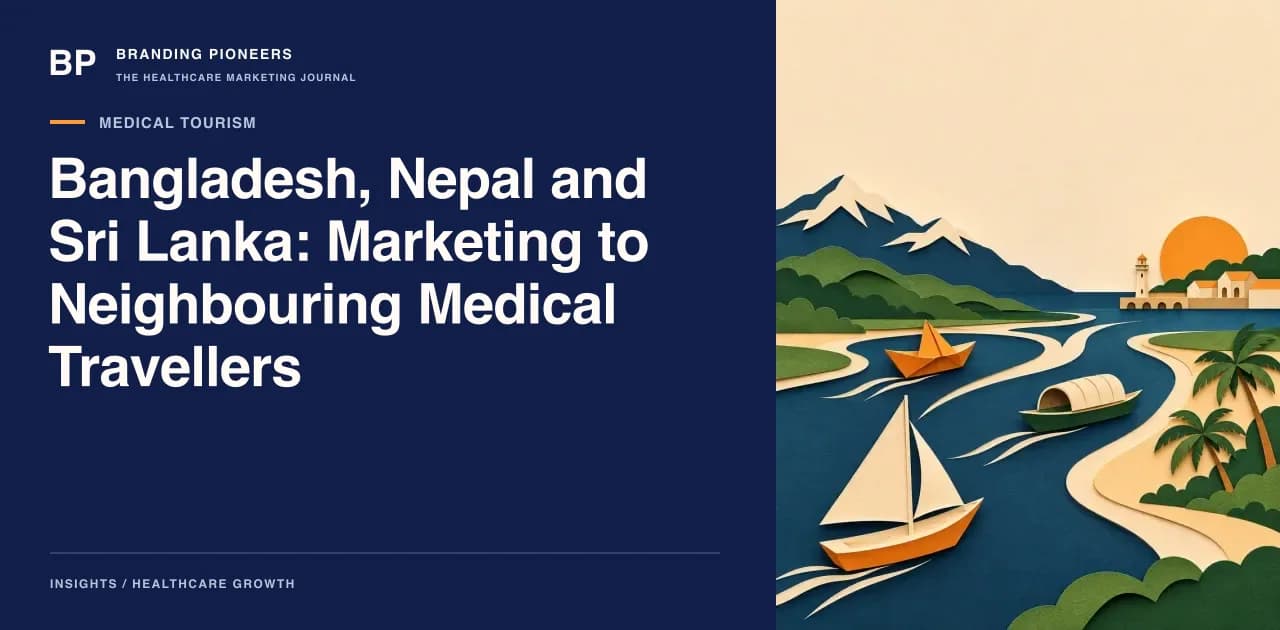
This post is for Indian hospitals, especially in Kolkata, Chennai, Vellore, Bengaluru, Delhi NCR and the border states, that treat patients from Bangladesh, Nepal or Sri Lanka and need a marketing plan that fits short-distance, high-frequency medical travel. It assumes you have read the basics in our international patient marketing overview.
The central point is that close-border patients are not scaled-down versions of long-haul patients. They travel more often, bring family on short notice, compare you against nearby alternatives, and keep the same phone number and social accounts for years. Your marketing should reflect that. It should also reflect that politics and visa policy can change demand sharply, and that a single-market strategy is fragile.
We do not give country-level patient counts beyond what an official source supports. For everything else we describe how to measure.
What changed in Bangladesh, and why it matters
Bangladesh has long been the largest single source of medical travellers to India. A ministry reply to Parliament, reported by ETV Bharat in August 2026, put medical visa totals at 6,43,541 in 2023, 6,24,761 in 2024 and 5,08,330 in 2025, and said Bangladesh accounted for more than three lakh patients in 2025.
The same market was also the most exposed to political and visa disruption. Al Jazeera's reporting in January 2025 cited industry data putting Bangladesh at around 60 per cent of India's roughly two million international patients each year, and described a sharp fall in appointment slots at Indian visa centres in Bangladesh after the 2024 unrest, as well as patients turning to Thailand, Malaysia, Singapore and Türkiye.
The lesson for planning is concentration risk. If one nationality supplies the bulk of your international revenue, a policy change can empty your wards faster than any marketing budget can refill them. Measure your own concentration: what share of international admissions came from your top nationality last year? Set a ceiling you are comfortable with, and build the second and third markets before you need them.
Three markets, three behaviours
Bangladesh. Bengali is the language of search, WhatsApp and Facebook. Patients often have repeat, chronic or follow-up needs, such as oncology review, cardiac care, orthopaedics or transplant follow-up. Many come through relatives or neighbours who have been before. Trust is personal and local. The practical obstacles are visa availability, currency and the cost of staying in the city for treatment.
Nepal. The relationship with India is unusually open. Nepali citizens travelling to India generally do not need a visa, though documentary requirements at the border and at airports can change, so check the current official position before publishing any "what you need to bring" guidance. Nepali, Maithili and Hindi all matter; Hindi comprehension is high in many communities, which lowers translation cost. Patients often come from towns and hill districts, and the first contact is frequently a local pharmacist, clinic or relative in India.
Sri Lanka. English is workable for much of the content, with Sinhala and Tamil versions improving trust for particular communities. The Indian High Commission in Colombo states that Sri Lankan nationals can apply for e-Visa categories, including Medical and Medical Attendant, through the government portal, and warns against look-alike sites. Chennai, Madurai and Bengaluru hospitals have natural links through language and flight connections.
These descriptions are working hypotheses. Confirm each one with your enquiry data before you build a campaign on it.
Channels that suit short-distance travel
Close-border markets favour channels that are conversational and repeatable.
WhatsApp as the front door. A national number, a local-language greeting and a records-request template convert faster than a web form for most patients in these markets. Offer a call-back option for patients who prefer voice. Set rules for after-hours messages so that no enquiry waits a day without acknowledgment. Our WhatsApp business API setup guide shows how to keep the channel auditable.
Facebook and Messenger in Bengali. In Bangladesh, Facebook remains central to community and family recommendations. Content that works is practical: how to book, what to carry, where to stay, what follow-up looks like. Avoid before-and-after imagery, miracle claims or any outcome promises.
Local-language search. Bengali, Nepali and Sinhala queries often include the city name and the specialty. Create one page per specialty-city combination you genuinely serve, in the local language, and keep the content accurate. See our piece on medical tourism website design for what international visitors expect to find.
Community and alumni groups. Patient communities, student groups and expatriate associations carry word of mouth. Join and contribute with consent and respect, not with advertising.
Local partners. Interpreters, guesthouse operators and transport providers are often the first people a patient trusts. Treat them as part of your service design, with written terms, not as informal marketing agents.
Design for repeat and follow-up
A neighbouring-country patient may travel three or four times for one condition. That changes the funnel.
- Returning-patient path. Give people who already have a UHID a different first message: "send your latest report and we will book your review."
- Follow-up by video. Offer remote follow-up between visits for suitable cases, as decided by the treating clinician, so the next trip is only needed when it is clinically necessary.
- Records portability. Provide discharge summaries and reports in a form the home doctor can use, in English with a local-language summary reviewed by a clinician.
- Visa-ready letters. For patients who need a visa, maintain a template hospital letter and a clear internal time commitment for issuing it. The official e-Visa page asks for a hospital letter on letterhead for the e-Medical visa, and states that two e-Medical Attendant visas are granted against one e-Medical visa.