Your Website Is the First — and Often Only — Impression You Get to Make
A Nigerian cardiologist referred his patient to three Indian hospitals for a cardiac bypass. He told the patient to research all three and decide. The patient's wife spent four hours on the three websites. She chose the hospital with the worst Google ranking and the highest cost.
We asked why. Her answer: "The other two websites felt like no one was home. This one felt like people who had done this before."
International medical tourism is a high-trust purchase. The patient is deciding to travel thousands of kilometers, hand their body to surgeons they have never met, in a country they may never have visited. The website is where that trust is built or broken.
Here is exactly what international patients look for, what makes them stay, and what makes them close the tab.
What International Patients Check in the First 8 Seconds
Do they have an international patients section? If the homepage has no clear signal that the hospital serves foreign patients — a language toggle, an "International Patients" link in the navigation, a flag icon anywhere — the patient starts with a negative prior. It looks like a domestic hospital that tolerates international inquiries rather than welcomes them.
Does the website look professionally maintained? Broken images, outdated blog posts dated 2019, stock photos that look like they were purchased from Getty's worst collection, fonts that clash, mobile layouts that overflow the screen — any of these signals abandonment and neglect. If you do not maintain your website, the patient wonders what else you do not maintain.
Is there a WhatsApp button? International patients treat email as formal and slow. They expect WhatsApp. A hospital without a visible WhatsApp CTA in 2026 is flagging unfamiliarity with how international patients communicate.
These three signals are evaluated in under 8 seconds. If two of the three are missing, the patient continues to the next hospital in their search results.
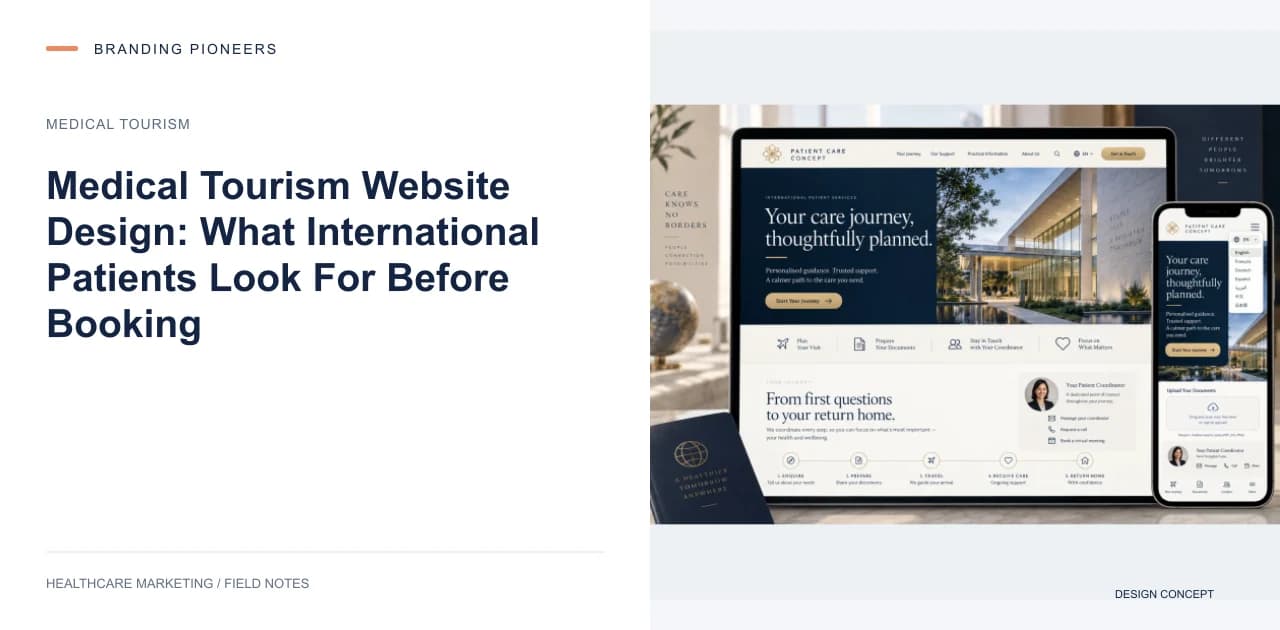
The 12 Elements Every Medical Tourism Website Needs
1. Dedicated International Patient Section
A top-level navigation item: "International Patients." Not buried under "Services" or "About Us." Top-level, always visible.
The section landing page establishes the experience: how many international patients you have treated (specific number), which countries they came from, what services you provide specifically for international patients (coordinator, visa support, airport pickup, interpreter), and the first CTA to start the inquiry.
2. Procedure Cost Pages With Real Numbers
This is the most visited page on any medical tourism website and the most commonly absent.
International patients' number one question is cost. They are traveling because the cost difference justifies the journey. If your website refuses to discuss cost, they move to a hospital that does.
You do not need to publish exact quotes — medical histories vary. But "Cardiac bypass surgery at our hospital typically ranges from ₹2.5 to 4 lakh for international patients, including surgeon fees, anesthesia, ICU, and 7-day hospital stay" answers the core question. It includes what is covered. It signals that you have thought about this.
Hospitals that publish cost ranges generate far more international inquiries per thousand website visitors than those that use "contact us for pricing" as a wall.
3. Surgeon Profiles Optimized for International Trust
International patients research surgeons specifically. They Google the name. They look at qualifications. They watch videos.
A strong surgeon profile for medical tourism includes:
- MBBS plus specialty degree and institution
- International fellowships, board memberships, recognition
- Number of procedures performed (be specific: "2,400 cardiac bypass surgeries" is more compelling than "extensive experience")
- Publications if relevant
- A 90-second video introduction — surgeon speaking directly to the camera, explaining their philosophy and approach
- Specific outcomes data if publishable
The video is not optional for medical tourism surgeons. International patients deciding to fly 5,000 km want to see and hear the person who will operate on them. A video that exists converts. One that does not exist is a missed opportunity every single day.
4. Country-Specific Patient Pages
A patient from Kenya and a patient from Nigeria and a patient from the UAE have different questions, different logistics, and different trust thresholds. A page that speaks directly to a Kenyan patient's context — flight options from Nairobi, Indian embassy in Kenya, payment methods, time zone for coordinator communication — converts far better than a generic international page.
Build these pages for your top 3 to 5 source markets. Keep them updated annually with accurate logistics information.
5. Proof That Isn't a Testimonial
This section used to say "put international patient testimonials on your site, segmented by country." For Indian hospitals that advice no longer holds. The National Medical Commission's guidelines of 6 October 2026 apply to Indian doctors and hospitals whatever the patient's nationality, and they rule out promotional testimonials and patient stories even with consent (para 6.1, 6.2, 8.1(xi)). Linking to a patient's public social post about you is sharing a testimonial too (Expl. V to para 3.2).
What a Kenyan prospect can still see: your accreditation status, the surgeon's qualifications and registration number, how many countries your coordinators work with, published cost ranges, and a step-by-step explainer of the journey from Nairobi. Facts that a stranger can verify build the trust testimonials used to. Our NMC guidelines summary covers the full rules.
6. Accreditation and Certifications — Prominently
JCI, NABH, ISO certifications should appear in the website header or hero section, not buried in an "About" page. For international patients, especially from countries where healthcare standards are inconsistent, seeing JCI accreditation in the first viewport is the equivalent of seeing a Michelin star — it signals validated quality.
Do not just display the logo. Link to your accreditation profile on the JCI or NABH website. Let patients verify it independently.
7. Pre-Arrival and Logistics Information
A complete "Planning Your Visit" section that covers:
- Medical visa application process (step by step)
- Hospital's invitation letter process (same-day provision)
- Airport pickup service
- Accommodation options: hospital guesthouse (rates per night), partner hotels (with corporate rates), extended stay options for 2 to 4 week recovery
- Dietary accommodation: halal, vegetarian, specific cultural requirements
- Currency exchange and payment methods at the hospital
- SIM card and internet access during stay
Patients who can answer all their logistical questions on your website are more likely to book than those who must ask each question individually and wait for responses.
8. A Live Chat or Response-Time Promise
"Our international patient coordinator responds within 2 hours" — publish this. Make it a commitment visible on the contact page, the international patients section, and the homepage.
If you have a live chat tool staffed during business hours, add it. Patients who can ask a question and get an answer without switching applications convert at significantly higher rates than those who must submit a form and wait.
9. Mobile-First, Fast-Loading Pages
The large majority of international patient website visits happen on mobile in markets like Kenya, Nigeria, and Bangladesh. If your international patient pages are not mobile-optimized — large text, tappable CTAs, fast loading on 4G — you are invisible to the majority of your audience.
Target: 3-second load time on 4G connection. Use compressed images, lazy loading, and a CDN. Test from the IP address of your target countries using tools like WebPageTest.
10. Language Options
Arabic for Gulf patients. Hindi or Bengali for Indian diaspora. French for West African markets. If you have capacity to serve patients in a language, indicate this clearly on the website. Even a message saying "Our coordinator speaks Arabic" is a conversion signal for Arabic-speaking patients.
Full translation is ideal but expensive. Prioritize the language of your largest non-English source market.
11. Transparent FAQs
An FAQ section answers the questions prospects are asking before they send an inquiry. For medical tourism websites, these include:
- How far in advance should I book?
- What documents do I need to apply for a medical visa?
- How long will I need to stay in India after surgery?
- Can my family member stay with me?
- Will I receive my full medical records in English?
- How do I send payment from my country?
A comprehensive FAQ reduces inquiry friction. Patients who find all their answers convert faster. Patients who cannot find answers assume the hospital is disorganized.
12. Multiple CTAs Calibrated to Stage
Not every international patient is ready to book. Give them multiple entry points:
- "Get a Free Cost Estimate" — low-commitment, high-volume top-of-funnel
- "Speak to Our Coordinator" — mid-funnel, ready to discuss specifics
- "Book a Free Video Consultation With the Surgeon" — high-intent, late-funnel
- "Download Our International Patient Guide" — nurturing patients who are researching but not yet ready
Each CTA leads to a different conversion path. The free cost estimate form asks for procedure and medical documents. The coordinator call books a specific time. The video consultation routes to a surgeon scheduling page. The guide download is gated by email for nurture sequence entry.
The Designs That Do Not Work
The brochure website. Beautiful full-screen images, minimal text, no pricing, no FAQ, no logistics. Looks prestigious. Converts nobody.
The domestic website with an "International" tab. If your entire website is designed for domestic patients and you have added one international page as an afterthought, international patients feel it. The framing, the language, the case studies — all domestic. They feel like exceptions rather than a served segment.
The outdated website. A copyright footer reading © 2020, blog posts from 2018, event announcements for events that have passed — these signals tell the patient the hospital is not paying attention. Attention to the website implies attention to patients.
We redesigned the international patient section for a multi-specialty hospital in Chennai in 2024. Same clinical quality. Same surgeons. Same pricing. International inquiries went from 12 per month to 67 per month in 90 days.
The difference was entirely the website.
Get Your International Patient Website Audit →