Foreign Patients Follow a Predictable Path. Most Hospitals Miss Every Step.
A 54-year-old woman in Nairobi named Grace is told she needs a hip replacement. Her local hospital quote: 1.8 million Kenyan shillings (approximately ₹9.4 lakh). She hears from her cousin, who works with an Indian company, that the same procedure costs ₹1.8 lakh in Delhi. The arithmetic sends her to Google.
She searches "hip replacement cost India." She finds a hospital's cost page. She finds a Medical Tourism Association directory listing for three other hospitals. She joins a Facebook group for Kenyan patients who have received treatment in India and asks for recommendations. She reads three hospital websites. She WhatsApps two hospitals.
One responds in 4 hours with a detailed message, a cost estimate, and an offer to arrange a video call with the surgeon. One responds 36 hours later with a generic email.
Grace books with the first hospital.
This scenario plays out 80,000+ times per year across African, Middle Eastern, South Asian, and diaspora markets. Attracting foreign patients is not mysterious. It is systematic. Here is the complete playbook.
Step 1: Define Your International Patient Persona
Before spending a rupee on marketing, understand who you are marketing to. Foreign patients are not a monolith.
The Cost-Motivated Patient (East Africa, South Asia):
- Traveling because home country cost is 4 to 8x higher than India
- Budget-conscious but willing to pay for quality
- Trust-building is slow — word-of-mouth critical
- WhatsApp is the primary communication channel
- Visa application support is a make-or-break factor
- Family member typically accompanies; accommodation for both required
The Quality-Seeking Patient (Gulf, UK Diaspora):
- Traveling for specialist expertise not available locally or NHS wait times
- Has means to pay premium rates
- Expects hotel-level service alongside medical care
- Private room, international SIM card, dedicated nurse preferred
- Response time and coordinator polish matter more than price
The Procedure-Specific Patient (Global):
- Traveling specifically for a procedure India is renowned for — bone marrow transplant, robotic surgery, Ayurvedic treatment
- High-research patient, has already decided India; comparing hospitals
- Online reviews and surgeon credentials are decisive
Your marketing strategy, messaging, and operational support must be calibrated differently for each persona.
Step 2: Build the Digital Infrastructure
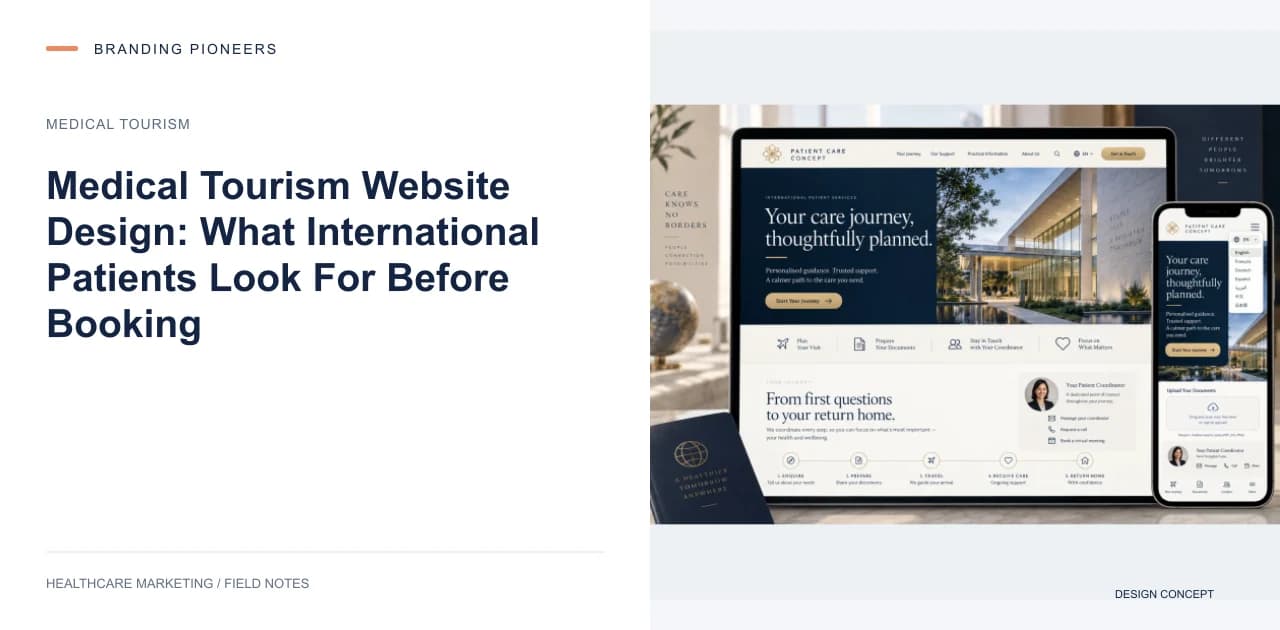
International Patient Website Section
Your existing website is likely designed for domestic patients. International patients need:
A dedicated entry point: /international-patients/ with its own navigation, visual design, and content focused entirely on the foreign patient journey.
Procedure-specific cost pages: Not exact quotes — medical histories vary — but ranges. "Hip replacement at our hospital typically ranges from ₹1.5 to 2.2 lakh for international patients, including implant, surgery, anesthesia, and 4-day hospital stay." Patients who find a cost range convert far better than those who hit a "contact us for pricing" wall.
Country-specific pages: Build a page for each of your top 3 to 5 source countries. Include country-specific logistics (flight options, visa process), accreditation and doctor credentials, and a coordinator contact flagged as the local specialist for patients from that country.
Pre-arrival information: Hospital guesthouse availability and rates (mention these explicitly — many hospitals have them and never advertise it). Partner hotels with corporate rates. Airport pickup arrangement process. Payment methods accepted.
WhatsApp CTA everywhere: International patients prefer WhatsApp for the entire communication journey. A floating WhatsApp button with a pre-filled message ("Hello, I am an international patient interested in [procedure]") on every page generates noticeably more inquiries than email forms alone.
Google Business Profile for International Visibility
Optimize your Google Business Profile with photos of international patient rooms, international patient coordinator profiles, and explicit mention in the description of international patient services. Respond to all reviews, including those left in foreign languages (respond in the same language using a translator if needed — this signals to future patients from that country that you are responsive and respectful).
Step 3: Run Targeted Paid Campaigns
Organic SEO takes time. Paid campaigns bring international patients in 30 to 60 days.
Google Ads Strategy
Campaign structure: One campaign per source country, one ad group per procedure cluster.
Example campaign — Kenya, cardiac:
- Keywords: "cardiac surgery India cost," "best cardiac hospital India," "heart bypass surgery India price"
- Geo-targeting: Nairobi, Mombasa, Kisumu
- Ad copy: "Cardiac Surgery in India from ₹2.5L. JCI-Accredited. Dedicated Kenya Patient Coordinator. Free Case Assessment."
- Landing page: /international-patients/kenya/cardiac-surgery/
Budget: ₹50,000 to 80,000/month per country-procedure combination for meaningful volume. CPC for these keywords in English-speaking African markets: ₹120 to 350.
Expected performance: 60 to 150 clicks/month per ₹50,000 budget. Conversion to inquiry at 8 to 15%. Cost per inquiry: ₹3,000 to 8,000. At ₹2 lakh revenue per patient, even 5% conversion to patient yields ROI above 10x.
Facebook and Instagram
Facebook remains strong for reaching patients over 40 in English-speaking African and Gulf markets. Target:
- Health condition interests (heart disease, diabetes, orthopedic pain)
- Age 40 to 65
- Income levels (use Facebook's income targeting in markets where available)
- Travelers who have visited India previously
Video ads outperform static for medical tourism. Keep them factual and institutional: a 30-second explainer of how a cardiac patient from Kenya gets a remote review of their reports, a cost estimate and a visa letter. Patient testimonial ads are off the table for Indian hospitals under NMC's 2026 guidelines, even with consent (para 6.2, 8.1(xi)), and hospital ads can't promote an individual doctor (para 8.3(ii)); see our NMC guidelines summary.
Step 4: Build the Inquiry Conversion System
Getting the inquiry is easy compared to converting it. Here is the conversion architecture:
Response SLA: International inquiries must receive a response within 2 hours during business hours and within 4 hours outside business hours. Every hour of delay meaningfully reduces conversion probability. A 24-hour response to an international patient inquiry is effectively no response.
Inquiry intake form: Ask for name, country, procedure needed, recent medical reports (upload field), preferred treatment dates, and WhatsApp number. Do not ask for too much upfront — you will get more completions. Additional information can be gathered in the first conversation.
Response template (personalized, not robotic): "Hello [Name], thank you for reaching out to [Hospital]. I am [Coordinator Name], your dedicated coordinator for patients from [Country]. I have reviewed your initial details. For [procedure], our treatment typically takes [X days] and costs between ₹X and ₹X depending on your medical history. I would love to arrange a free 20-minute video consultation with Dr. [Surgeon] to review your case personally. Are you available [date/time in their time zone]?"
Medical record review process: Have a physician review international patient records within 24 hours and provide a preliminary assessment. This free service, explicitly mentioned in marketing, is a powerful differentiator.
Video consultation: Offer free surgeon consultations via Zoom or WhatsApp video. The patient sees the surgeon. The surgeon sees the patient. Trust is established, and conversion probability jumps substantially.
Step 5: Operationalize the Patient Experience
Marketing brings patients to the inquiry stage. Operations close the sale and generate referrals.
Pre-arrival:
- Visa invitation letter within same day of request
- Treatment schedule sent 2 weeks before arrival
- Airport pickup confirmed with driver's name and photo
- Welcome pack with hospital WiFi password, coordinator's direct number, and a brief "what to expect on day 1"
During stay:
- Daily coordinator check-in separate from clinical check-in
- Dietary preferences respected (halal, vegetarian, specific cultural requirements)
- Local SIM card provided if needed
- International patient lounge if scale justifies it
Post-discharge:
- Discharge summary and follow-up protocol in English (and local language if possible)
- WhatsApp follow-up at 48 hours, 1 week, 1 month
- Mechanism to send medical updates to the coordinator who relays to the treating team
- Connection to physician in home country if needed for local follow-up care
Common Failures and How to Avoid Them
"Our website has an international page." One generic page that says "we welcome international patients" is not a marketing strategy. It is a checkbox.
"We respond to all inquiries." When? In what detail? Do you offer video consultations? Do you address their specific procedure? Generic acknowledgment emails generate zero conversions.
"We don't advertise because word-of-mouth works." Word-of-mouth is the ideal endgame. The start is paid digital. You cannot get word-of-mouth without the first 20 patients. Digital advertising creates those first patients.
"International marketing is expensive." At ₹8 lakh per month, generating 8 international patients per month at ₹2.5 lakh average revenue produces ₹20 lakh in revenue. Net return: ₹12 lakh monthly. Show me a domestic marketing channel with that math.
We have built international patient programmes for hospitals in India. The playbook above works consistently when executed consistently. The hospitals that fail cut corners at the response time stage, the coordinator stage, or the content stage. The ones that win treat it like the high-value enterprise sales process it actually is.
Get Your Foreign Patient Acquisition Plan →
Filed underhow to attract foreign patientsattract international patients hospitalforeign patient marketingmedical tourism patient acquisition

About the author
Nishu Sharma
Founder & CEO · Gurugram, India
Nishu founded Branding Pioneers in 2016 with one rule that hasn't changed since: healthcare only. She'd run digital strategy at a top-10 Indian agency and watched generalist marketing underserve medical clients who needed something built for how patients actually search and decide. So she left to build the specialist instead. It's now an 80-person team working with healthcare brands worldwide.
Free guide · 17 pages
The Patient Acquisition Blueprint
A 90-day plan from first search to booked appointment.