Specialty Marketing

Hair Transplant Digital Marketing: Ads, Before-and-After Rules and the Consultation Funnel

Hair transplant is one of the few medical categories where the patient assumes the advertising is exaggerated before they read it. Everything in the funnel has to be built around that assumption.

NS
Founder & CEO · September 30, 2026 · 7 min read
FILE · HAIR-TRA
Hair Transplant Digital Marketing: Ads, Before-and-After Rules and the Consultation Funnel

Hair transplant is one of the few medical categories where the patient starts out assuming the advertising is exaggerated.

They have seen the graft-count claims, the identical before-and-after grids, the prices per graft that make no sense against each other, and the results that clearly belong to somebody with a different hairline. By the time they reach your page, their default setting is suspicion.

That changes what marketing has to do. In most specialties the job is to be found. Here the job is to be believed, and the clinics that grow are the ones that build the whole funnel around the credibility problem rather than shouting over it.

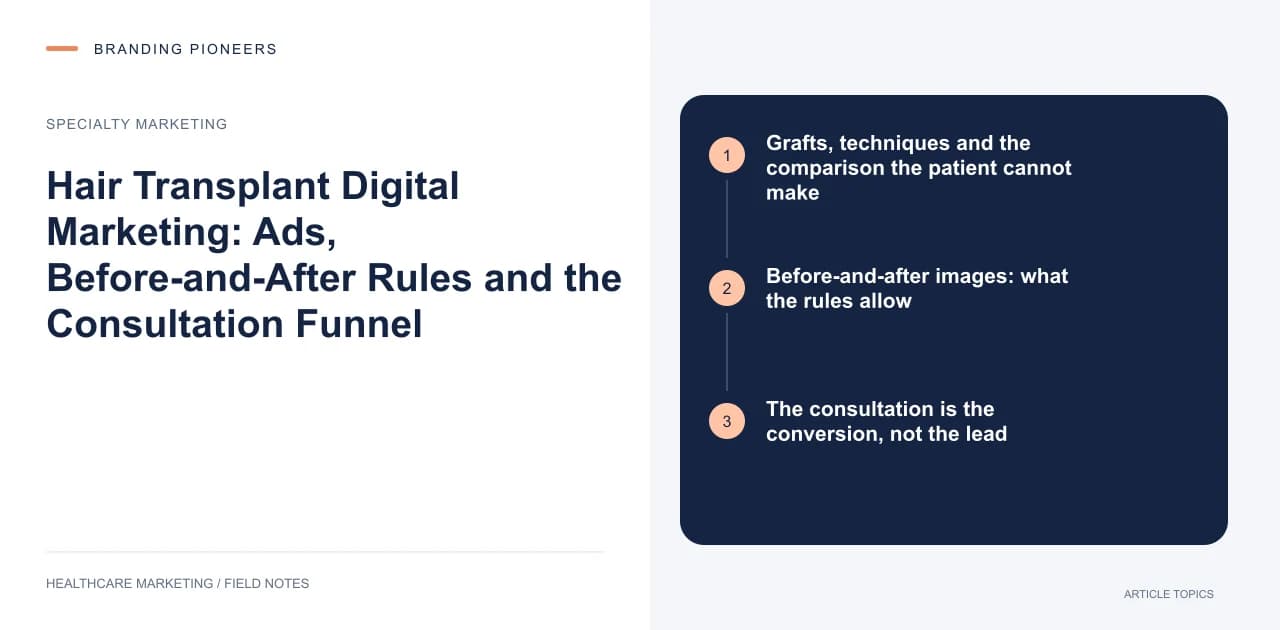
Grafts, techniques and the comparison the patient cannot make

Patients try to compare clinics on graft count and technique because those are the only numbers on offer. Both comparisons are close to useless to them, and they half know it.

A clinic that explains why — that the graft count depends on the donor area and the pattern being treated, that the technique matters less than who is doing the extraction and placement, that the same number of grafts produces different results on different scalps — takes ownership of the comparison. The patient then evaluates everyone else using your framework.

You can do this without denigrating competitors, which matters, because comparative attacks are both a regulatory risk and a credibility cost.

Before-and-after images: what the rules allow

This is where most hair transplant marketing goes wrong, and the rules are specific enough to follow.

In India, the NMC's professional conduct rules restrict how a registered practitioner may advertise, including claims of superiority and solicitation of patients. The Drugs and Magic Remedies (Objectionable Advertisements) Act, 1954 restricts advertising drugs and remedies for the conditions in its Schedule, which matters if you promote medical hair-loss treatments alongside surgery. The ASCI code applies to the advertising itself, and ASCI's provisions on misleading claims and on disclosure of digital enhancement are directly relevant to a category built on photographs.

In the UAE, healthcare advertising needs prior approval: the Dubai Health Authority for Dubai, the Department of Health for Abu Dhabi, and the Ministry of Health and Prevention for the northern emirates. That approval covers the creative, the claims and often the individual image. In Saudi Arabia, the Ministry of Health governs advertising by licensed health facilities. Plan lead time for permits into the campaign calendar; it is the single most common reason a Gulf launch slips.

HIPAA does not apply to an Indian or a Gulf clinic. Do not let an agency tell you otherwise — it is a US law and citing it in a Dubai or Gurugram pitch is a sign the agency is reusing American templates.

Then there is platform policy, which applies in every market. Meta's advertising standards restrict before-and-after images and images that imply unexpected or unlikely results, and restrict ads that draw negative attention to a personal attribute. Hair loss is a personal attribute. Ads built around "before" images of a bald crown get rejected routinely, and the rejection is correct.

What survives: the patient's documented consent, consistent lighting and angle, a stated time interval, no retouching, and no implication that the result is typical. Our pages for aesthetics clinics cover the same consent and claims discipline across the wider category.

The consultation is the conversion, not the lead

A hair transplant enquiry is worth very little. A consultation attended is worth a great deal, and the gap between them is where most clinics lose their budget.

Two things close that gap. First, describing the consultation properly: whether there is a scalp examination, whether the donor area is assessed, whether a density measurement is taken, whether the surgeon is present, whether they will be given a written plan, and how long it takes. Second, a follow-up rhythm that assumes the patient is comparing three clinics and will decide in weeks rather than hours.

Online consultation is a real advantage here, because the first conversation can happen from a patient's own home with photographs taken there — which removes the step most people dread, walking into a hair clinic where somebody might see them.

Three different searchers, three different pages

Hair transplant demand splits cleanly and most sites merge it.

The early searcher is looking up hair fall causes, thinning at the crown, whether medication works. They are months away. They need content, not ads.

The comparison searcher is looking up techniques, graft counts, cost, clinic names and city terms. They are weeks away and this is where paid search earns its place.

The repair searcher has had a transplant elsewhere and is unhappy — bad hairline design, visible scarring, poor density. This group is small, high-value, poorly served and almost never addressed directly, and they convert faster than anyone else.

Our hair transplant marketing pages split these out, and a clinic that also treats non-surgical hair loss should keep that demand separate again under trichology, because the searcher is different and the claims allowed are different.

Channel mix differs by market, and copying does not work

In India the practical mix is Google Search for comparison intent, YouTube and Instagram for the surgeon's visibility, and WhatsApp for the conversation. TikTok has been banned in India since 2020, so any plan that includes it was written for somewhere else.

In the Gulf the mix genuinely is different. Snapchat and Instagram carry a large share of attention in Saudi Arabia and the UAE, TikTok is available and widely used, and Arabic search behaviour is not a translation of English search behaviour — Gulf users mix Arabic and English within a single query, use dialect terms rather than Modern Standard Arabic, and search on the phone almost exclusively. Keyword research has to be done in-market rather than translated, and creative has to be produced in Arabic rather than subtitled.
WhatsApp is the funnel in both markets

In India and the Gulf, the enquiry moves to WhatsApp almost immediately, and that is where the consultation is booked, rescheduled, and usually lost.

Treat it as a channel with a structure rather than as an inbox. Defined response times. A first message that asks for the photographs you need rather than pitching. A clear handover to the clinical team. A follow-up sequence measured in days and weeks. And a record of consent for the messages you send, because in India the Digital Personal Data Protection Act, 2023 and the DPDP Rules, 2025 govern how patient data is collected, notified and stored, with the Data Protection Board of India as the regulator. In the UAE, Federal Decree-Law No. 45 of 2021 on personal data protection applies alongside the health-specific data rules.

Per-graft pricing is a trap the market set for itself

Almost every clinic in this category prices per graft, and almost every patient tries to compare on that basis and ends up confused.

The confusion is structural. A clinic quoting a low per-graft figure can reach the same total by recommending more grafts. A clinic quoting a higher figure with a lower count can be cheaper. The technique, the surgeon's involvement, the number of days, and what is included after the procedure all vary. None of it is visible from the number in the ad.

The clinic that explains this openly is trusted disproportionately, because the patient has just been given the tool they were missing. You can explain the structure without publishing a price: what determines the graft requirement, what the total typically includes, what is charged separately, how many sessions a given pattern usually needs, and what follow-up is covered.

Then, when a price is quoted in the consultation, it arrives inside a framework the patient already accepts.

Reviews, forums and what patients check that you do not control

Hair transplant patients research in places most clinics never look — long-running forums, regional subreddits, YouTube comment sections, and video diaries posted by people who had the procedure months ago.

You cannot control those spaces and should not try. What you can do is be present in a way that stands up to scrutiny: real reviews from real patients collected properly, a Google Business Profile that is complete and current, and consistent information everywhere so that a patient cross-checking your claims finds the same answers.

Ask for reviews at the right moment, which in this category is not the week after surgery. It is months later, when the result has grown in. That timing is inconvenient and it is the only timing that produces a review worth having.

The surgeon has to be visible

In a category where patients doubt the advertising, the only reliable trust signal is a named, findable, qualified surgeon who appears on camera and is the same person the patient eventually meets.

That means a real profile page with registration details, honest experience, and video where they answer difficult questions: what happens if the donor area is not enough, why some results look unnatural, what the healing period really looks like, when the transplant will and will not work.

Clinics resist this because it makes the practice dependent on an individual. That dependency already exists. The marketing is just admitting it.

What to measure

Cost per enquiry will flatter the wrong channels. Track enquiry to consultation booked, consultation booked to attended, attended to procedure, and the time each step takes.

You will usually find one channel produces most of the enquiries and another produces most of the procedures. Budget follows the second one.

---

If you want an outside read on where your hair transplant funnel leaks — from search visibility through to the WhatsApp conversation — get a free audit. Or book a strategy call and we will go through the market-specific rules with you.

FILED UNDERhair transplant digital marketinghair transplant clinic marketinghair restoration marketinghair transplant ads
Stop reading. Start ranking.
Get a free specialty marketing audit — we'll show you exactly what's missing.
Book audit →
Author
Founder & CEO · Gurugram, India

Nishu founded Branding Pioneers in 2016 with one rule that hasn't changed since: healthcare only. She'd run digital strategy at a top-10 Indian agency and watched generalist marketing underserve medical clients who needed something built for how patients actually search and decide. So she left to build the specialist instead. It's now an 80-person team working with healthcare brands worldwide.

The Patient Acquisition Blueprint (2026 Edition) — guide cover
Free · 15 pages

The Patient Acquisition Blueprint (2026 Edition)

The exact 90-day patient-acquisition system, step by step.

We never share your details

FREE · 30 MIN
See your specialty marketing opportunity gap.

Senior strategist, no boilerplate. Reply within 4 hours.

Book audit → Or call us directly
The Pioneers Brief · weekly
One essay. Three benchmarks. One teardown.
Subscribe — free
The Patient Acquisition Blueprint (2026 Edition) — guide cover
Free for specialty marketing readers

The Patient Acquisition Blueprint (2026 Edition)

The exact 90-day patient-acquisition system, step by step.

  • The 90-day patient acquisition operating system
  • Channel-by-channel budget allocation (₹50L–₹5Cr/yr)
  • 12 real, named client engagements walked through
  • ROI tracking spreadsheet (CAC, LTV, payback)
15 pages · Used by 350+ healthcare clients · Updated for AI search

We never share your details

Continue reading

More on specialty marketing.

BROWSE ALL →
From the studio

This thinking, applied.

Creative services for healthcare brands
Creative
The creative studio
Meta Ads reach and delivery reporting
Meta Ads
Meta Ads — delivery and reach reporting
Orthopaedics and joint care — healthcare marketing by Branding Pioneers
Vertical
Orthopaedics and joint care
Branding Pioneers healthcare clients across the globe
Reach
Clients across 30 countries
Max Smart Super Speciality — editorial feature and doctor-led video feature
Editorial · Video
Max Smart — editorial feature and video
Why choose us

Why healthcare brands choose us.

Six reasons hospitals, clinics, and doctors pick a healthcare-only firm over a generalist agency.

  • Healthcare-only

    It's all we do. No retail, no fintech — the whole team thinks in patient journeys, clinical trust, and the way people actually choose a doctor.

  • AI-first systems

    Receptionists, WhatsApp triage, and attribution built in-house — we answer patients in seconds and tie every click to a booked appointment.

  • Compliance built-in

    HIPAA-aware handling, ASCI-reviewed creative, and GDPR/DPDP sign-off on every campaign — our standard, not an upcharge or an afterthought.

  • Senior on every account

    The senior who pitched you stays on the engagement. No bait-and-switch to juniors learning on your budget.

  • Measured to the appointment

    Patient-level attribution across calls, forms, and walk-ins. Monthly reports show booked patients — not just clicks and impressions.

  • Receipts, not promises

    We name our clients and show the work. Quarterly reviews with the numbers attached, every cycle.

The Branding Pioneers healthcare-marketing team at work
Healthcare-only · since 2016
A team that does one thing well.
More from the brief

If this resonated, here’s what else lands.

Adjacent practices, the relevant tools, and the case files where we shipped this thinking against real patient-acquisition targets.

THE PIONEERS BRIEF · WEEKLY

One essay,
three benchmarks,
one teardown.

Healthcare growth, every Thursday morning. No hype, no fluff.