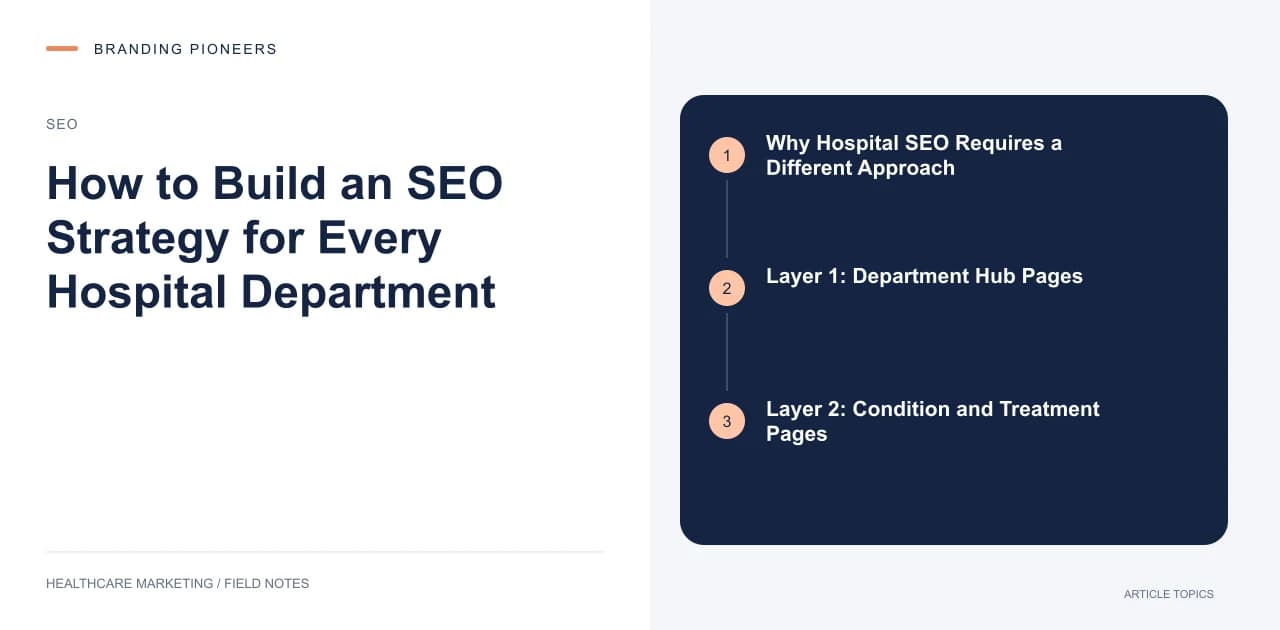
Why Hospital SEO Requires a Different Approach
A single-specialty clinic can focus its SEO effort on 20 to 30 keywords. A multi-department hospital needs to rank for thousands. Cardiology, orthopedics, neurology, oncology, gynecology — each department has its own set of conditions, treatments, symptoms, and patient questions. Without a structured approach, hospital SEO becomes chaotic: duplicate content across departments, competing pages cannibalizing each other, and massive gaps in coverage.
The framework we use breaks hospital SEO into three content layers: department hubs, condition pages, and provider profiles. Each layer serves a distinct purpose and targets different search intent.
Layer 1: Department Hub Pages
Every department needs a comprehensive hub page that serves as the anchor for all related content. This page should target the primary department keyword — "cardiology department in [city]" or "best orthopedic hospital in [city]" — and provide an overview of all services, conditions treated, key providers, and patient resources.
Think of the department hub as a table of contents. It links down to every condition page, every treatment page, and every provider profile within that department. This internal linking structure signals topical authority to Google and helps patients navigate to exactly what they need.
The hub page should include: department overview with unique content (not a copy of the homepage), list of conditions treated with links, list of treatments and procedures with links, featured providers with links to their profiles, patient testimonials specific to that department, and FAQs relevant to the specialty.
Layer 2: Condition and Treatment Pages
This is where the volume lives. Each department should have individual pages for every major condition it treats and every significant procedure it performs. A cardiology department might have pages for coronary artery disease, heart failure, arrhythmia, valve disease, and 15 other conditions — plus pages for angioplasty, bypass surgery, pacemaker implantation, and so on.
Each condition page should target a specific keyword cluster: "coronary artery disease treatment in [city]," "heart bypass surgery cost," "symptoms of arrhythmia." The content should be genuinely educational — written or reviewed by a physician in that department — and structured with clear headings for symptoms, causes, diagnosis, treatment options, recovery, and FAQs.
The critical mistake hospitals make is creating thin condition pages with 200 words of generic content. These pages will not rank. Each page needs at least 800 to 1,200 words of unique, medically accurate content. Yes, this is a significant content investment. But one well-written page for "knee replacement surgery in Delhi" can generate 100 to 300 organic visits per month for years.
Layer 3: Provider Profile Pages
Individual doctor profile pages are chronically underutilized in hospital SEO. Most hospitals create a directory listing with a photo, a bio paragraph, and a list of qualifications. That is a missed opportunity.
A well-optimized provider profile should include: the doctor's full name with credentials and specialty (H1), a 300 to 500 word biography highlighting experience and areas of focus, conditions they specialize in (with links to condition pages), treatments they perform (with links to treatment pages), education, training, and board certifications, publications or research if applicable, patient reviews or testimonials, and an embedded appointment booking widget.
These pages target name-based searches ("Dr. [Name] reviews," "Dr. [Name] appointment") which have extremely high conversion intent. A patient searching for a specific doctor by name is ready to book.