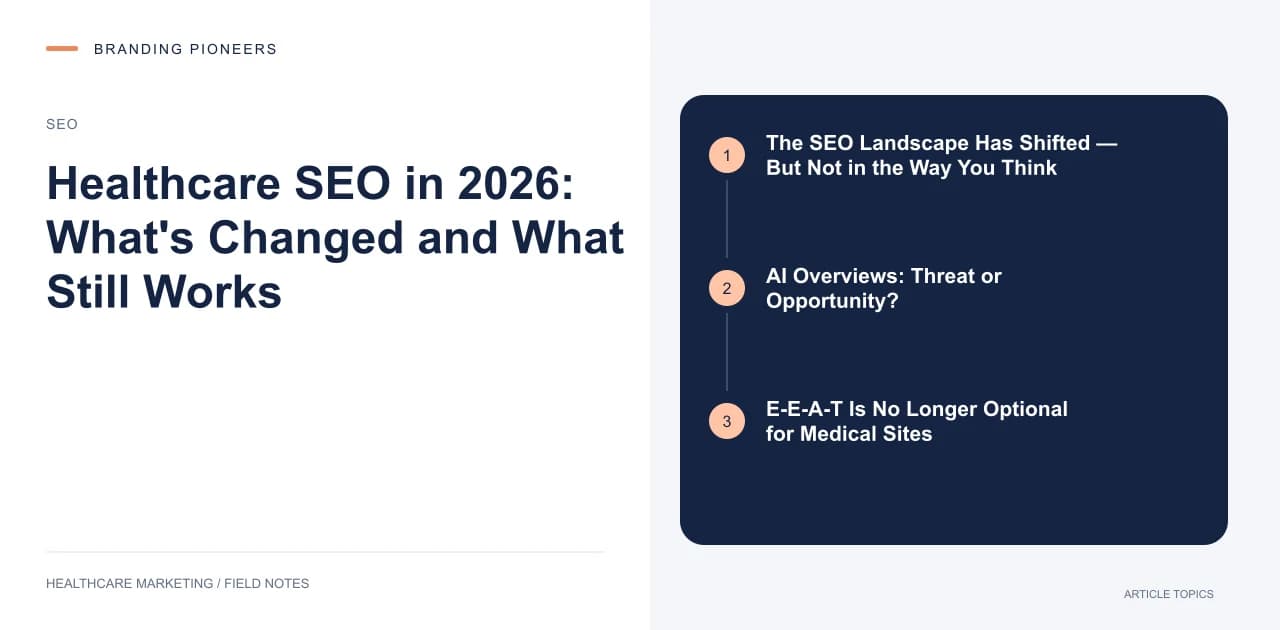
01The SEO Landscape Has Shifted — But Not in the Way You Think
If you marketed a hospital or clinic in 2024, the playbook you used back then will not produce the same results today. Google's AI Overviews now appear for roughly 40 percent of health-related queries, E-E-A-T enforcement has become measurably stricter for medical content, and local ranking signals have been reshuffled.
But here is the good news: the practices that lost traction were the shallow ones — thin location pages, keyword-stuffed service descriptions, and low-effort blog posts written purely for bots. If you are willing to invest in genuine expertise and real patient value, 2026 is actually a better year for healthcare SEO than any that came before.
02AI Overviews: Threat or Opportunity?
Google's AI Overviews now synthesize answers for a huge share of symptom, condition, and treatment queries. For many practices, this felt like the sky falling. But look at the data more carefully. AI Overviews still cite sources, and the sources they cite tend to be authoritative healthcare websites with structured, well-organized content.
What gets cited? Pages that answer a specific question comprehensively in the first 300 words, use clear subheadings, include original data or clinical references, and come from domains with strong topical authority. Sound familiar? That is exactly what good healthcare content has always looked like.
The real losers are aggregator sites and thin directory pages. If your practice has a content hub with genuinely helpful condition and treatment pages, AI Overviews may actually send you more qualified traffic than the old ten blue links — because the patients who click through from an AI Overview citation have already been pre-qualified by the summary.
Actionable step: Audit your top 20 service and condition pages. For each one, ensure the opening paragraph directly answers the primary search intent. Add a concise FAQ section at the bottom — AI Overviews love pulling from FAQ blocks.
03E-E-A-T Is No Longer Optional for Medical Sites
Google's quality rater guidelines have always emphasized Expertise, Experience, Authoritativeness, and Trustworthiness for YMYL (Your Money or Your Life) content. In 2026, the enforcement has teeth. We have seen medical sites lose 30 to 50 percent of organic traffic after a core update simply because their content lacked clear author attribution.
Here is what you need at a minimum: every clinical content page should have a named physician author with credentials, a link to their profile page (which itself has schema markup), and a clear editorial review date. Your about page should describe your editorial process. If a blog post discusses treatment options, it should reference peer-reviewed sources.
This is not bureaucratic overhead. It is a competitive moat. Most small practices still publish anonymous blog posts with no author byline. Adding proper E-E-A-T signals immediately sets you apart.
04Local SEO: The Three Factors That Actually Moved the Needle
Local pack rankings for healthcare queries still come down to three things: Google Business Profile completeness, review velocity, and on-site location relevance. But the weighting has shifted.
Review velocity now matters more than total review count. A practice with 80 reviews that gets 5 new reviews per month will typically outrank a practice with 300 reviews that gets 1 per month. Google wants to see that patients are currently choosing you.
Google Business Profile posts have also gained more influence. Practices that publish weekly GBP posts with service-specific content see measurably better local pack visibility. Think of GBP posts as mini blog entries — 150 to 300 words about a specific treatment, a seasonal health tip, or a patient success milestone.
Finally, NAP consistency still matters, but it is table stakes rather than a differentiator. Ensure your name, address, and phone number are identical across your website, GBP, Healthgrades, Zocdoc, and any directory listing. Then move on to the factors that actually drive separation.
05Voice Search and Conversational Queries
Around 25 percent of health-related mobile searches now use voice input. These queries tend to be longer, more conversational, and more intent-rich. Someone typing might search "dermatologist near me," but someone speaking might ask "where can I see a dermatologist for eczema this week in Gurgaon."
The optimization strategy is straightforward: build content that mirrors natural language. FAQ pages, condition-specific Q&A sections, and blog posts structured around real patient questions all perform well for voice search. Pay attention to your Google Search Console data — filter for queries containing words like "how," "where," "can I," and "should I." These reveal the conversational patterns your potential patients actually use.
06Content Strategy: Quality Over Quantity, Finally
The days of publishing three mediocre blog posts per week are over. One deeply researched, physician-reviewed article per week will outperform ten shallow posts. Google's helpful content system can now reliably distinguish between content created to help patients and content created to manipulate rankings.
Focus your content calendar on three types of pages: condition explainers (what is X, symptoms, when to see a doctor), treatment guides (what to expect, recovery, cost factors), and decision-support content (comparing treatment options, questions to ask your doctor). Each type maps to a different stage of the patient journey and captures different search intent.
07What Still Works — The Fundamentals
Despite all the changes, the fundamentals of healthcare SEO remain remarkably stable. Fast page speed matters. Mobile-first design matters. Internal linking between related conditions and treatments matters. Schema markup for medical organizations, physicians, and FAQs matters.
Do not chase algorithm updates. Build a website that genuinely helps patients find the information they need to make informed healthcare decisions. That has always been the north star of healthcare SEO, and in 2026, it is truer than ever.