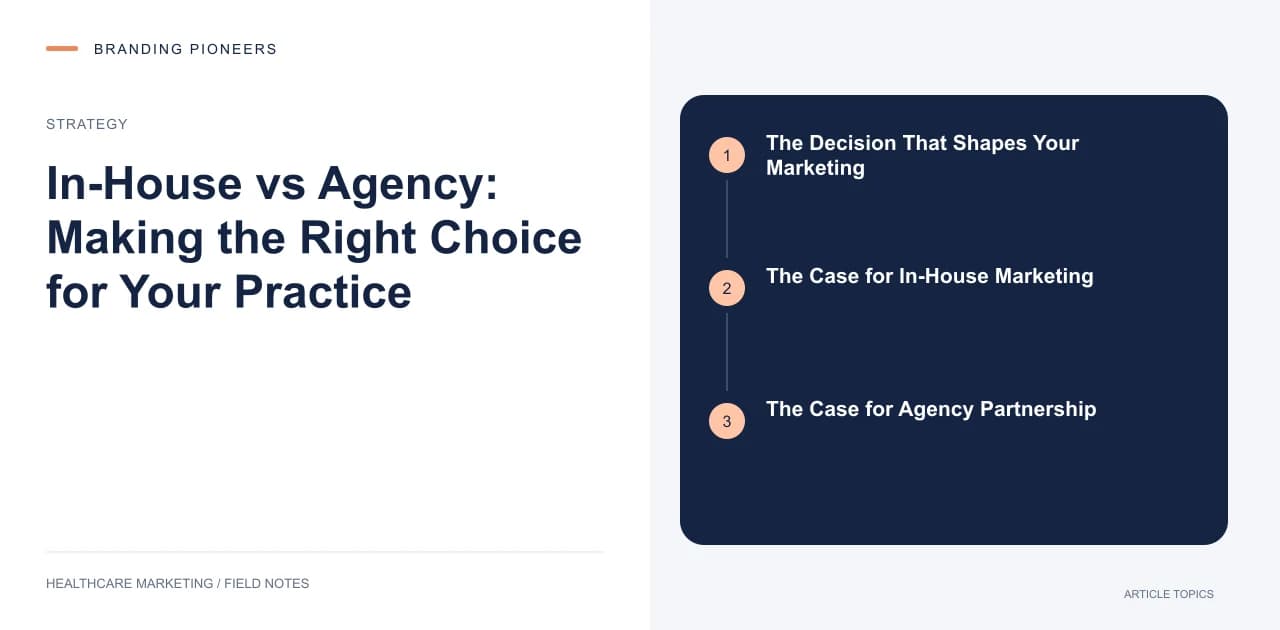
The Decision That Shapes Your Marketing
This is one of the most consequential decisions a practice owner makes: who should handle your marketing? Hire someone in-house, work with an agency, or some combination of both?
There is no universal answer. A solo dermatologist with 500,000 dollars in revenue has very different needs than a 20-provider multi-specialty group at 8 million dollars. Let us break down the trade-offs honestly.
The Case for In-House Marketing
Deep Practice Knowledge
An in-house marketer lives and breathes your practice. They know your doctors, understand your patients, attend team meetings, and absorb the culture. This intimacy produces marketing that feels authentic — because it is. They can capture a patient testimonial on the spot, snap behind-the-scenes photos naturally, and write social media content that genuinely reflects your practice personality.
Speed and Responsiveness
Need to promote a last-minute appointment opening? An in-house marketer can create and publish a social media post in 15 minutes. An agency needs to go through briefing, approval, and scheduling processes that can take days.
Dedicated Attention
An in-house marketer works exclusively for you. An agency account manager juggles 10 to 20 clients. The attention difference is real and impacts execution quality.
The Cost Reality
A competent in-house marketing coordinator costs 40,000 to 60,000 dollars annually in salary plus benefits, taxes, equipment, and software subscriptions. An experienced marketing manager costs 60,000 to 90,000 dollars. A marketing director with strategic expertise costs 90,000 to 130,000 dollars.
And one person cannot do everything. SEO, Google Ads, social media, content creation, email marketing, website management, analytics, and strategy require different skill sets. You either hire a generalist who is mediocre at everything or a specialist who excels at one thing but cannot handle the rest.
The Case for Agency Partnership
Breadth of Expertise
A good healthcare marketing agency has specialists in SEO, paid advertising, social media, content, web development, and analytics. You get a team of five to ten specialists for the cost of one to two in-house employees.
Healthcare-Specific Experience
Agencies that specialize in healthcare have worked with dozens or hundreds of practices across multiple specialties and markets. They know what works, what has failed, and what the current best practices are. That pattern recognition accelerates results and avoids expensive trial-and-error.
Scalability
Need to ramp up Google Ads spend for a new service line? An agency has the capacity to handle increased workload without you hiring additional staff. Need to scale back during a slow season? You adjust your retainer rather than laying someone off.
Technology and Tools
Enterprise-grade SEO tools, ad management platforms, analytics dashboards, and automation software cost thousands of dollars per month. Agencies spread these costs across multiple clients, giving you access to technology you could not justify purchasing individually.
The Cost Reality
Healthcare marketing agencies typically charge 3,000 to 10,000 dollars per month for a comprehensive marketing retainer. Specialized services like SEO or PPC management range from 1,500 to 5,000 dollars per month each. This sounds expensive, but compare it against the fully loaded cost of in-house employees with equivalent capabilities.