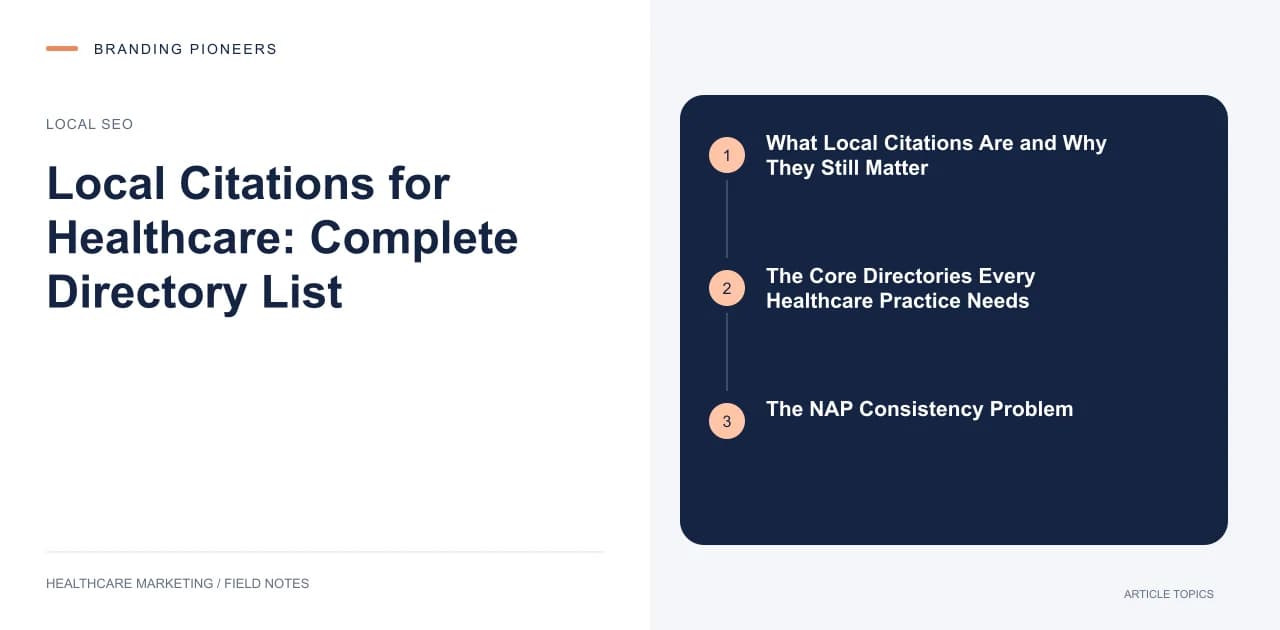
What Local Citations Are and Why They Still Matter
A local citation is any online mention of your practice's name, address, and phone number (NAP). Citations appear in business directories, healthcare-specific platforms, social media profiles, and data aggregator databases. Google uses citations to verify that your practice is a real, legitimate business at the address you claim.
While citations alone will not catapult you to number one in the local pack, inconsistent or missing citations can actively suppress your rankings. Think of them as hygiene factors — they will not win the race, but they will keep you from falling out of it.
The Core Directories Every Healthcare Practice Needs
Tier 1: Essential (Do These First)
Google Business Profile is the single most important citation. Make sure it is claimed, verified, and fully optimized.
Apple Maps Connect: Siri uses Apple Maps for location queries. Claim your listing at mapsconnect.apple.com and ensure it matches your GBP data exactly.
Bing Places: Still handles about 6 percent of search volume, and its data feeds into Cortana and other Microsoft products. Set it up at bingplaces.com.
Facebook Business Page: Even if you are not active on Facebook, having a page with accurate NAP data matters for citation consistency.
Yelp: Powers many voice search results on Alexa and Apple devices. Claim your listing and keep it current.
Tier 2: Healthcare-Specific Directories
Healthgrades: The largest healthcare-specific directory in the US. Claim and complete your provider profiles.
Zocdoc: Particularly important if you accept online appointment bookings. Zocdoc listings rank well for "doctor near me" searches.
Practo: Essential for practices serving Indian markets. One of the highest-traffic healthcare directories in South Asia.
Doximity: The professional network for physicians. Profiles here carry E-E-A-T authority.
WebMD Physician Directory: High domain authority, and profiles appear in WebMD search results for local providers.
RealSelf: Critical for cosmetic surgery and dermatology practices. Patients actively search and compare providers here.
Psychology Today: The go-to directory for mental health professionals. Therapists and psychiatrists should prioritize this above most other directories.
Vitals.com: Another major healthcare directory with strong search visibility.
Tier 3: General Business Directories
Yellow Pages (YP.com), Better Business Bureau, Chamber of Commerce (local), Foursquare, Hotfrog, Manta, and CitySearch. These may seem outdated, but they feed data to aggregators that power hundreds of smaller directories.
Tier 4: Data Aggregators
Data aggregators distribute your NAP data to dozens or hundreds of smaller directories. The major ones are Neustar Localeze, Factual (now part of Foursquare), and Data Axle (formerly Infogroup). Submitting your data to these three aggregators ensures broad citation coverage without manually updating hundreds of individual sites.
The NAP Consistency Problem
The most common citation issue is inconsistency. If your website says "123 Main Street, Suite 200" but Healthgrades says "123 Main St. Ste 200" and Yelp says "123 Main Street #200," Google has to guess which is correct. That uncertainty weakens your local ranking signals.
Choose one exact format for your name, address, and phone number. Use it everywhere. Write it down. Share it with anyone who might create a listing on your behalf.
Common inconsistencies to watch for: abbreviated versus spelled-out street types (St vs Street), suite number formatting, inclusion or exclusion of a DBA name, different phone numbers on different listings, and old addresses that were never updated after a move.