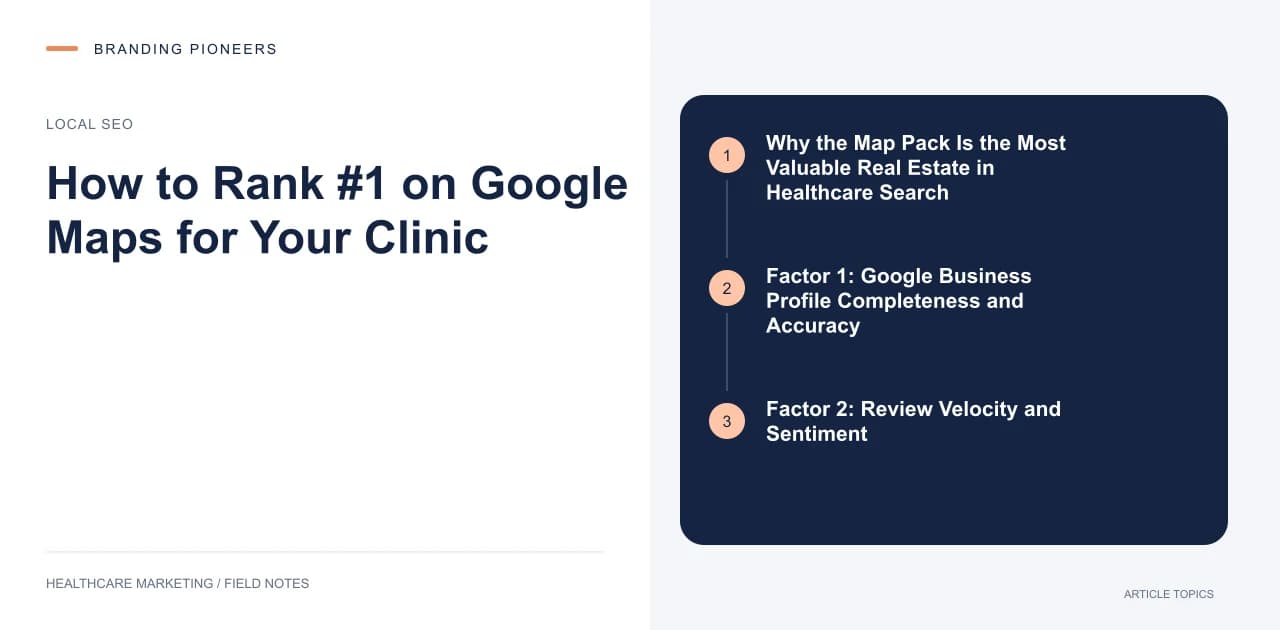
Why the Map Pack Is the Most Valuable Real Estate in Healthcare Search
When a patient searches "dentist near me" or "orthopedic doctor in Gurgaon," the first thing they see is the Google Maps three-pack. These three listings capture roughly 44 percent of all clicks on the page. If your clinic is not in that top three, you are invisible for the most commercially valuable searches in your market.
The good news is that Google Maps ranking factors are well understood, and the majority of healthcare practices do a poor job optimizing for them. That gap is your opportunity.
Factor 1: Google Business Profile Completeness and Accuracy
Google rewards profiles that are fully filled out. That sounds simple, but most clinics stop after adding their address and phone number. A complete profile means filling out every available field: business description using all 750 characters, services with descriptions and pricing where appropriate, insurance accepted, appointment links, accessibility features, opening hours including holiday schedules, and health and safety attributes.
Pay special attention to your primary category. "Dermatologist" will outrank "Doctor" for dermatology-related searches every time. Choose the most specific primary category available, then add up to nine secondary categories for related specialties.
Update your profile at least monthly. Google tracks freshness. A profile that was last updated six months ago signals a less engaged business.
Factor 2: Review Velocity and Sentiment
Total review count matters, but review velocity — how many new reviews you get each month — matters more. Say a clinic with 85 Google reviews is gaining six new ones per month — it will typically outrank a competitor sitting on 400 Google reviews but gaining only one per month.
Build a systematic review generation process. After each appointment, send a text or WhatsApp message with a direct link to your Google review page. (Check local rules first: in India, NMC's 2026 guidelines say a doctor shall not request patient reviews for professional promotion — see our NMC guide. In the US, the FTC treats review gating as potentially deceptive, so send requests to every patient, never only the happy ones.) The link format is simple: search "Google Place ID finder," enter your business name, copy the Place ID, and construct the URL. Most CRM platforms like GoHighLevel can automate this entirely.
Respond to every review within 24 hours. For positive reviews, thank the patient specifically. For negative reviews, acknowledge the concern, apologize, and invite them to contact you directly. Google confirms that responsive businesses rank higher.
Factor 3: Proximity and Service Area Configuration
You cannot change your physical location, but you can optimize how Google understands your service area. If you serve patients across multiple neighborhoods or cities, configure your service areas in GBP. You can add up to 20 service areas.
For multi-location practices, each location needs its own GBP listing with a distinct address, phone number, and landing page. Do not use virtual offices or PO boxes — Google verifies physical locations and will suspend listings that fail verification.