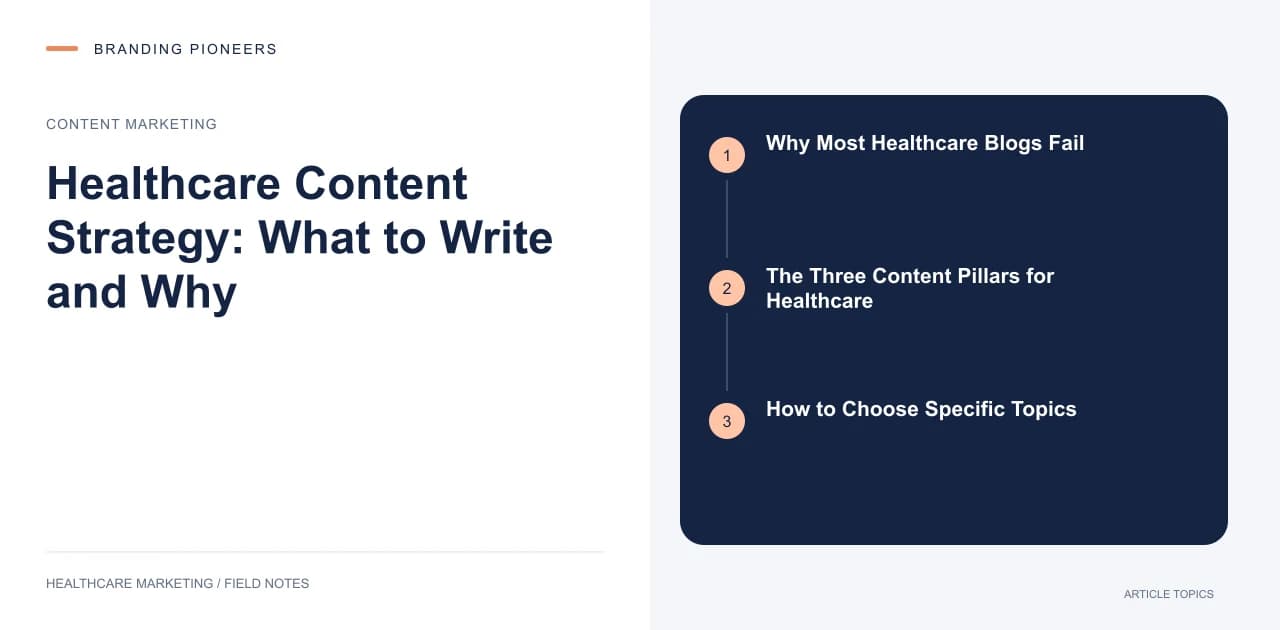
Why Most Healthcare Blogs Fail
Visit any healthcare practice website and you will find a blog section with three to five posts from 2022 that never got updated. "Five Tips for Better Sleep" and "The Importance of Regular Checkups" sitting there gathering digital dust.
These blogs fail for two reasons. First, the topics are too generic to rank for anything. Second, they were written without a strategy connecting content to patient acquisition. A blog post needs to do one of three things: rank for a search query patients actually use, establish E-E-A-T authority, or nurture existing leads toward booking. If it does none of these, it is a waste of time.
The Three Content Pillars for Healthcare
Pillar 1: Condition Explainers
These pages answer the question "What is wrong with me?" Patients searching for symptoms, conditions, or diagnoses are in the early stage of their healthcare journey. They may not know which type of doctor to see, let alone which practice to choose.
Condition explainer content targets searches like "what causes knee pain when walking" or "symptoms of thyroid problems." These pages should cover symptoms, causes, risk factors, when to see a doctor, and what to expect during diagnosis.
The strategic value is enormous. A patient who discovers your thorough, trustworthy article about their condition is far more likely to book with you than to continue shopping. You became their trusted source of information first.
Write condition explainers for your top 10 to 15 most-treated conditions. Each page should be 1,500 to 2,500 words, include medical references, and be reviewed by a physician.
Pillar 2: Treatment and Procedure Guides
These pages answer "What are my options?" and "What should I expect?" Patients searching for treatment information are further down the funnel — they know their condition and are evaluating solutions.
Target searches like "ACL surgery recovery timeline" or "dental implant vs bridge pros and cons." Cover what the treatment involves, preparation steps, the procedure itself, recovery expectations, potential risks, and cost factors.
Treatment pages are your highest-converting content because the search intent is closest to booking. A patient reading your detailed guide on what to expect during cataract surgery is one phone call away from becoming your patient.
Pillar 3: Decision Support Content
These pages help patients choose between options. "Best treatment for receding gums" or "should I see an orthopedic surgeon or a physiotherapist for knee pain" or "questions to ask your doctor before hip replacement."
Decision support content builds trust because it positions your practice as an honest advisor rather than a salesperson. The patient feels you are helping them make the right choice, not just pushing your services.
How to Choose Specific Topics
Start with your appointment data. What are the top 20 reasons patients visit your practice? Each of those reasons should have at least one condition page and one treatment page.
Next, analyze your Google Search Console data. What queries are you already appearing for? Which ones get impressions but low clicks? These are quick wins — you are already somewhat relevant but need stronger content to earn the click.
Then use keyword research tools like Ahrefs, SEMrush, or even Google's autocomplete to find question-based queries around your specialties. Sort by search volume and keyword difficulty. Target queries with at least 100 monthly searches and moderate competition.