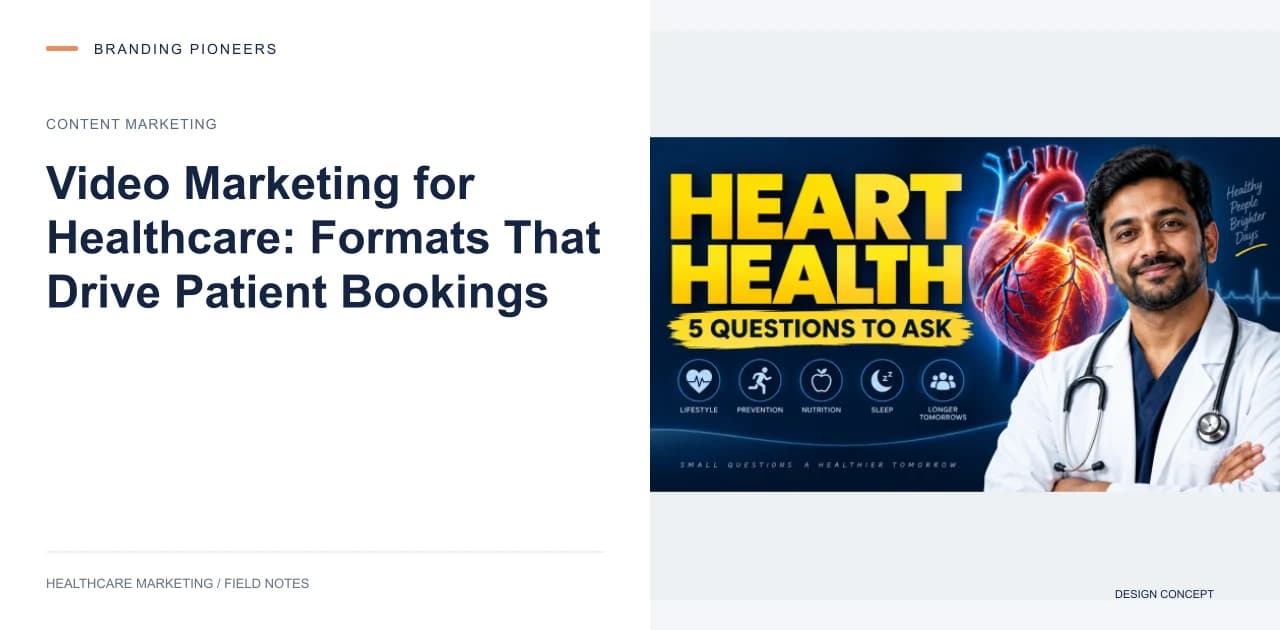
Video Marketing for Healthcare: Formats That Drive Patient Bookings
Video generates 3x more patient engagement than text or images. Here are the seven video formats that work for healthcare practices, with production tips and distribution strategy.
Sources & References
Video generates 3x more patient engagement than text or images. Here are the seven video formats that work for healthcare practices, with production tips and distribution strategy.
Patients watch video before making healthcare decisions. Approximately 71 percent of patients report watching a doctor's video before booking an appointment. On YouTube alone, health-related searches generate over a billion views daily. Video is no longer optional for healthcare marketing — it is the primary medium through which patients evaluate providers.
Yet the vast majority of healthcare practices produce zero video content. The perceived barriers — cost, time, technical expertise, and camera shyness — are all solvable. A smartphone, a ring light, and 30 minutes per week is all you need to start.
The single highest-ROI video type for healthcare. A 60-to-90-second video of each doctor introducing themselves, their specialty, their approach to patient care, and why they chose medicine. Place these on physician profile pages, your Google Business Profile, and social media.
Patients who watch a doctor introduction video before their appointment report 35 percent higher satisfaction and 50 percent lower no-show rates. They arrive feeling like they already know their doctor, which reduces anxiety and builds immediate rapport.
Production tip: film in the doctor's actual office or consultation room, not a studio. Authenticity matters more than production quality. Use natural language — a doctor saying "I became an orthopedic surgeon because I love helping people get back to the activities they enjoy" is infinitely more compelling than a scripted corporate bio.
Walk patients through what to expect during a specific procedure. Cover preparation, what happens during the procedure, recovery timeline, and common concerns. Use a combination of doctor narration and simple animations or illustrations to explain the steps.
These videos directly address the anxiety that prevents patients from booking. A patient considering knee replacement who watches a clear, reassuring explainer video is 2.5 times more likely to book a consultation than one who only reads text.
Keep these between 2 and 4 minutes. Longer videos have diminishing returns for this format — patients want clarity, not a medical lecture.
Short (30 to 60 seconds) videos of real patients describing their experience. Focus on three elements: what brought them in, how the treatment went, and how they feel now. Authenticity is everything — overly produced, scripted testimonials are less believable than a simple phone-recorded conversation.
Always get written consent specifically for video testimonials. Record at the follow-up appointment when patients are most satisfied with their results.
Testimonial videos perform best on social media (Instagram Reels, Facebook) and on procedure-specific landing pages. They convert at 2 to 3 times the rate of text testimonials because viewers can see genuine emotion and judge credibility in ways that text cannot convey.
A 2-to-3-minute walkthrough of your facility showing reception, waiting areas, consultation rooms, operating theaters (if appropriate), and recovery areas. Narrate with a focus on patient experience: cleanliness, comfort, technology, and the care that goes into creating a welcoming environment.
Place facility tour videos on your homepage, Google Business Profile, and share when responding to patients who are comparing providers. For hospital-level institutions, create department-specific tours for each major service line.
Take your five most common patient questions and answer each one in a 60-to-90-second video. "How much does this procedure cost?" "What insurance do you accept?" "How long is recovery?" "What makes your approach different?" "What should I bring to my first appointment?"
FAQ videos serve double duty: they provide useful information and they give patients another touchpoint with your doctor's face and voice before their visit. Embed these on the relevant service pages and FAQ sections of your website.
15-to-60-second videos covering a single health tip, myth bust, or seasonal health reminder. These are designed for social media distribution — Instagram Reels, YouTube Shorts, and TikTok. "Three signs you should see a cardiologist," "Why your headache might not be just a headache," "The sunscreen mistake 80 percent of people make."
Health education shorts build top-of-funnel awareness. They may not drive immediate bookings, but they grow your following and keep your practice top-of-mind. Over time, followers become patients.
Monthly live sessions on Instagram or Facebook where your doctor answers audience questions in real time. Promote the session a week in advance with a call for questions. During the session, alternate between pre-submitted questions and live audience questions.
Live sessions generate the deepest engagement of any video format. Average watch time is 3 to 5 times higher than pre-recorded content, and the real-time interaction builds stronger parasocial connections. Practices that run monthly live Q&A sessions report 15 to 20 percent of live viewers booking consultations within 30 days.
Produce once, distribute everywhere. Every video should appear on your YouTube channel (optimized with medical keywords), your website (embedded on relevant service or profile pages), your Google Business Profile (video tab), your social media (trimmed to platform-specific formats), and your email and WhatsApp follow-up sequences (linked or embedded).
YouTube deserves special attention because it is both a social platform and a search engine. Optimize video titles for patient search queries: "What to Expect During Knee Replacement Surgery" rather than "Knee Replacement Explained." Add detailed descriptions with keywords, timestamps, and links to your booking page.
You do not need professional equipment. Film with your smartphone in landscape mode. Use a ring light (available for under 2,000 rupees) for consistent lighting. Use a lavalier microphone (available for under 1,000 rupees) for clear audio — audio quality matters more than video quality for viewer retention.
Batch-produce content: schedule one filming session per month where you record 8 to 12 short videos in a single afternoon. Edit with free tools like CapCut or Canva Video. This approach makes video content creation sustainable even for busy practices with no dedicated marketing team.
Writing on healthcare growth, AI-powered patient acquisition, and the operational reality of marketing inside hospitals and clinics.
The exact 90-day patient-acquisition system, step by step.
Most healthcare blogs fail because they publish the wrong content. Here is a framework for choosing topics that attract …
Patient education content is the intersection of medical expertise and marketing strategy. Done right, it ranks for high…
Google holds healthcare content to its highest quality standards. Here is the practical framework for building E-E-A-T s…
Six reasons hospitals, clinics, and doctors pick a healthcare-only firm over a generalist agency.
It's all we do. No retail, no fintech — the whole team thinks in patient journeys, clinical trust, and the way people actually choose a doctor.
Receptionists, WhatsApp triage, and attribution built in-house — we answer patients in seconds and tie every click to a booked appointment.
HIPAA, ASCI, NABH and GDPR sign-off baked into every campaign — our standard, not an upcharge or an afterthought.
The senior who pitched you stays on the engagement. No bait-and-switch to juniors learning on your budget.
Patient-level attribution across calls, forms, and walk-ins. Monthly reports show booked patients — not just clicks and impressions.
We name our clients and show the work. Quarterly reviews with the numbers attached, every cycle.
Adjacent practices, the relevant tools, and the case files where we shipped this thinking against real patient-acquisition targets.