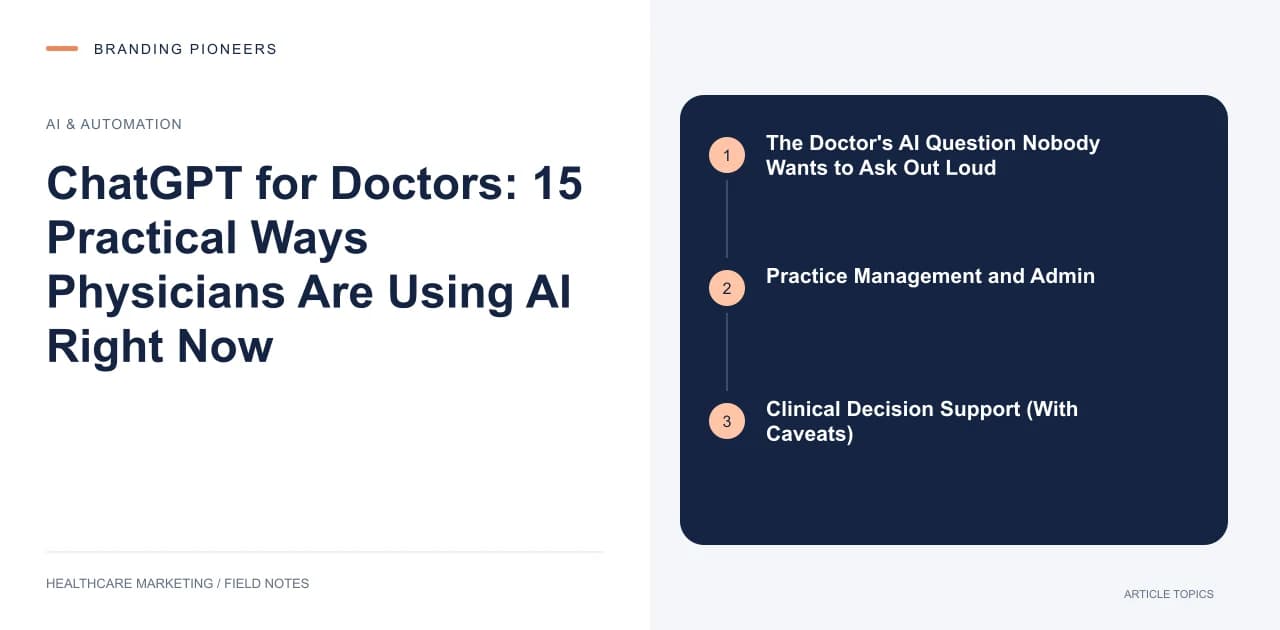
The Doctor's AI Question Nobody Wants to Ask Out Loud
Every physician conference in 2025 and 2026 has had at least one AI panel. And at every single one, the question hanging in the room is the same: "Should I actually be using this, or is it going to get me in trouble?"
Fair question. A wrong AI suggestion in medicine is not the same as a wrong AI suggestion for a restaurant recommendation. The stakes are different. But here is what most conference panels miss: 12,100 people search for "ChatGPT for doctors" every single month. Many of them are your colleagues. They are already using it. They are just not talking about it at lunch.
We work with hundreds of doctors on their digital presence and marketing. We have seen how they actually use AI in practice — not the theoretical use cases from research papers, but the day-to-day, practical applications that save time without compromising care.
Here are 15 of them.
Practice Management and Admin
1. Drafting Patient Communication Templates
Writing aftercare instructions, pre-procedure checklists, or consent form summaries is time-consuming and repetitive. Doctors are using ChatGPT to draft initial versions, then customizing them for their specific practice and patient population.
One orthopedic surgeon we work with created all his post-surgery recovery instruction sheets — 14 different procedures — in a single afternoon. Previously, he had been photocopying the same 1998 printouts from residency.
2. Medical Documentation and Dictation Cleanup
AI medical scribes like Abridge, Nuance DAX, and even ChatGPT with voice input are handling clinical note generation. The doctor talks naturally during the consultation, and AI transforms it into structured SOAP notes.
The time savings are real: physicians report saving 1 to 2 hours per day on documentation. That is 5 to 10 more patients seen per week, or — just as valuable — going home on time.
3. Responding to Online Patient Reviews
This one matters more than doctors realize. Most patients read online reviews before choosing a provider. Responding to reviews — both positive and negative — directly affects your Google ranking and patient trust.
But crafting a thoughtful, HIPAA-aligned response to a negative review takes 15 to 20 minutes. AI can draft a response in 30 seconds. The doctor reviews it, tweaks the tone, and posts. We have helped doctors set up this workflow, and it turns a dreaded task into a 2-minute habit.
4. Insurance Prior Authorization Appeals
Denied claims are a revenue killer. Writing appeal letters is tedious. Doctors are using AI to draft prior authorization appeals that cite specific clinical guidelines, CPT codes, and medical necessity arguments.
Practices that have adopted this approach tell us their approval rate on AI-assisted appeals improved noticeably — because the letters were more detailed, better structured, and cited the right guidelines. The AI did not make the clinical argument. It organized the doctor's clinical reasoning into the format that insurance reviewers respond to.
5. Staff Training Materials
Creating onboarding documents for new nurses, front desk scripts for handling common patient calls, or HIPAA training quizzes. All the things that should exist but nobody has time to write. AI drafts the structure, the practice manager fills in the specifics.
Clinical Decision Support (With Caveats)
6. Differential Diagnosis Brainstorming
This is not about AI replacing diagnostic thinking. It is about expanding the list of possibilities. A physician enters a set of symptoms, lab values, and patient history — and AI generates a differential diagnosis list that might include conditions the doctor had not initially considered.
Think of it as a second-year resident who has read everything but examined nothing. Useful for broadening your thinking. Dangerous if you take the output at face value.
7. Medication Interaction Checks
AI can cross-reference a patient's medication list and flag potential interactions faster than manual lookup. Several physicians tell us they use it as a quick first pass before prescribing, then verify against their pharmacy system.
Not a replacement for clinical pharmacist review. But useful for the majority of cases where you just need to quickly confirm there are no major red flags.
8. Patient-Friendly Explanations of Complex Diagnoses
A cardiologist needs to explain atrial fibrillation to a 72-year-old patient who has never heard the term. AI can generate an explanation at a 6th-grade reading level in seconds. The doctor reviews it, adds personal context, and either uses it verbally or as a printed handout.
Patients consistently report higher satisfaction when they feel they understand their diagnosis. This directly affects your Google reviews and patient retention.
9. Clinical Research Summaries
When a patient asks about a new treatment they read about online, the doctor often needs to quickly review the latest literature. AI can summarize recent papers on a topic — key findings, limitations, and clinical relevance — in under a minute.
Important caveat: AI can hallucinate citations. Always verify the actual papers exist before referencing them with patients.