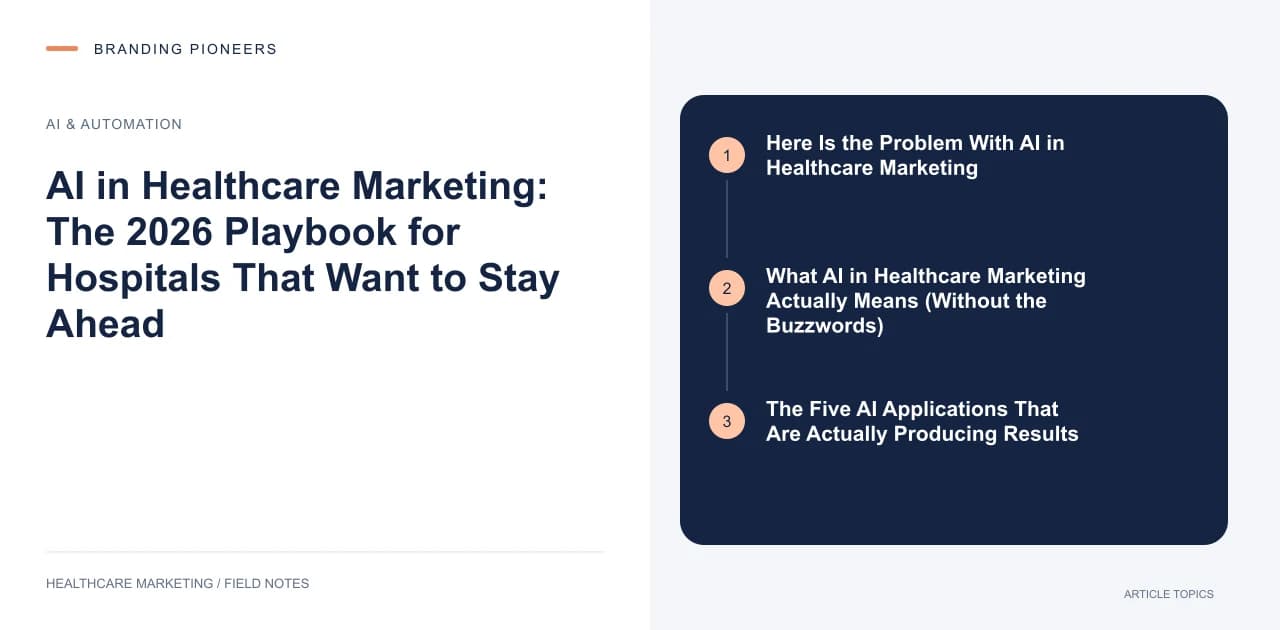
Here Is the Problem With AI in Healthcare Marketing
Everyone is talking about AI. Very few hospitals are actually using it well.
We work with hundreds of healthcare clients worldwide. And what we see on the ground looks nothing like the conference presentations. Most hospitals fall into one of two camps: they have either ignored AI entirely and are running the same 2019 playbook, or they have bought into the hype, installed three different AI tools, and cannot figure out why none of them talk to each other.
Both camps are losing patients. Not to hospitals with bigger budgets — to hospitals that figured out which specific AI applications actually move the needle for patient acquisition.
This is not a think piece about what AI might do someday. This is a playbook based on what is working right now, in real hospitals, with real patient numbers behind it.
What AI in Healthcare Marketing Actually Means (Without the Buzzwords)
Strip away the jargon and AI in healthcare marketing comes down to three things:
Faster response to patient inquiries. Many hospitals take hours to respond to a website form submission, and by then a good number of those patients have already called someone else. AI chatbots and automated WhatsApp responders cut that response time down to seconds. We have seen this single change — just responding faster — noticeably increase appointment bookings.
Smarter ad spend allocation. Predictive models can analyze which keywords, audiences, and time slots produce actual patients (not just clicks). Hospital chains that let an AI model reallocate their Google Ads budget weekly based on conversion data typically see a meaningful drop in cost per patient acquisition within a few months. Their total spend stays the same. They just stop wasting it.
Content at scale without losing quality. Here is where it gets nuanced. AI can draft a blog post about knee replacement recovery in 30 seconds. But Google's helpful content system can spot AI-generated medical content that has not been reviewed by a physician. The play is not to replace your content team — it is to make them much faster. AI drafts. Humans edit, add clinical nuance, and attach their name and credentials.
The Five AI Applications That Are Actually Producing Results
We have tested dozens of AI tools across our client base. Five applications consistently produce measurable ROI. Everything else is either too early, too expensive, or too unreliable.
1. AI-Powered Patient Triage Chatbots
Not the robotic "How can I help you?" chatbots from 2020. Modern healthcare chatbots understand context. A patient types "I've had a headache for three days and my vision is blurry" — the bot recognizes urgency, asks one clarifying question, and routes them to the appropriate department with a pre-filled inquiry form.
We have deployed these across many healthcare websites. What we consistently see:
- A large share of chatbot conversations convert to booked appointments
- Most inquiries are handled without human intervention
- Patient satisfaction scores for chatbot interactions: consistently high in post-chat feedback
The key? Training the bot on your actual services, pricing (where applicable), doctor availability, and common patient questions. A generic chatbot that answers "I'll connect you with our team" is useless. A chatbot that says "Dr. Mehta has availability this Thursday at 3 PM for joint pain consultations — shall I book that?" converts.
2. Predictive Lead Scoring
Not every patient inquiry is equal. Someone filling out a form for knee replacement research at 2 AM is different from someone searching "best orthopedic surgeon near me" and calling during office hours. AI lead scoring assigns a priority score to every inquiry based on intent signals, urgency indicators, and demographic data.
Your front desk team then focuses on the high-score leads first. The result: the same team handles the same volume of inquiries but converts noticeably more of them into appointments. We have seen this across cardiac, orthopedic, and IVF clinics — the pattern holds.
3. Automated Patient Follow-Up Sequences
Here is something that should bother every hospital administrator: no-shows are common for medical appointments in India. A large share of booked patients simply do not show up.
AI-powered follow-up sequences across WhatsApp, SMS, and email have brought that down significantly for our clients. The system sends a confirmation 48 hours before, a reminder 4 hours before, and (if the patient misses) a rescheduling prompt within 30 minutes. All automated. All personalized with the patient's name, doctor's name, and appointment details.
But follow-up goes beyond appointment reminders. Patients who inquired but never booked? An AI sequence nurtures them with relevant content — a video about what to expect during the procedure, a cost breakdown, answers to the questions patients most often ask. (Leave patient testimonials out: since 6 October 2026, the NMC's guidelines bar Indian doctors and hospitals from using them for promotion, even with consent — see our NMC guide. Any AI-generated material you keep should carry a source mark under para 7.2.) A meaningful share of "dead" leads reactivate through these sequences.
4. AI-Optimized Google Ads Bidding
Google's own AI bidding strategies (Performance Max, Target CPA, etc.) work reasonably well for e-commerce. For healthcare, they need guardrails. Medical keywords have wildly different values. A click from someone searching "hair transplant cost in Delhi" is worth far more than a click from "what causes hair loss."
We layer custom AI models on top of Google's bidding to adjust bids based on healthcare-specific conversion data. The model learns which combinations of keyword + time of day + device + location produce actual patients — not just form submissions — and reallocates budget accordingly.
Typical result: a meaningful reduction in cost per patient acquisition, with no change in total patient volume. Sometimes the volume actually increases because we stop spending on keywords that generate clicks but never appointments.
5. AI Content Generation With Medical Review Workflows
Let me be direct: publishing AI-generated medical content without physician review is a bad idea. Google has said explicitly that YMYL content needs demonstrable expertise. Patients can tell. And in some jurisdictions, it raises compliance issues.
But here is what works: using AI as a first-draft engine within a structured workflow.
Step 1: AI generates a 1,500-word draft based on a clinical topic brief. Step 2: A medical writer edits for accuracy, tone, and patient readability. Step 3: A named physician reviews and approves. Step 4: The post goes live with the physician's byline, photo, and credentials.
This workflow produces 8 to 12 clinically accurate, SEO-optimized blog posts per month — what would have taken a full-time content team to produce manually. Our clients using this system typically see substantial increases in organic traffic within 6 months.