Australia regulates healthcare advertising through three overlapping regimes, but one rule stands out and surprises almost every marketer who encounters it: in Australia you may not use testimonials about clinical care in advertising a health service — at all. It is not a disclosure requirement or a consent requirement; it is a prohibition written into the law itself. That single feature, combined with aggressive enforcement by the national regulator and a strict ban on advertising prescription medicines to the public, makes Australian healthcare marketing one of the most tightly controlled in the English-speaking world. This guide walks through the whole framework.
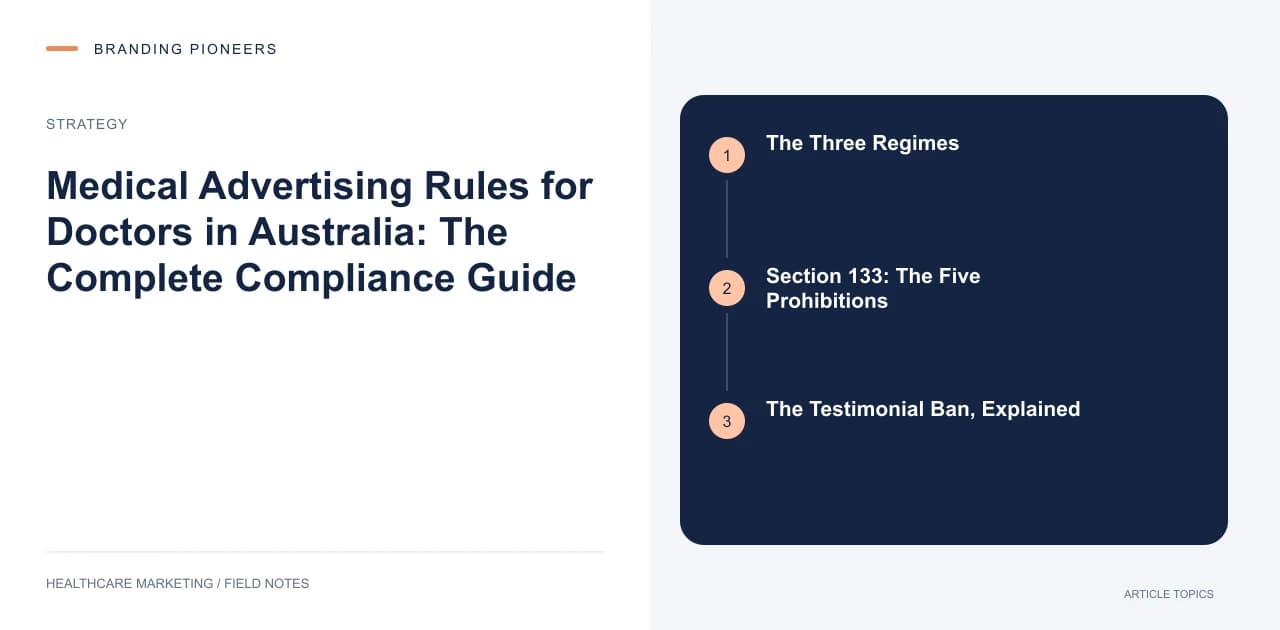
The Three Regimes
Australian medical advertising is governed by three systems that can all apply to a single ad at once. The Health Practitioner Regulation National Law, administered by AHPRA and the National Boards (including the Medical Board of Australia), governs who may advertise a regulated health service and how. The Therapeutic Goods Act 1989, administered by the TGA, governs the advertising of medicines and medical devices. And the Australian Consumer Law, administered by the ACCC, provides a general misleading-conduct overlay. You have to clear all three.
Section 133: The Five Prohibitions
The centrepiece is Section 133 of the National Law. It makes it a criminal offence to advertise a regulated health service in a way that does any of five things, and it binds not just practitioners but anyone who advertises a regulated health service — clinics, companies, and the marketers acting for them.
Advertising must not: (1) be false, misleading or deceptive, or likely to be — the broadest limb, which catches exaggeration, omission of material facts, misuse of titles like "specialist" or "surgeon," and any false overall impression even from literally true statements; (2) offer a gift, discount or inducement without stating the terms and conditions; (3) use testimonials or purported testimonials about the service; (4) create an unreasonable expectation of beneficial treatment, such as implying guaranteed or risk-free outcomes; or (5) directly or indirectly encourage the indiscriminate or unnecessary use of health services. Breaching Section 133 is both a prosecutable offence and grounds for AHPRA disciplinary action against the practitioner's registration.
The Testimonial Ban, Explained
Because the testimonial prohibition trips up so many practices, it is worth understanding precisely. AHPRA defines a testimonial as a recommendation or positive statement about the clinical aspects of a regulated health service. A statement is "clinical" — and therefore banned in advertising — if it references the patient's symptom, their diagnosis or treatment, or the outcome or the practitioner's skill. So "Dr X cured my back pain and I can run again" is a banned clinical testimonial.
What is not a testimonial, and may be used, is comment purely about customer service that does not touch clinical matters — "friendly staff," "easy to book," "clean clinic," "ran on time."
The nuance that matters most in practice concerns third-party reviews. A practitioner is not responsible for removing unsolicited clinical reviews that patients post on platforms the practitioner does not control, such as Google or RateMDs — those are not the practitioner's advertising. But the moment a practitioner engages with such a review — sharing it, re-posting it, linking to it, embedding it, "liking" it, or inviting it onto a page they control — it becomes advertising they are responsible for, and it breaches Section 133. AHPRA's guidance is therefore to disable reviews and testimonials on your own website and social media pages so that clinical testimonials cannot appear on a platform you control. (There has been reform pressure to repeal the testimonial ban, but as of writing that repeal has not commenced and the ban remains fully in force — an area worth re-checking.)
The TGA: No Advertising Prescription Medicines to the Public
The second regime bans direct-to-consumer advertising of prescription medicines. Under the Therapeutic Goods Act and the Advertising Code, prescription (Schedule 4) medicines, controlled drugs (Schedule 8), most pharmacist-only medicines, and any product not on the Australian Register of Therapeutic Goods may not be advertised to the public. The TGA specifically flags weight-loss injections (GLP-1s), medicinal cannabis, and nicotine vaping products as prescription-only and off-limits for consumer advertising. You cannot dodge the ban with an "ask your doctor" disclaimer. Advertising directed only to health professionals is separately permitted and regulated, and information a doctor gives directly to their own patient is exempt. The Code also restricts references to serious diseases and requires care with endorsements and influencer content for therapeutic goods.