Singapore is unusual in how specific its medical advertising rules are. Where most countries say "do not use exaggerated or self-laudatory claims" and leave you to guess, Singapore's Ministry of Health publishes an actual list of banned words — "best," "leading," "state-of-the-art," "pioneer," "gold standard," "world-class," and dozens more, by name. Combine that with a flat prohibition on before-and-after photos, tight rules on testimonials, and a regime that holds the licensed clinic responsible even when a third party created the content, and you have one of the most precise and demanding advertising frameworks in Asia. This guide explains it — including the cross-border rules that catch medical-tourism marketers.
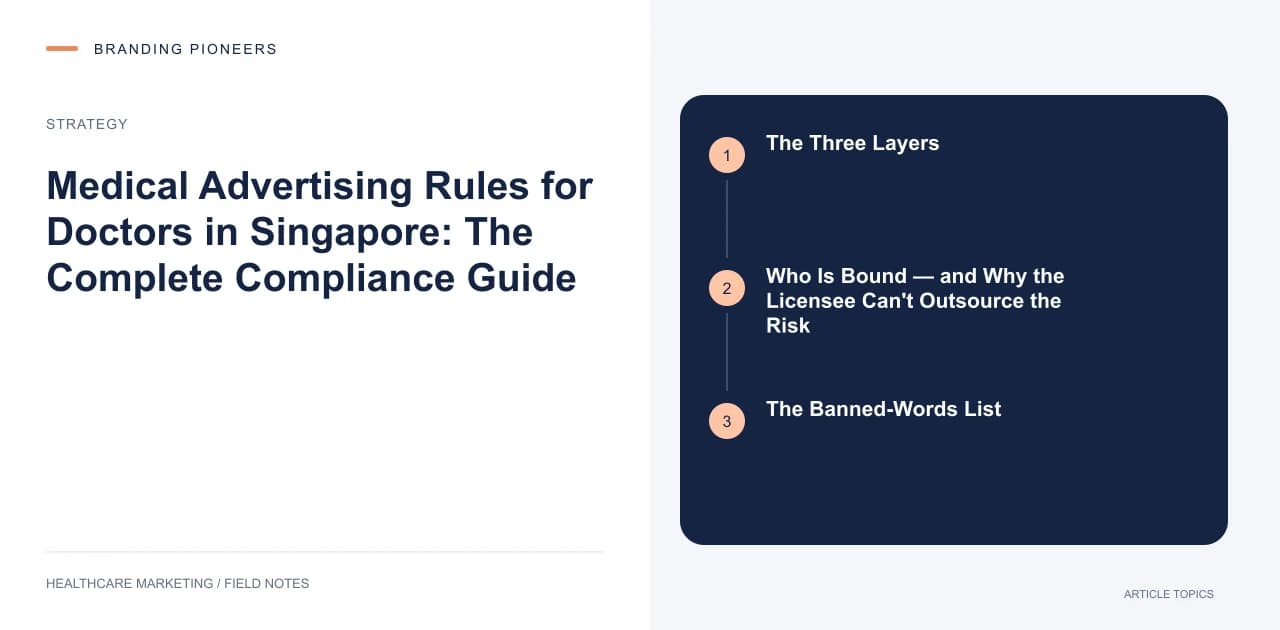
The Three Layers
Three frameworks apply at once. The Healthcare Services Act (HCSA) and its Healthcare Services (Advertisement) Regulations 2021 govern the licensed entity — the clinic, hospital, or service. The Singapore Medical Council (SMC) Ethical Code and Ethical Guidelines govern the individual doctor. And product-specific laws enforced by the Health Sciences Authority govern any medicines or health products advertised, including a ban on advertising prescription-only medicines to the public.
One important update for accuracy: the HCSA replaced the old Private Hospitals and Medical Clinics Act, with the transition completing in December 2023. Older guidance citing the PHMCA rules or the old "$2,000 fine" is out of date — the current instrument is the 2021 Advertisement Regulations.
Who Is Bound — and Why the Licensee Can't Outsource the Risk
Under the HCSA, only a licensee or an authorised person acting on the licensee's behalf may advertise a licensable healthcare service. Advertising such a service when you are neither — the provision used against medical-tourism platforms, influencers, and agencies that promote clinics without authorisation — is itself an offence. And crucially, even when a third party or agency creates the content, the licensee remains responsible for compliance and for correcting or withdrawing a non-compliant ad. You cannot contract the liability away.
There is also a territorial reach that matters enormously for medical tourism. The Regulations apply to any advertisement with a "Singapore link" — meaning it is accessible to someone physically in Singapore, or addressed to people the advertiser believes are in Singapore. An ad on a clinic's own website is caught even if it is aimed at foreign patients, because someone in Singapore can access it. A clinic marketing medical tourism abroad must comply with both Singapore's rules and the destination jurisdiction's.
The Banned-Words List
The most distinctive feature of Singapore's regime is that the rules against "laudatory" content come with a published, non-exhaustive list of forbidden terms. Regulation 5 prohibits subjective praise and self-commendation regardless of whether it is factually accurate, and the Ministry's Annex A spells out examples. Among the banned terms: best, better, leading, leader, industry leader, number one, top, first (as in "first in Asia"), only, premier, premium, pioneer, pioneering, renowned, internationally renowned, world-class, gold standard, state-of-the-art, cutting-edge, next generation, latest, most advanced, highest, safest, superior, unmatched, outstanding, exceptional, excellent, centre of excellence, highly skilled, vast experience, wealth of experience, and well-established.
That list reshapes how a Singapore practice must write every headline and bio. The compliant style is purely factual: state your qualifications, services, and location, and let the facts speak — without a single superlative.
What Else Is Prohibited
Beyond laudatory terms, Regulation 5 and the related rules prohibit a great deal more. Any claim that is not factual or cannot be substantiated (and you must be able to produce the supporting evidence to MOH on request). Content that is comparative or disparaging of other providers. Before-and-after photos — and this is a hard line: they are prohibited in any advertisement even with a disclaimer, and "after-only" images are equally banned; such images may only be shown one-to-one to a patient during a consultation. Anything that solicits or encourages consumption, including promises of results in a timeframe ("straight teeth in two weeks").
The rules on inducements and pricing are exceptionally broad. Ads may not contain "discount," "promotion," "offer," "free," "complimentary," "package" (at a discount), "as low as," or "lowest prices"; no price comparisons or time-limited prices; no giveaways, lucky draws, prizes, or group-buying deals; no redeeming services with credit-card points or vouchers. Referral programmes may exist but may not be advertised, and sharing a screenshot of one on social media is specifically prohibited. A licensee may only list the exact final price of a service, with no comparative or discounted framing.
On testimonials, paid reviews, testimonials, and endorsements are prohibited — and disclosing the payment does not cure it. A licensee may not reproduce a testimonial or patient photo on its premises, website, or social media, which includes re-sharing a patient's own social post. What is permitted is a genuinely organic, unpaid, unsolicited, unedited review that a patient provides directly and that the licensee does not reproduce — and unpaid, self-initiated reviews on independent third-party platforms, which are not treated as the clinic's advertising. The SMC separately cautions doctors against participating in "top doctor" or rating platforms, treating paid participation as a prohibited testimonial.
Finally, awards and accreditations may only be displayed if earned for meeting technical standards (such as JCI or ISO) — and buying an award is prohibited, a point the Ministry has actively enforced against pay-for-award schemes.
The SMC Ethics Layer
On top of the HCSA rules, the SMC Ethical Code requires individual doctors to keep information factual, accurate, verifiable, and not misleading; not unduly persuasive or laden with inducements; not laudatory; and not comparative or disparaging. Its testimonial rule is blunt: testimonials must not be used in any media over which the doctor has control, and doctors must not ask or induce anyone to write positive testimonials. A breach is a matter for SMC disciplinary action, which runs separately from the HCSA financial penalties.
The Penalties
The figures most consistently reported by Singapore legal commentary are these. Advertising a licensable service by an unauthorised person — the charge aimed at influencers, agencies, and medical-tourism platforms — carries a fine of up to S$20,000 and/or up to twelve months' imprisonment. Breaching the content rules in the Advertisement Regulations carries a comparable fine of up to S$20,000 and/or up to twelve months, plus a continuing-offence fine for each day a breach persists. Displaying a purchased or unearned award carries the same order of penalty. Because each non-compliant advertisement is a separate offence, a multi-creative campaign can stack fines. The regulator can also order an ad altered, withdrawn, or discontinued, and in serious cases review, suspend, or revoke the operating licence. And the SMC disciplinary track — censure, fines, conditions, suspension, or being struck off the register — runs in parallel for the individual doctor. (These figures come from consistent secondary legal sources rather than the gazette text, so confirm the exact clause before relying on a specific number.)
A Compliant Singapore Marketing Playbook — With a Medical-Tourism Note
Write everything in a purely factual register: services, qualifications, exact final prices, location, and hours, with not a single word from the banned list. Cut all before-and-after imagery from advertising entirely — it is the single biggest aesthetic-clinic trap — and keep such images to one-to-one consultations. Strip out every discount, promotion, package, and giveaway. Do not reproduce or re-share testimonials or patient posts on anything you control; let genuine, unsolicited third-party reviews live on platforms you do not touch, and stay off paid "top doctor" listings. Display only technical-standard accreditations, and never buy an award. Lean instead on compliant educational content — how a treatment works, what to expect — which is the strongest legitimate tool you have. And for medical tourism, remember the "Singapore link": your own website is regulated even when it targets foreigners, and you remain liable for what your appointed marketers publish, so build the whole funnel to Singapore's rules from the outset.
This is general educational information, not legal advice. Singapore medical advertising law spans the HCSA Advertisement Regulations, the SMC Ethical Code, and product-advertising law; the framework replaced the older PHMCA regime in 2023, and the penalty figures above are drawn from secondary legal sources rather than the gazette text. Confirm the current position with MOH, the SMC, and a qualified Singapore healthcare lawyer before acting.
Filed undermedical advertising rules SingaporeHealthcare Services Act advertisement regulationsSMC ethical code advertisinglaudatory terms healthcare Singaporebefore and after photos ban Singaporeclinic marketing compliance Singapore

About the author
Nishu Sharma
Founder & CEO · Gurugram, India
Nishu founded Branding Pioneers in 2016 with one rule that hasn't changed since: healthcare only. She'd run digital strategy at a top-10 Indian agency and watched generalist marketing underserve medical clients who needed something built for how patients actually search and decide. So she left to build the specialist instead. It's now an 80-person team working with healthcare brands worldwide.
Free guide · 17 pages
The Patient Acquisition Blueprint
A 90-day plan from first search to booked appointment.