If India restricts what doctors may advertise and the US lets them advertise freely, the United Arab Emirates runs on a different principle entirely: pre-clearance. In the UAE you cannot publish a medical advertisement and deal with complaints afterwards. The content must be reviewed and permitted before it goes live — and not by one body but, increasingly, by several stacked layers of approval. For any clinic, hospital, or aesthetic practice marketing in the Emirates — especially those chasing the region's booming medical-tourism market — understanding this permit regime is not optional. This guide explains how it works, what is prohibited, and what it costs to get wrong. (UAE rules genuinely vary by emirate and are being updated through 2025–2026, so treat this as a map, not a substitute for confirming the current position with the relevant authority.)
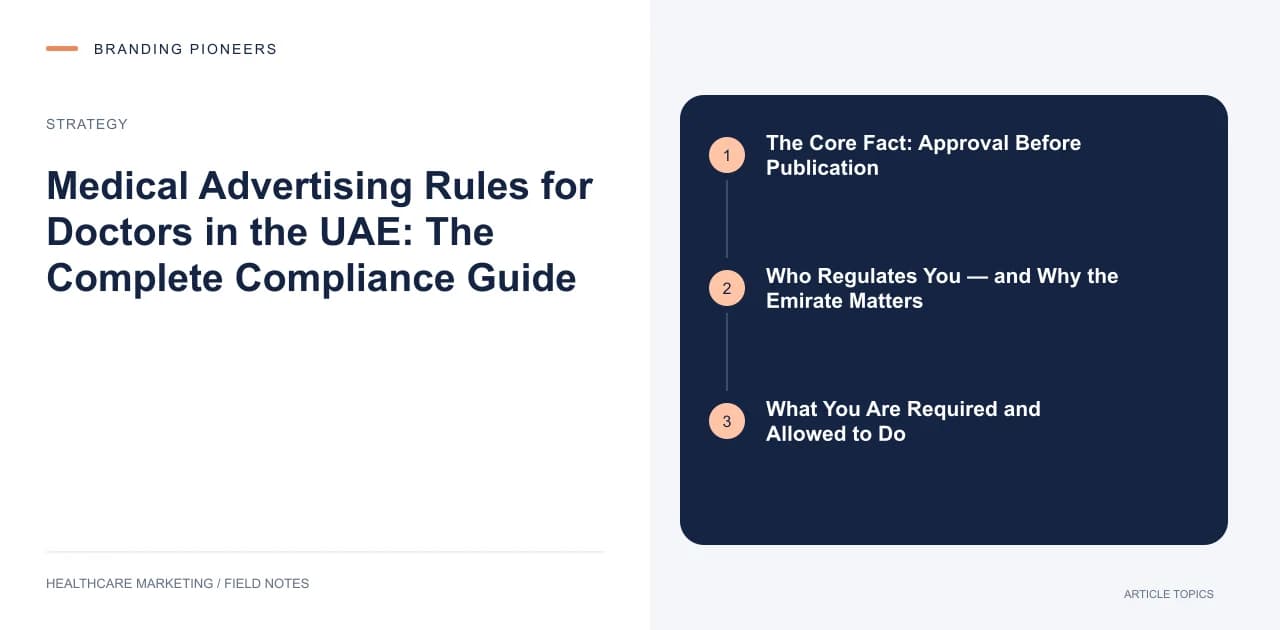
The Core Fact: Approval Before Publication
The single most important thing to understand is that UAE health advertising is a pre-clearance system. A compliant medical advertisement typically has to clear several gates before it can run:
First, the advertiser must be licensed — only a licensed health facility or a licensed healthcare professional may advertise health services, and only within the scope of that licence. Second, where a medical or pharmaceutical product is involved, the federal Ministry of Health and Prevention (MOHAP) must have issued a market authorisation for the product, and then each individual advertisement must be separately reviewed and licensed. Third, the emirate health authority — the Dubai Health Authority (DHA) in Dubai, or the Department of Health (DOH) in Abu Dhabi — must review and approve the content before it is implemented in that emirate. And fourth, advertising online or on social media additionally requires a permit from the UAE Media Council under the country's media regulation law.
The practical upshot: a Dubai clinic running a digital campaign needs to be a licensed facility, advertising within its scope, with health-authority content approval and a Media Council advertiser permit, displaying the relevant licence number on its official account. This stack applies fully to social media and, importantly, to influencers and content creators, who are now regulated much like media outlets.
Who Regulates You — and Why the Emirate Matters
The UAE splits health-advertising authority across federal and emirate levels, and the differences are real. MOHAP is the federal regulator for medical products and governs health regulation in the Northern Emirates. DHA regulates Dubai and issued binding Standards for Medical Advertisement Content on Social Media. DOH regulates Abu Dhabi and, since a 2023 circular, requires facilities to complete a training programme and submit content through its Health Media and Advertising System. Dubai Healthcare City has its own free-zone regulator with its own advertising policy, separate from DHA. And the UAE Media Council governs the publication channel itself. A campaign running across the country generally needs clearance in each relevant jurisdiction — what is approved in Dubai is not automatically cleared for Abu Dhabi.
What You Are Required and Allowed to Do
Within the permit system, factual marketing is allowed. A licensed professional must state their name, title, qualification, and specialty exactly as they appear on their licence — and may not use loose marketing titles like "aesthetic consultant" or "anti-aging specialist" unless that is the licensed title. The "Dr." prefix is restricted to physicians, dentists, and recognised PhD holders. Content must be factual, accurate, substantiated by credible scientific evidence, and balanced — meaning the risks and disadvantages of a treatment must be stated alongside its benefits, not just the upside. Every social-media advertisement that names or locates the facility must be approved by the facility's Medical Director, who is accountable for it. And written, documented consent is required from any patient shown or quoted, with parental consent for minors.
Permitted content includes a factual statement of services, contact details, hours, languages spoken, non-enhanced photos of the professional or office, genuine qualifications and registrations, accreditations, peer-reviewed publications, and evidence-based public-health information.
What Is Prohibited
The prohibited list is long and strict. Misleading, false, exaggerated, or deceptive content of any kind — including by emphasis, comparison, or omission. Guarantees and absolute claims — the DHA explicitly bans words like "the best," "the only," "safest," "100%," "miraculous," "magic," "guaranteed success," "no side effects," and "immediate results," and prohibits any treatment that "guarantees full recovery." Comparative and superlative claims that you are better or safer than others, unless scientifically proven with credible references. Fear-based or pressure marketing that induces anxiety or implies harm if the patient does not act. Discounts, offers, and price-led promotion of medical services are heavily restricted, and "trial usage" of medical products or services is outright prohibited.
Two areas that are restricted with conditions rather than flatly banned in Dubai deserve care. Before-and-after images are permitted only under tight conditions — the same individual, the same camera, no Photoshop or enhancement, only genuine patients, and a same-font-size disclaimer that results are not guaranteed and vary by individual — plus the risks. Patient testimonials are prohibited without written patient consent and are high-risk in practice. Other emirates and the aesthetic-specific rules can be stricter, so do not assume a before-and-after reel that is legal elsewhere is legal here.
Also prohibited: filming or live-streaming patients in surgery or under anaesthesia for promotion; using patient-identifiable information without authorisation; content contrary to UAE culture or Islamic values; using government or authority logos without approval; disparaging other professionals or facilities; advertising without a permit; and advertising beyond your licensed scope. At the federal level, advertising prescription-only medicines to the public, and advertising treatments for certain conditions (including cancer, sexually transmitted diseases, and others), is prohibited.
Social Media and Influencers
The DHA Standards apply specifically and fully to social media, and the facility is liable for content filmed on its premises — whether by a professional or on someone's personal phone, and whether posted on the facility's account or an influencer's. An influencer promoting a named facility or service must have the content approved by the Medical Director, and any paid or in-kind relationship must be transparent and disclosed. Only a licensed professional may give medical advice or advertise medical content online, and only within their scope. Separately, the UAE's media regulation law now requires anyone posting promotional content — influencers included — to hold a Media Council advertiser permit, with health advertising requiring pre-clearance. The exact enforcement dates for the social-media advertiser-permit requirement have shifted across sources, so treat it as an active, evolving 2025–2026 requirement and confirm the current guidance.
The Penalties
The UAE media regulation law (Federal Decree-Law No. 55 of 2023) sets administrative fines that, on the figures reported, range from a low base into the high hundreds of thousands or up to around one million dirhams, doubled for repeat violations up to a higher cap. Media content-standard violations — which include misleading medical ads on social media — are reported in tiered bands, and posting promotional content without the required advertiser permit has drawn fines reported in the region of ten thousand dirhams, varying by emirate. Beyond fines, regulators can issue warnings, suspend activity, order temporary closure, and revoke licences or permits. The health authorities (DHA, DOH) act under their own licensing powers — content take-downs, professional-conduct measures, and licence suspension — and MOHAP product-advertising breaches can be criminal. Note that the health authorities do not publish a single consolidated fine schedule the way the media law does, so specific amounts for a given DHA or DOH breach are best confirmed case by case.
A Compliant UAE Marketing Playbook — With a Medical-Tourism Note
Start from the permit, not the creative: confirm the facility and professionals are licensed, secure health-authority content approval and the Media Council permit, and display the required licence number. Keep every claim factual, substantiated, and balanced with risks. Drop superlatives, guarantees, "free/discount" language, and fear-based hooks entirely. Treat before-and-after images and testimonials as high-risk, conditional tools requiring written consent and strict technical compliance — or avoid them. Put influencer content through Medical Director sign-off and disclose the relationship. And mind the cross-border rules that matter for medical tourism: under the DHA Standards a professional who also practises abroad must keep a separate, DHA-compliant Dubai account, and may not feature patients treated in Dubai facilities on international accounts, nor feature foreign patients on the Dubai account unless the content meets DHA standards. "Global" reels that are legal elsewhere can breach UAE rules — so build the UAE campaign to UAE rules from the start.
This is general educational information, not legal advice. UAE health advertising is split across MOHAP, DHA, DOH, free-zone regulators, and the Media Council; rules vary by emirate and are being updated through 2025–2026, and several fine figures are reported rather than published in a consolidated schedule. Confirm the current position with the relevant UAE health authority, the Media Council, and a qualified UAE lawyer before acting.
Filed undermedical advertising rules UAEDHA advertising permit Dubaihealthcare advertising approval UAEMOHAP medical advertisement licenceDubai clinic marketing complianceUAE Media Council advertiser permit

About the author
Nishu Sharma
Founder & CEO · Gurugram, India
Nishu founded Branding Pioneers in 2016 with one rule that hasn't changed since: healthcare only. She'd run digital strategy at a top-10 Indian agency and watched generalist marketing underserve medical clients who needed something built for how patients actually search and decide. So she left to build the specialist instead. It's now an 80-person team working with healthcare brands worldwide.
Free guide · 17 pages
The Patient Acquisition Blueprint
A 90-day plan from first search to booked appointment.